Collision.
If you have never stood on the sideline of a professional football game in November, when the Winnipeg wind slices through three layers of thermal gear like wet paper, you do not truly know what three hundred pounds of human muscle sounds like when it hits another three hundred pounds at full sprint. It is not the crisp, theatrical crack you hear through a television broadcast. It is a dull, wet thud. A car crash without the shattering glass. And in the Canadian Football League, where the field is wider, the pre-snap motion is relentless, and defensive ends get a full yard of running start before the ball even leaves the center’s hand, that sound happens sixty times a night.
For years, the men who absorb those collisions have lived in a peculiar kind of sporting purgatory. We celebrate the quarterbacks who throw the spirals. We memorize the names of the receivers who high-point the football in the corner of the end zone. Meanwhile, the offensive linemen—the very people who purchase the time required for those miracles to happen—are only ever mentioned when they fail. A holding penalty. A blown assignment. A quarterback lying flat on his back, staring up at the stadium lights while the trainer sprints onto the turf.
Until a season comes along that forces everyone to look down at the dirt.
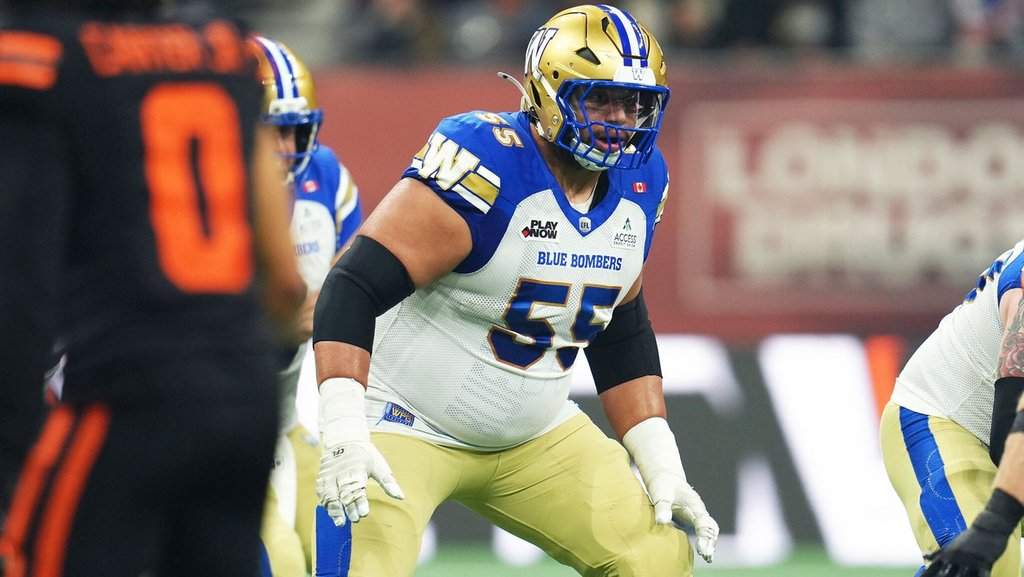
When the Canadian Football League named Winnipeg Blue Bombers left tackle Jarell Broxton the Most Outstanding Offensive Lineman, the announcement arrived in the standard, sterile packaging of modern sports journalism. A press release. A trophy presentation. A handful of polite quotes about team effort and hard work. If you read the typical recap, you might nod, appreciate the trivia for ten seconds, and scroll on to the next headline.
You would miss the entire point.
Because Jarell Broxton winning that award is not just a line item in the Winnipeg Blue Bombers media guide. It is the culmination of a quiet, brutal revolution in how football is survived, a masterclass in anatomical geometry, and the story of a man who spent years on the margins of professional football before becoming the most immovable object north of the forty-ninth parallel.
The Anatomy of a Half-Second
To understand what Broxton actually accomplished on the turf at Princess Auto Stadium, you have to strip away the scoreboard and look at the clock. Specifically, you have to look at three-tenths of a second.
Consider a hypothetical scenario on a third-and-four in the fourth quarter of a tied game. The stadium is deafening. Twenty-five thousand voices are vibrating in your ribcage. Across from you lines up a defensive end who runs a four-six forty-yard dash, weighs two hundred and sixty pounds, and has spent the last seventy-two hours watching film of your left pinky finger to see if it twitches before a pass play.
In the CFL, that defender is allowed a full yard off the ball. That single yard is a lifetime. It means by the time you, the left tackle, have even finished standing up out of your three-point stance, he is already at top speed, dipping his inside shoulder, trying to turn the corner toward your quarterback’s blindside. Your quarterback cannot see him. His eyes are downfield, reading a cover-three zone. If you lose your balance by two inches—if your weight drifts onto your heels for the blink of an eye—your quarterback is going to take a blindside hit that could end his season.
I remember the first time I ever tried to mirror a pass-rusher in a controlled drill during a college camp years ago. I thought strength was the currency of the trenches. I thought if I could bench-press enough weight, I could simply stop a man in his tracks. I was wrong. Within a tenth of a second, my feet were tangled, my chest was exposed, and I was flat on my back staring at the clouds while the coach blew his whistle in disgust. Offensive line play isn't weightlifting. It is ballet danced in a phone booth while someone tries to hit you with a sledgehammer.
This is the exact space where Jarell Broxton operates.
Standing six-foot-five and carrying roughly three hundred and twenty-five pounds, Broxton does not look like a ballet dancer. He looks like a granite monument that someone decided to put in shoulder pads. Yet when you watch the game tape—really watch it, zooming in on his footwork rather than following the football—you see an astonishing economy of motion. There is no panic in his kick-slide. When a speed rusher tries to threaten the outside edge, Broxton doesn't lunge. Lunging is death for a tackle; it shifts your center of gravity forward and lets the defender swim right past you. Instead, Broxton absorbs the momentum, resets his base, and drops an anchor so heavy that the defender simply runs out of turf.
The Long Road to Manitoba
Greatness in the CFL rarely arrives via a red carpet. Unlike the American game, where first-round draft picks are handed generational wealth before they ever take a snap, the Canadian league is a sanctuary for the overlooked, the underestimated, and the stubborn.
Jarell Broxton knows the geography of the football fringe intimately. Before he ever pulled on the blue and gold of Winnipeg, his career was a map of brief stops, practice rosters, and the constant, gnawing uncertainty that defines life on the NFL bubble. He played his college ball at Baylor, learning the violent, high-tempo trenches of the Big 12. Then came the grinder: stints with the Baltimore Ravens, time in the developmental leagues, moments where the phone didn't ring and the dream looked less like a career and more like a hobby with a high medical bill.
It is easy to romanticize perseverance when a trophy is sitting on the table. It is much harder to live through the Tuesday afternoons in October when you are nursing a torn labrum or a sprained MCL, living out of a suitcase in a city thousands of miles from home, wondering if your body is breaking down for nothing.
When Broxton eventually found his way to the CFL—first cutting his teeth with the BC Lions before arriving in Winnipeg—he brought that edge with him. You could see it in the way he finished blocks. In football, there is a vast difference between blocking a man until the whistle blows and blocking him until he wishes he had chosen a different profession. Broxton plays with the quiet, methodical cruelty of a man who remembers what it felt like to be told he wasn't quite enough.
The Winnipeg Standard and the Burden of Succession
To appreciate the weight of this specific award in this specific city, you have to look at the ghosts walking the hallways of the Winnipeg Blue Bombers facility.
Winnipeg has not merely had good offensive lines over the past half-decade; they have constructed a dynasty built entirely on trench warfare. For years, the standard of excellence in the CFL was defined by Stanley Bryant, the legendary Blue Bombers tackle who won the Most Outstanding Offensive Lineman award an astonishing four times. Bryant was the sun around which Winnipeg’s offensive solar system orbited. When injuries and age finally began to catch up with him, the prevailing wisdom across the league was simple: the empire was going to crumble. You do not simply replace a Hall of Fame left tackle. You do not just plug a new body into the most demanding position on the field and expect the machine to keep humming.
That was the invisible stake hanging over Broxton’s head every time he stepped onto the field. He wasn't just fighting the defensive ends across from him. He was fighting the shadow of a legend.
If the Winnipeg offense stalled, the narrative was pre-written. The dynasty was over. The protection had finally cracked. Quarterback Zach Collaros, one of the most lethal passers in league history when given a clean pocket, would suddenly look mortal. Running back Brady Oliveira, a bruising, relentless runner who thrives on downhill momentum, would find himself hitting brick walls at the line of scrimmage instead of daylight at the second level.
None of that happened.
Instead, Broxton stepped into the breach and turned a potential transition year into a clinic. He anchored a unit that paved the way for Oliveira to lead the league in rushing once again, while keeping Collaros upright through the brutal, high-stakes stretches of the regular season. Look at the metrics that actually matter to coaches—not the flashy box-score numbers, but the pressure rates, the yards before contact, the third-and-short conversion percentages. Whenever Winnipeg desperately needed two yards to keep a drive alive and bleed the clock dry in the fourth quarter, they didn't get cute. They didn't run trick plays. They ran behind number sixty-six.
The Invisible Language of Five Men
There is a myth that winning an individual award as an offensive lineman means you dominated your one-on-one matchups. That is only half the truth. The deeper truth is that you cannot win this award unless you are fluent in a silent, telepathic language spoken by five men simultaneously.
Think of an offensive line as a single organism with five brains. If the left guard sees a defensive tackle slant inside, he has to pass that defender off to the center while immediately picking up a blitzing linebacker—all without saying a word, because the crowd noise makes verbal communication impossible. If one man is a fraction of a second late, the entire pocket collapses like a house of cards.
Broxton’s real genius lies in how he elevates the men standing next to him. Watch him during a pre-snap cadence. His head is on a swivel, scanning the secondary for disguised blitzes, tapping his guard on the hip to adjust the slide protection, calmly absorbing the chaos while twenty-three other men are screaming and shifting. He brings a low pulse rate to a high-voltage environment.
When a left tackle plays with that kind of composure, it is contagious. The guard next to him plays faster because he knows his outside shoulder is completely secure. The quarterback steps up into the pocket with conviction because he doesn't feel phantom footsteps creeping up behind his left ear. Confidence in football isn't a motivational speech given in the locker room before kickoff; it is the physical certainty that the man on your left is going to win his battle.
Why the Trenches Still Decide Everything
We live in an era of sports that is utterly obsessed with speed, space, and spectacle. Every rule change over the last twenty years has been engineered to make offense faster, lighter, and more explosive. Fans want seventy-yard touchdown passes and acrobatic one-handed catches. Analysts spend hours dissecting launch angles, quarterback mechanics, and spread concepts.
And yet, when the temperature drops below freezing in November and the Grey Cup is on the line, all of that modern sophistication strips away. The passing windows shrink. The ball becomes slick and heavy like a wet brick. The fancy spread concepts stop working.
Football reverts to its oldest, most primitive truth: can my five guys push your four guys backward?
That is why Jarell Broxton’s recognition as the CFL’s top offensive lineman resonates so deeply beyond the borders of Manitoba. It is a validation of the unglamorous work. It is proof that in a game increasingly dominated by flash and finesse, the foundation of winning still belongs to the men who willingly step into the dark, absorb the shockwaves, and refuse to yield an inch of ground.
Next time you watch a Winnipeg game, do yourself a favor. Ignore the ball when it is snapped. Don't follow the arc of the pass, and don't watch the receivers streaking down the sidelines. Keep your eyes locked entirely on the left side of the offensive line. Watch number sixty-six sink his hips, shoot his hands into the chest plate of a charging defender, and steer two hundred and seventy pounds of pure aggression harmlessly into the turf.
Listen closely through the broadcast audio, right beneath the roar of the crowd. You won't hear a cheer. You won't hear an announcer screaming a catchphrase. You will just hear that dull, heavy thud—the unmistakable sound of a man doing his job so well that nobody else has to worry about theirs.