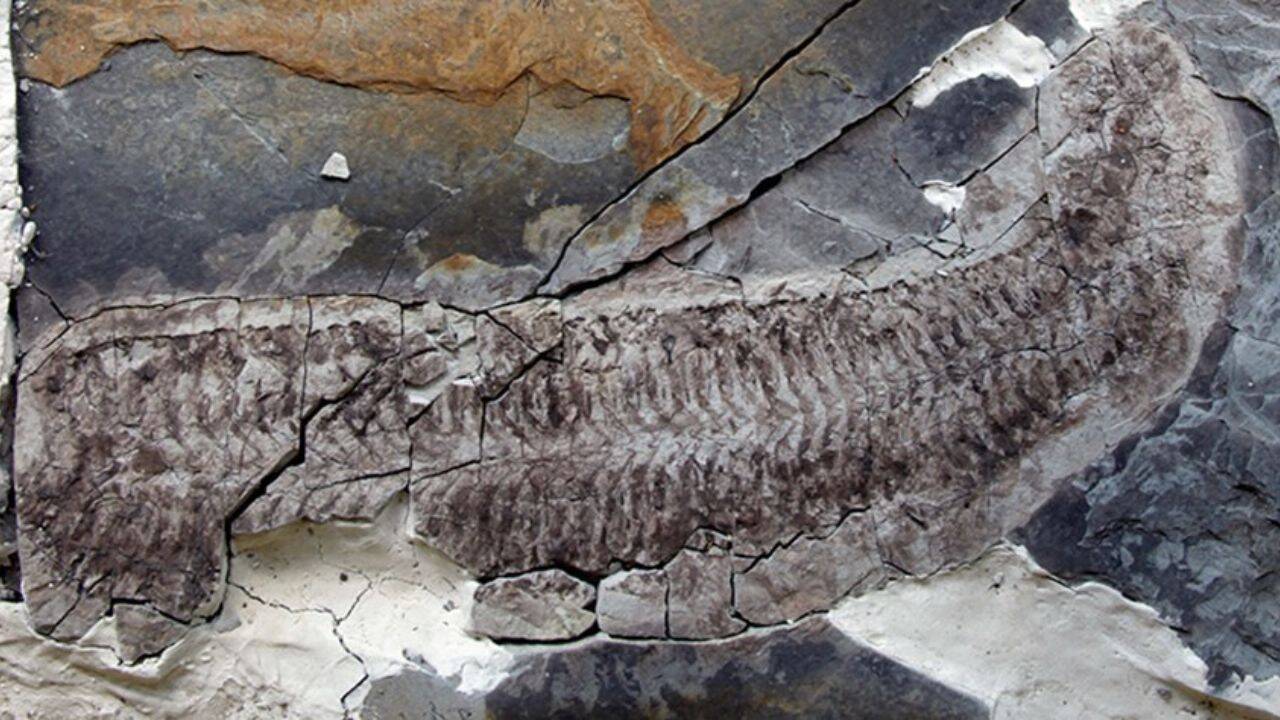
In the Soom Shale of South Africa, paleontologists uncovered a 444-million-year-old fossil that breaks the standard rules of preservation. Dubbed Keurbos susanae, this ancient arthropod completely lost its head, legs, and tough outer shell, yet retained its delicate internal muscles, tendons, and gut in extraordinary three-dimensional detail.
For decades, the fossil record has operated on a predictable bias. Hard parts like bones, teeth, and shells survive the crushing weight of geological time, while soft tissues rot away within days of death. Keurbos susanae flips that script entirely. By preserving the squishy interior while dissolving the armored exterior, this specimen gives scientists a rare, unfiltered look at the internal mechanics of life during the Late Ordovician period—right as Earth was plunged into one of its most devastating mass extinctions.
The Anatomy of an Inside-Out Anomaly
When researchers first examined the slab from the Cederberg Mountains, the specimen looked like an unsolvable puzzle. Without a head, eyes, or walking appendages, classifying an ancient arthropod becomes a forensic nightmare. In paleontology, the head and limbs are the primary diagnostic tools used to place an organism on the evolutionary tree.
Take those away, and you are left staring at a segmented trunk.
Yet, what remained inside that trunk was unprecedented. Under scanning electron microscopes and chemical mapping, the fossil revealed distinct muscle fibers, tendon attachments, and the digestive tract. These are the exact anatomical features that normally vanish first when bacteria begin breaking down a carcass.
The specimen belongs to an extinct group of marine arthropods, distant relatives of modern lobsters, spiders, and insects. Because the exterior cuticle—the chitinous armor that protects arthropods—was entirely missing, researchers had to reverse-engineer the creature's identity from the inside out. By mapping the arrangement of the longitudinal and dorsoventral muscles, they confirmed it was a segmented, mobile marine animal built for active swimming or crawling along the seafloor.
Why the Hard Parts Vanished
To understand how an animal loses its armor while keeping its guts, you have to look at the chemistry of death. Typically, an arthropod's exoskeleton is reinforced with minerals like calcium carbonate, making it vastly more durable than muscle tissue.
In the case of Keurbos susanae, the post-mortem environment turned hostile to minerals while simultaneously pickling the flesh.
- Acidic Pore Waters: The sediment trapping the creature likely had a low pH, creating localized acidic conditions that dissolved the mineralized outer shell before it could fossilize.
- Anoxic Conditions: The seafloor lacked oxygen, effectively shutting down the scavengers and aerobic bacteria that would normally devour soft tissue in hours.
- Rapid Mineral Replacement: Before the muscle fibers could decay, dissolved minerals in the water—primarily calcium phosphate and clay minerals—infiltrated the cells, turning soft tissue into stone at a microscopic level.
This process, known in paleontology as exceptional preservation or Konservat-Lagerstätte conditions, requires a razor-thin balance of chemical accidents. If the water is too oxygenated, the muscles rot. If the sediment shifts too early, the delicate fibers smear into an unreadable smudge.
The Soom Shale Time Capsule
The discovery site itself is a geological outlier. Located roughly 250 miles north of Cape Town, the Soom Shale represents a narrow band of fine-grained rock deposited 444 million years ago. At that time, this region was not a dry mountain range, but a cold, deep marine basin sitting near the South Pole.
Earth was in the grip of the Hirnantian glaciation, a severe ice age that triggered the Late Ordovician mass extinction. Roughly 85 percent of all marine species were wiped out as sea levels plummeted and ocean chemistry shifted violently.
While most of the planet's ecosystems were collapsing, the deep, freezing waters of the Soom basin acted as a biological vault. Glacial meltwater carried massive amounts of fine silt and clay into the sea. When organisms died and sank into this mud, they were instantly sealed off from the outside world.
The Soom Shale has already yielded bizarre, soft-bodied creatures that exist nowhere else in the fossil record. It produced the first known soft tissues of conodonts—eel-like early vertebrates whose eyes and throat muscles were preserved in the same fine clay. It also preserved naked eurypterids (sea scorpions) and bizarre, giant organisms of uncertain lineage. Keurbos susanae joins a growing roster of fossils from this formation that prove our understanding of ancient biodiversity is heavily skewed by what normally survives fossilization.
The Taphonomic Bias Blind Spot
Every textbook diagram of prehistoric life relies on an unspoken compromise. Paleontologists reconstruct entire ecosystems based almost entirely on shells, bones, and tracks. This creates what scientists call taphonomic bias—a distorted view of history where hard-shelled organisms appear dominant simply because soft-bodied creatures failed to leave a trace.
Consider a modern coral reef. If you stripped away every jellyfish, worm, sea slug, and soft coral, leaving only the clams and fish skeletons, you would get a fundamentally wrong picture of how that ecosystem functions.
The same distortion plagues our view of the Ordovician period. When researchers rely exclusively on mineralized exoskeletons, they miss the evolutionary experimentation happening beneath the surface. Muscles and digestive tracts tell us how an animal actually lived—how fast it moved, how it processed food, and how much energy it burned. A shell only tells you what kind of armor it wore.
By preserving the internal musculature without the shell, Keurbos susanae exposes how much anatomical data is routinely lost. The muscle architecture shows sophisticated segmentation, indicating that early arthropods had already developed complex, coordinated movement patterns long before they colonized land.
The Missing Head Problem
The absence of the head and legs on Keurbos susanae raises a lingering forensic question. Did the creature lose its extremities before burial, or did the preservation process selectively destroy them?
Scavenging is unlikely given the oxygen-starved environment of the Soom seafloor. A more plausible explanation lies in disarticulation during transport. If the arthropod died in shallower water and was swept into the deep basin by a turbidity current—an underwater landslide of mud and water—the fragile joints connecting the limbs and head to the main trunk could have snapped off.
Alternatively, the chemical composition of the head shield and leg joints may have differed slightly from the trunk, making them even more susceptible to acid dissolution in the sediment. Regardless of the mechanism, the missing parts highlight a frustrating reality of paleontological fieldwork: nature rarely gives you the whole picture. You get a pristine view of the engine block, while the steering wheel and tires vanish completely.
Rethinking Fossil Hunting Strategies
For generations, fossil hunters trained their eyes to look for distinct, recognizable shapes—the curve of an ammonite shell, the segmented shield of a trilobite, or the serrated edge of a shark tooth. Specimens like Keurbos susanae demonstrate that the most valuable evolutionary clues often look like indistinct smears on a flat piece of gray rock.
If you were walking past this slab in the field, you would likely kick it aside. Without a head or legs, it lacks the visual drama that fills museum display cases.
Modern paleontology increasingly depends on analytical technology rather than just a sharp eye and a rock hammer. Techniques like energy-dispersive X-ray spectroscopy (EDS) and synchrotron scanning allow researchers to map elemental distributions across a rock surface. Carbon, phosphorus, and sulfur traces reveal the ghost outlines of organs that are completely invisible to the naked eye.
This shift in methodology is forcing institutions to re-examine existing collections. Thousands of unremarkable slabs sitting in museum drawers worldwide—cataloged decades ago as "indeterminate organic remains"—may actually contain preserved nervous systems, blood vessels, and muscle fibers waiting to be mapped.
What Soft-Tissue Fossils Mean for Evolutionary Timelines
The preservation of internal organs in a 444-million-year-old arthropod does more than fill a gap in a museum catalog. It provides hard data for calibrating molecular clocks—the genetic models scientists use to estimate when different animal groups diverged from a common ancestor.
Genetic data often suggests that major animal groups appeared tens of millions of years earlier than their oldest known fossils. Critics of molecular clocks argue that if those animals existed, we should find their shells. Fossils like Keurbos susanae prove that complex, muscular animals can exist in massive numbers while leaving zero mineralized trace behind.
When the chemistry of the ocean shifts—as it did repeatedly during the Paleozoic Era—entire lineages can become invisible to the standard fossil record. Animals that relied on unmineralized cuticles or specific shell chemistries simply dissolved upon death, creating artificial "ghost lineages" where evolution appears to pause, only to suddenly burst forward when ocean chemistry changes back.
The Soom Shale specimen serves as a stark reminder that the fossil record is not a continuous movie of life on Earth. It is a heavily edited highlight reel where the lighting only works under freakish chemical conditions.
The Reality of Studying Deep Time
Working with specimens like Keurbos susanae requires accepting permanent uncertainty. Because the specimen is unique, researchers cannot slice it open to examine deeper tissue layers without destroying the very evidence they are trying to study. Every scan, every chemical test, and every interpretation has to be non-destructive.
Furthermore, comparing 444-million-year-old muscle fibers to modern arthropods involves educated inference. While the basic mechanics of striated muscle tissue have remained remarkably consistent across hundreds of millions of years, subtle differences in how those muscles anchored to an unpreserved exoskeleton leave room for debate among morphologists.
Some researchers may argue over the exact placement of the missing appendages based on the muscle attachment scars. Others will debate whether the creature was an active predator or a sediment-sifting scavenger. The fossil provides the raw anatomical blueprint, not the instruction manual.
Yet the core takeaway remains undeniable. Deep time does not just preserve the hard, armored winners of evolutionary history. Under the right combination of freezing water, suffocating mud, and acidic chemistry, the earth can lock away the most fragile biological structures imaginable—leaving behind a headless, legless ghost that tells us more about how ancient animals actually moved than a thousand intact shells ever could.