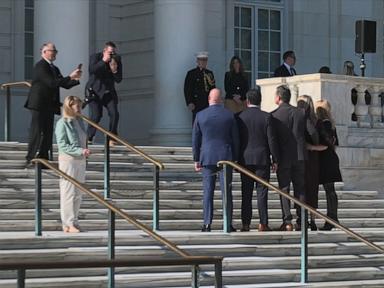
Arlington National Cemetery doesn't bend its rules for anyone. Not for tourists in flip-flops, and certainly not for high-profile political figures accompanied by camera crews.
During a Veterans Day visit to Arlington National Cemetery, a group accompanying Pete Hegseth drew a sharp verbal reprimand from a Tomb Guard at the Tomb of the Unknown Soldier. According to reporting from outlets including The Washington Post and Military.com, the incident unfolded right at the plaza where the Old Guard maintains its famous 24-hour vigil. The sentinel on duty stopped his ceremonial march, turned toward the group, and delivered a crisp warning after members of the party stepped beyond the designated visitor boundaries and disrupted the quiet protocol required at the monument.
If you've ever stood along that marble railing in Virginia, you know the atmosphere immediately. The air feels heavy. Thousands of visitors watch in near-total silence as a soldier from the 3rd U.S. Infantry Regiment takes 21 precise steps, pauses for 21 seconds, and repeats the routine in rain, snow, or summer heat. When a Tomb Guard breaks that rhythm to address the crowd, every head turns.
Why the Tomb of the Unknown Soldier Has Strict Rules
People often assume the guards at Arlington are purely ceremonial. That's a massive misconception.
The soldiers of the Old Guard who stand watch at the Tomb of the Unknown Soldier are active-duty infantrymen serving as official sentinels. Under federal regulations governing Arlington National Cemetery—specifically 32 CFR Part 553—the cemetery is a national shrine, not a public park or a campaign backdrop. Those regulations explicitly prohibit partisan political activities, unauthorized filming for commercial or political gain, and crossing the chains or railings that separate visitors from the plaza.
Here's what actually triggers a confrontation with a sentinel on the mat:
- Crossing the physical barrier. Even leaning over the chain or resting a camera lens across the boundary line violates the perimeter.
- Loud talking or commotion. Visitors are expected to remain silent and respectful during the changing of the guard and throughout the watch.
- Unauthorized media production. While personal photography is permitted from behind the railing, organized film crews and political media teams require prior clearance from Arlington National Cemetery Public Affairs.
According to accounts of the Veterans Day incident, Hegseth—a former Fox News host and Army National Guard veteran—arrived at the monument with an entourage that included individuals filming the visit. When members of that group breached the boundary and created a disturbance near the plaza, the sentinel halted his walk and admonished them to step back and maintain silence.
How Tomb Guards Are Trained to Handle Disruptions
A sentinel's warning isn't an emotional outburst. It's a calculated, rehearsed protocol.
Soldiers who volunteer for Tomb Guard duty undergo months of grueling preparation. They memorize pages of cemetery history verbatim, spend hours perfecting uniform measurements down to a fraction of an inch, and practice the exact vocal cadence used when addressing unruly spectators. When someone crosses the line, the guard stops, executes a sharp facing movement toward the crowd, brings their rifle to port arms, and issues a loud, commanding directive.
"It is requested that everyone remain quiet and standing," or a direct order to step back behind the chains, echoes across the amphitheater. Most visitors freeze on the spot.
In the case of Hegseth's group, witnesses and news reports noted that the admonition followed standard Old Guard procedure. The sentinel didn't single out political affiliation or debate anyone. He enforced the exact same boundary line enforced against middle school field trips and distracted vacationers every single day of the year.
The Bigger Picture Around Arlington National Cemetery Protocol
This wasn't the first time high-profile visits to Arlington sparked debate over rules and optics.
Earlier in the same election cycle, Donald Trump's campaign faced scrutiny from Army officials after an altercation occurred in Section 60, where campaign staffers clashed with a cemetery employee over filming rules in an area reserved for recent war dead. Following that August incident, the U.S. Army issued a rare public statement reminding visitors that federal law strictly prohibits political campaign or election-related activities within Army National Military Cemeteries.
Those two episodes highlight a recurring friction point in Washington politics. Veterans Day and Memorial Day naturally draw elected officials, nominees, and commentators to Arlington to pay respects. Yet the line between personal tribute and public messaging gets blurry fast when cameras roll.
Critics of Hegseth's visit argued that bringing an entourage and filming crew into the plaza space showed poor awareness of military decorum, especially for someone with prior service in the Minnesota Army National Guard. Supporters, meanwhile, contended that Hegseth was attending on Veterans Day to honor fallen service members and that minor boundary confusion in a crowded holiday setting shouldn't be blown out of proportion.
Both perspectives miss the simpler operational reality at Arlington. The rules exist to protect the dignity of the unknown service members buried beneath the marble sarcophagus—representing World War I, World War II, and the Korean War—and to preserve the space for grieving families.
What Visitors Should Know Before Going to Arlington
If you plan to visit the Tomb of the Unknown Soldier, especially on major holidays like Memorial Day or Veterans Day, knowing the ground rules saves you from an unforgettable public correction.
- Stay completely behind the chains and railings. Do not rest bags, phones, or elbows over the barrier.
- Silence your phone before reaching the Memorial Amphitheater. Even a ringtone can draw an immediate reprimand from the guard on duty.
- Stand during the Changing of the Guard and Taps. Unless you have a medical need to remain seated, standing shows basic respect for the ceremony.
- Leave professional filming gear at home unless cleared. Handheld smartphones are fine from the visitor plaza, but tripods, boom mics, and coordinated crews require formal media accreditation through Arlington's public affairs office.
Arlington National Cemetery runs on precision and quiet reverence. Whether you're a tourist from out of state or a familiar face from cable news, the sentinel on the mat treats every single person behind that chain the exact same way. Follow the signs, keep your voice down, and let the ceremony speak for itself.