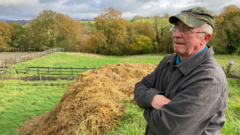
The headlines love a David and Goliath story. A lone farmer stands in a muddy field, arms crossed, staring down the sleek black SUVs of "greedy developers" who want to build 2,000 homes. The public swoons. They call him a hero. They talk about "preserving heritage" and "stopping the concrete jungle."
They are wrong. Dead wrong.
That farmer isn't a hero. He’s a bottleneck. By refusing to budge, he isn't saving the soul of the countryside; he is actively dismantling the future of the middle class, driving up the cost of living for thousands of families, and stagnating regional growth. We have been conditioned to romanticize the "stubborn holdout," but it is time to look at the math, the economics, and the cold reality of why this sentimentality is a luxury we can no longer afford.
The Arable Land Fallacy
The most common argument in favor of the holdout is food security. "We need this land to feed the nation," they cry. This is a fundamental misunderstanding of modern agricultural output.
Modern farming is an exercise in efficiency and technology, not raw acreage. Small, fragmented plots surrounded by encroaching suburban sprawl are the least efficient way to grow food. Heavy machinery needs scale. Logistics need proximity to hubs. A lone farm in the path of a natural urban expansion is an anomaly, not a vital organ of the national food supply.
When we preserve these "heritage" plots at the expense of 2,000 homes, we aren't protecting food; we are protecting a view. It is an aesthetic preference masquerading as a moral crusade.
The High Cost of Sentimentality
Every time a major development is blocked by a single landowner or a handful of vocal neighbors, a specific set of economic dominoes begins to fall.
- Supply Scarcity: Basic economics dictates that when demand remains high and supply is artificially constrained, prices skyrocket. By blocking 2,000 homes, that farmer has effectively added a "scarcity premium" to every other house in a 20-mile radius.
- Infrastructure Stagnation: Developers don't just build houses. They pay for roads, sewers, schools, and utility upgrades. When a project dies, the local council loses millions in Section 106 agreements or Community Infrastructure Levies. The "heritage" stays, but the potholes remain unfilled and the local school stays overcrowded.
- Labor Mobility: People move where the houses are. If a region cannot house its workers, businesses stop moving there. The "stubborn farmer" isn't just stopping houses; he’s stopping the next 50 small businesses that would have opened to serve those 2,000 families.
I have seen city councils spend five years and millions in legal fees trying to navigate around a single holdout. That is money taken directly from public services to entertain the ego of someone who thinks their 100 acres of low-yield wheat is more important than the housing crisis.
The Misunderstood Value of "Green Space"
Let’s be honest about what we are "preserving." Most of the time, it’s a monoculture of grass or a single crop that is ecologically sterile. These aren't pristine rainforests; they are industrial sites that happen to be green.
A well-planned housing development with integrated parks, sustainable drainage systems, and native planting actually offers higher biodiversity than a chemically-treated field. We have been sold a lie that "green" equals "good for the planet," regardless of what is actually happening on that land.
If we truly cared about the environment, we would advocate for high-density, transit-oriented development on these peripheral lands. This prevents the "sprawl" that happens when developers are forced to skip over the stubborn holdout and build 10 miles further out, increasing commute times and carbon emissions.
The Ethics of the "Holdout"
Is it their land? Yes. Do they have a right to refuse? In a strict legal sense, currently, yes. But we need to stop treating this as a noble act.
There is a point where individual property rights collide with the collective survival of a community. When 2,000 families are forced to live in cramped rentals or stay at home with their parents into their 30s because "Farmer John" likes his morning silence, that isn't liberty. It’s a soft form of tyranny.
We often hear the phrase "they aren't making any more land." Exactly. Which is why the land we have must be used for its "highest and best use." In a housing crisis, the highest and best use of land on the edge of a growing city is shelter, not silage.
Why Developers Aren't the Villains
The "evil developer" trope is the easiest way to avoid a complex conversation. Yes, they want to make a profit. So does the farmer. The difference is that the developer’s profit is tied to providing a solution to a desperate social need.
- Risk: Developers take on massive debt and years of regulatory uncertainty.
- Investment: They are the primary funders of modern public infrastructure.
- Standardization: New builds are significantly more energy-efficient than the drafty "heritage" cottages the NIMBYs are so keen to protect.
If we keep vilifying the only people capable of building at scale, we shouldn't be surprised when the only people who can afford homes are the ones who already own them.
The Nuance of Compulsory Purchase
The "middle ground" usually involves Compulsory Purchase Orders (CPOs), which are often portrayed as the ultimate government overreach. In reality, they are a necessary tool for progress.
Imagine if the interstate highway system or the railways had to stop every time someone refused to sell a patch of dirt. We would still be traveling by horse and buggy. Housing is infrastructure. It is the foundation of a functioning economy. We need to start treating major residential developments with the same urgency as a new bridge or a power plant.
The farmer should be compensated fairly—above market value, even. But they should not be allowed to hold an entire region's economy hostage.
Dismantling the "People Also Ask" Nonsense
"Won't new houses ruin the character of the village?"
The character of a village is its people, not its bricks. If your children can't afford to live there, your village has no character; it’s a museum for the wealthy.
"What about the pressure on local doctors and schools?"
This is a planning failure, not a housing failure. You solve this by demanding the developer build the school, not by banning the houses.
"Isn't brownfield land enough?"
No. It’s a common myth. Even if we built on every scrap of contaminated urban soil, we still wouldn't meet the demand. Brownfield development is also exponentially more expensive and slower. We need both.
The Brutal Truth
The romanticization of the stubborn farmer is a symptom of a society that has decided its past is more important than its future. We are choosing the comfort of a familiar view over the ability of the next generation to start their lives.
Every time we cheer for the holdout, we are voting for higher rents.
Every time we protest a "greenfield" development, we are voting for longer commutes.
Every time we prioritize "heritage" over housing, we are voting for economic decline.
It’s time to stop calling them heroes. It’s time to start calling them what they are: obstacles to a functioning society.
The farmer needs to move. The houses need to be built. The future cannot wait for someone who refuses to see past their own fence line.
Build the houses. All 2,000 of them. And then build 2,000 more.