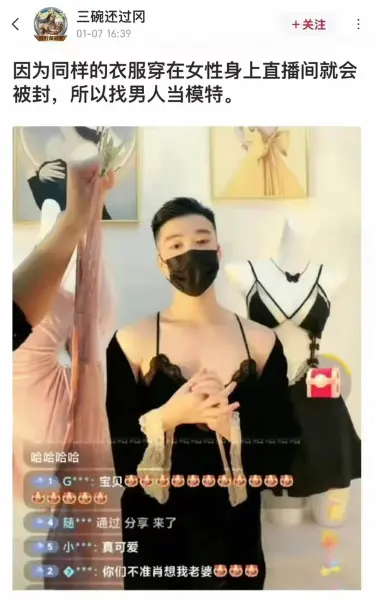
China’s digital economy is built on a foundation of hyper-speed adaptability. When the state tightens its grip on one sector, the market doesn’t just retreat; it morphs into something unrecognizable. The recent crackdown on female lingerie models during live-streaming sessions serves as a masterclass in this survival instinct. By leveraging male models to showcase push-up bras and silk nightgowns, Chinese e-commerce platforms have bypassed decency regulations while simultaneously tapping into a bizarre, high-engagement marketing niche. This is not a simple quirky news story about men in lace. It is a calculated response to a tightening regulatory environment that threatens the multi-billion dollar live-commerce industry.
The Regulation Trap
The shift began when Chinese authorities intensified their scrutiny of "obscene" or "vulgar" content on live-streaming platforms like Douyin and Taobao. In an effort to "clean up" the digital space, algorithms were tuned to flag any skin-heavy content. For brands selling intimate apparel, this created an immediate crisis. If a female model wore a bra to demonstrate its fit, the stream risked an instant ban.
Business owners were left with two choices: use plastic mannequins or find a way to display the product on a human body without triggering the censors. Mannequins don't sell. They lack the movement, the "live" feedback, and the interactive charm that drives sales in China’s frantic shopping apps. Then came the pivot. Since the regulations specifically targeted the "sexualization" of the female form, brands realized that putting the same garments on men technically satisfied the letter of the law while mocking its spirit.
Survival of the Fastest
The logic is cold and practical. A male model wearing a lace negligee over a t-shirt—or even on bare skin—does not trigger the same automated "indecency" filters that a woman would. It is a glaring loophole. Entrepreneurs in the garment hubs of Guangzhou and Hangzhou recognized that the algorithm’s rigidity was its greatest weakness.
By employing men, these businesses ensure their streams stay live for hours. Staying live is the only way to keep the traffic flowing. In the world of Chinese e-commerce, being "de-platformed" for even ten minutes can result in thousands of dollars in lost revenue. The men aren't there for a laugh; they are there to keep the lights on.
The Economics of Irony
While the initial motivation was purely about avoiding bans, a strange thing happened on the way to the checkout counter. The male models started selling more than the women ever did.
The novelty of a man professionally explaining the "lifting" properties of a wireless bra provides a level of entertainment that traditional modeling lacks. It creates "scroll-stop" moments. Users who would typically swipe past a standard lingerie ad stop out of pure curiosity. Once they stop, the sales pitch begins.
Engagement Over Aesthetics
In a saturated market, attention is the scarcest resource. The male lingerie models are often highly professional, maintaining a deadpan delivery while discussing strap comfort and fabric breathability. This juxtaposition creates a viral feedback loop.
- Higher Retention: Viewers stay longer to see the "absurdity," which the platform’s algorithm interprets as high-quality content, pushing the stream to even more people.
- Reduced Returns: Surprisingly, some male models are better at demonstrating the technical construction of the garments, focusing on the "utility" of the item rather than the "allure."
- Cost Efficiency: Many of these models are actually the business owners themselves or small-scale influencers who are willing to take the reputational risk for a spike in sales.
A Cultural Pushback
This phenomenon isn't happening in a vacuum. It sits at the intersection of China’s "Mulan Economy"—a term for the massive purchasing power of Chinese women—and the state’s desire for "traditional" masculinity. The government has previously criticized "sissy men" or "effeminate" aesthetics in media, yet here is a segment of the economy where that exact aesthetic is the only way to stay profitable.
It is a silent protest wrapped in a sales pitch. By following the rules to an absurd degree, businesses are highlighting the impracticality of the regulations themselves. If a woman cannot show a bra, a man will. If the man is then banned for being "effeminate," the platforms risk stifling one of the few growing sectors of the retail economy.
The Censor’s Dilemma
The authorities are in a bind. If they ban men from modeling lingerie, they must define exactly what a man can and cannot wear, a move that would require a level of micro-management even the most dedicated censors are wary of. Furthermore, the live-streaming industry is a massive employer. Disrupting it further during an era of economic cooling is a risky move for social stability.
The "male model" workaround is a symptom of a larger trend where Chinese tech firms and retailers are constantly playing a game of cat-and-mouse with the state. Every time a new "red line" is drawn, the industry finds a way to dance right on the edge of it.
Technical Barriers and Algorithmic Bias
To understand why this works, you have to understand how the AI oversight functions. Platforms use computer vision to scan frames of live video in real-time. These systems are trained on datasets that categorize "exposure" based on female anatomy.
When the AI sees a male torso, the threshold for what constitutes "lewdness" changes. A man’s chest is not flagged with the same severity as a woman’s. This technical blind spot is what allows the "Lingerie Brothers"—as some have dubbed them—to flourish. They are exploiting a bias in the code.
Beyond the Gimmick
Is this a long-term business model? Probably not. It is a bridge. It is a way for companies to survive until the next shift in the regulatory wind or until they can develop new ways to market intimate products without human models. We are already seeing an uptick in high-fidelity 3D avatars and "virtual models" that can be customized to show clothing without any risk of "indecent" behavior.
However, the human element remains king in China. The "authenticity" of a live person answering questions about whether the lace is itchy or if the color fades in the wash is something a digital avatar cannot yet replicate.
The Global Implications
What happens in the Chinese digital market rarely stays there. We are seeing the rise of "shoppertainment" globally, with TikTok Shop and Amazon Live attempting to mimic the success of Taobao. The lesson here for global brands is clear: regulation doesn't kill demand; it just forces it into weirder, more resilient shapes.
The "Lingerie Brothers" are a testament to the ingenuity of the small business owner. They prove that in a battle between a rigid state and a hungry market, the market will always find a crack in the wall. They have turned a restrictive policy into a viral marketing campaign, proving that the best way to beat an algorithm is to give it exactly what it asked for, in the most inconvenient way possible.
If you want to see the future of retail, don't look at the sleek boutiques in Shanghai or New York. Look at a cramped live-streaming studio in a back alley where a man is currently explaining the benefits of a silk camisole to fifty thousand viewers. That is where the real innovation is happening.
The survival of these businesses depends entirely on their ability to stay one step ahead of the next software update. They aren't just selling clothes; they are stress-testing the limits of digital governance. As long as there is a gap between what the law says and what the machine can see, there will be someone standing in that gap, holding a sales link and wearing a lace bra.
The move is now back in the hands of the regulators. They can either ignore the loophole and allow the "effeminate" content they claim to dislike, or they can tighten the rules further and risk damaging the economic engine of the live-stream world. Either way, the merchants have already won this round by proving that even in the most controlled digital environment on earth, creativity is a form of currency that never devalues.
Stop looking for a return to normalcy in the Chinese market. Normalcy is dead. There is only the pivot.