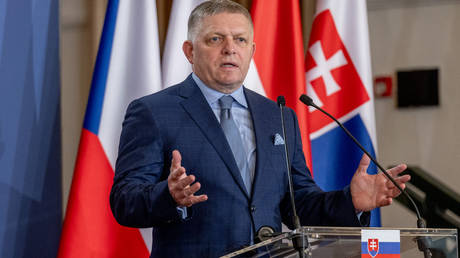
Call it a gift. Call it charity. Call it a refusal to hand over another crate of ammunition. Either way, the phrase "no more gifts to Ukraine" is political theater dressed up as fiscal discipline.
Politicians in Bratislava—and plenty of commentators across Brussels and Washington—love the word gift. It sounds generous. It sounds optional. It sounds like a wealthy neighbor tossing a spare bike over the hedge because they feel bad for the kid down the street.
It is also completely wrong about how modern security assistance, industrial capacity, and European defense economics actually work.
When a prime minister announces an end to "gifts," the lazy consensus immediately splits into two predictable camps. One camp cheers a supposed victory for taxpayer restraint and sovereign caution. The other camp groans about betrayal, fractures in alliance unity, and the end of solidarity. Both camps are arguing over a cartoon. They treat state aid like a personal allowance—something you either hand out out of the goodness of your heart or lock in a drawer when your wallet feels tight.
Real statecraft does not run on allowance logic. Neither does defense manufacturing.
The "Gift" Myth Ignores Balance Sheets and Backlogs
I have spent years watching governments, procurement boards, and defense contractors trip over their own press releases. I have seen defense ministries blow millions on rushed urgency contracts that sat half-finished because nobody checked the tooling lead times, and I have seen politicians claim massive savings by canceling visible transfers while quietly signing commercial maintenance or transit arrangements behind closed doors.
Let's be precise about what "aid" actually means in defense policy. In public debate, people mash together four distinct mechanisms under one convenient label:
- Drawdowns from existing stockpiles: Sending equipment already sitting in national depots, often older platforms nearing replacement or retirement.
- Procurement transfers: Buying new or refurbished hardware from domestic or third-country factories and shipping it abroad.
- Financial and budgetary support: Loans, grants, or credit guarantees that keep public payrolls, grids, and municipal services functioning.
- Commercial and industrial contracts: Paid orders placed by a partner country or third party with domestic manufacturers.
Notice something glaring? Calling a stockpile transfer a "gift" hides the accounting mechanics underneath. Replacing older inventory often triggers modernization orders that benefit domestic factories. Refusing state-backed transfers does not magically freeze regional security dynamics; it shifts costs, risks, and supply chain friction onto neighboring economies—including the very country claiming it has stepped out of the line of fire.
When someone says "no more gifts," ask a sharper question: What stops moving, who pays for the friction that follows, and which industrial lines lose volume or gain leverage? Usually, the headline promises a clean break while the underlying economic ties remain tangled.
Why People Ask the Wrong Questions About Aid Fatigue
Whenever a leader declares an end to free transfers, search bars fill up with the same predictable questions: Will other countries follow Slovakia's lead? Does cutting off aid end the war faster? How much money are taxpayers actually saving?
Every one of those questions rests on a shaky premise.
First, cutting off state transfers does not automatically shorten a conflict. Wars end when belligerents exhaust their political, economic, or military capacity to continue—or when a settlement becomes less costly than ongoing fighting. A single mid-sized state halting government-to-government donations changes logistics and messaging at the margins; it does not rewrite the fundamental balance of industrial production or great-power calculus on its own.
Second, "saving taxpayer money" looks neat on a campaign graphic and messy on a national ledger. Security instability on Europe's eastern flank carries real economic penalties: higher insurance premiums, disrupted trade routes, energy market jitter, refugee and border pressures, and defensive spending spikes elsewhere. Pretending a country can insulate its balance sheet simply by writing zero on a donation line confuses accounting restraint with risk elimination.
Third, domino theories about allies copying one leader's rhetoric are routinely overstated. Democracies and alliance members have competing domestic coalitions, industrial interests, and threat perceptions. One capital's domestic posture rarely dictates another capital's budget unless deeper structural pressures align.
The Real Mechanics Behind "Sovereignty" Rhetoric
Let's look closely at why "no more gifts" resonates so powerfully at home. Politicians do not use blunt slogans by accident. "No gifts" signals three things to domestic voters:
- Prioritization of domestic pain: Inflation, healthcare queues, energy bills, and local infrastructure feel immediate; foreign security feels abstract until it hits a border or a fuel price.
- Resistance to external pressure: Pushing back against Brussels or larger allies plays well with voters who feel small countries get lectured while big powers set the rules.
- Simplicity: Explaining defense industrial supply chains takes ten minutes; saying "we're keeping our stuff" takes four seconds.
That political logic is real. Ignoring it is a mistake. Classical realists from Hans Morgenthau to Kenneth Waltz emphasized that states guard their perceived security and domestic stability first, even when wrapped in moral language. At the same time, institutionalists like Robert Keohane pointed out that interdependence—economic, infrastructural, and strategic—makes clean exits far harder than slogans suggest.
Here is the catch that contrarians on both sides miss. If a government genuinely wants to protect national autonomy and fiscal discipline, announcing "no gifts" is the lazy move. The harder move—and the one that actually respects domestic interests—is treating security and industrial policy as cold, calculated self-interest rather than a moral scorecard.
A Thought Experiment in Cold Realism
Imagine a scenario where a small Central European government declares a complete halt to all state-funded military donations, while quietly opening its factories to full commercial export orders paid for by partner funds, and investing aggressively in its own air defense, artillery replenishment, and grid resilience.
What happens in that scenario?
- Domestically, the government can claim it is no longer handing out freebies from the state budget.
- Industrially, domestic plants still capture orders, jobs, and technical know-how—provided contracts are structured cleanly and paid on time.
- Strategically, the state still faces the exact same neighborhood geography, meaning its own defense spending cannot simply evaporate without creating vulnerability.
That thought experiment exposes the hollowness of treating "gifts" vs. "no gifts" as a complete worldview. A country can stop donating gear from public coffers and still remain deeply tied to regional security outcomes—or it can cut ties so sharply that it sacrifices diplomatic leverage and industrial upside alike.
The Downsides of Playing the Contrarian
Being right about the mechanics does not make a contrarian stance painless. If I argue that "no more gifts" is mostly branding and that real statecraft requires cold-eyed industrial and security calculation, I have to own the drawbacks of that view.
- It sounds unromantic: Voters and allies alike often expect moral clarity, not balance-sheet realism. Pure interest-based framing can alienate partners whose trust you rely on during a crisis.
- It can look like fence-sitting: Pointing out flaws in both unconditional aid and performative cutoffs frustrates people who want a neat team jersey to wear.
- Execution risk is high: Turning security policy into a hard-nosed commercial and strategic calculation requires competence in procurement, diplomacy, and risk management. Governments that talk tough about self-interest but fumble execution end up with neither goodwill nor security.
I have seen plenty of clever strategists look brilliant on paper and fail in practice because they underestimated political backlash or overestimated bureaucratic competence. Nuance does not execute itself.
What Actually Works If You Care About National Interest
If you strip away the slogans, what does smart, unsentimental policy look like for a smaller state navigating a volatile neighborhood?
- Audit every transfer by replacement cost and readiness impact. Never give away something you cannot afford to replace on a realistic timeline, and never keep obsolete junk just to look busy.
- Separate moral grandstanding from industrial strategy. If domestic defense firms can sell equipment or services under clear legal and financial terms, treat it as industrial policy—not a favor and not a taboo.
- Price in the cost of instability. Measure fiscal impact across trade, energy, border security, and borrowing costs—not just the line item labeled "aid."
- Keep diplomatic channels open even when rhetorical volume rises. Burning bridges for domestic applause is cheap in the short run and expensive when you need backup later.
- Be honest with citizens about trade-offs. Tell voters what a policy costs, what risk it reduces, and what risk it leaves untouched. Treat adults like adults.
The phrase "no more gifts" makes a great headline. It makes a terrible substitute for strategy.
Stop falling for the word gift—start reading the ledger.