Darkness is supposed to be empty.
For most of human history, we looked up at the night sky and assumed that the black spaces between the stars were just that—nothing. Dead zones. Oceans of absence separating blazing archipelagos of light. We mapped the constellations, tracked the glowing ribbons of galaxies, and calculated the trajectories of spinning rocks, all while ignoring the vast, silent machinery humming in the dark.
We were wrong.
The universe is screaming. It is speaking in a language so quiet, so elusive, that it passes straight through your body by the trillions every single second without leaving a trace. It passes through your floor. It passes through the Earth beneath your feet. It shoots out the other side of our spinning planet into the void beyond, entirely unbothered by the fact that you, and everything you have ever loved, happened to be in its way.
They are called neutrinos. And for decades, trying to catch one was like trying to scoop up wind with a fishnet.
Francis Halzen knew this. He knew that the hardest truths in science do not yield to brute force; they demand a stubborn, almost unreasonable kind of patience.
Imagine standing on a frozen plain at the bottom of the world, where the wind scours the ice until it screams and the temperature drops low enough to freeze your breath before it hits your scarf. That is the South Pole. To most, it is a dead, white desert at the end of the Earth. To Halzen, it was a telescope.
For years, mainstream physics chased photons. Light is easy. You point a glass lens at a star, you catch the glow, you write down the math. But light lies. It gets tangled in dust clouds, bent by magnetic fields, and scattered by wandering gas. By the time a photon hits a lens on Earth, its journey has been so warped that its origin story is hopelessly scrambled.
Neutrinos don't care about dust. They don't care about magnetic fields. They are the ultimate cosmic messengers, born in the most violent cauldrons of the universe—supermassive black holes, exploding stars, colliding galaxies—and they travel in a straight, uncompromising line across billions of light-years. If a neutrino leaves a dying star in a distant galaxy and points toward Earth, it will cross the entire cosmos and strike our planet without ever deviating an inch.
The catch? Because they interact with almost nothing, catching them requires a trap of impossible proportions.
How do you catch a ghost? You build a cathedral out of pure ice.
Deep beneath the surface of the South Pole, buried in a mile of ancient, compressed ice that is so clear you can see straight through a block of it, lies IceCube. It is not made of gleaming metal and polished mirrors. It is made of the glacier itself.
Halzen and his team did something that sounded like madness to the traditional scientific establishment. They took hot-water drills and melted holes a mile deep into the Antarctic ice sheet, dropping strings of sensitive light detectors—digital optical modules—down into the freezing slush before it refroze around them. They turned a cubic kilometer of solid glacier into a giant trap.
Think about what happens when a ghostly neutrino finally decides to interact with normal matter. It is a rare lottery win, a microscopic collision that produces a flash of blue light known as Cherenkov radiation. By embedding thousands of electronic eyes across a cubic kilometer of ice, the IceCube detector waits in the pitch black for that single, faint blue spark.
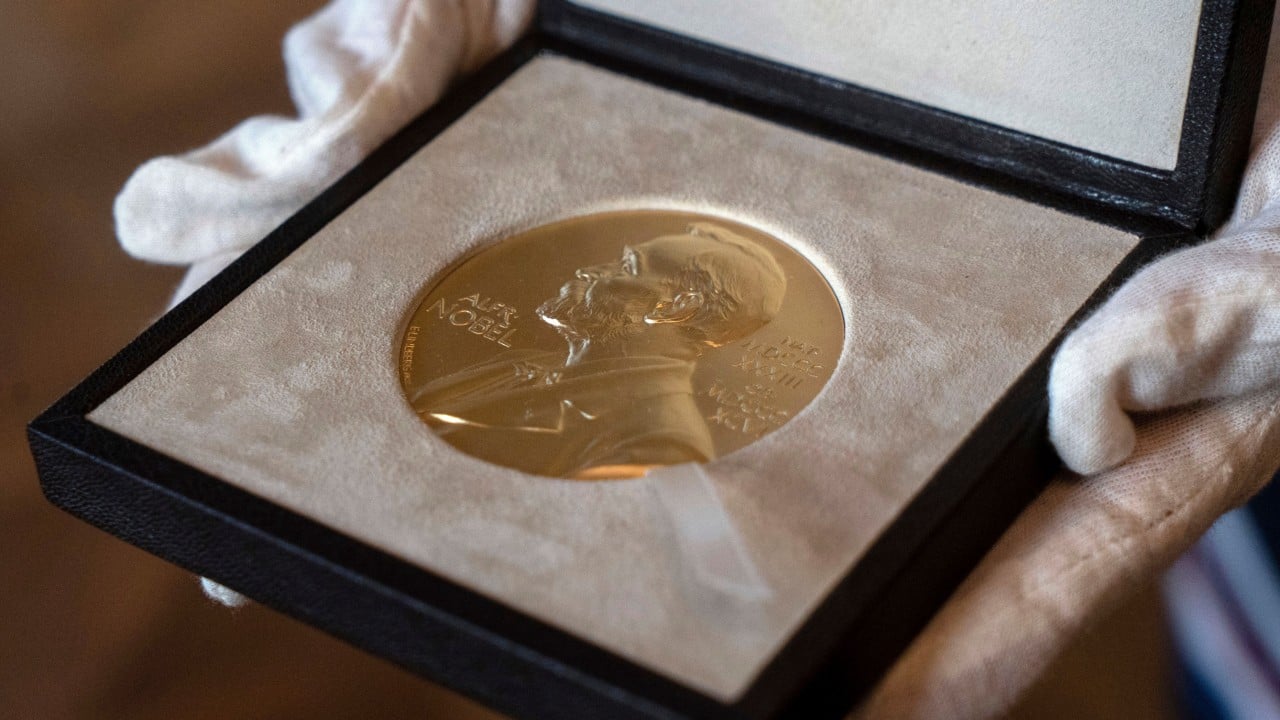
When the Nobel Prize committee finally picked up the phone to call Francis Halzen, they were not just honoring a man who won a race. They were validating a decades-long gamble against the consensus of the scientific community. They were recognizing the moment we stopped looking at the sky with glass eyes and started listening to the deep, invisible pulse of the cosmos.
Consider what that means for how we understand reality. Every time you look at a sunset, you are only seeing the surface. You are seeing the light that managed to survive the gauntlet. But beneath that light lies a hidden universe of high-energy particles carrying the blueprints of cosmic cataclysms.
We used to think we were isolated on our little blue marble, protected by the vastness of space. Now we know we are sitting in the middle of a cosmic crossfire. High-energy neutrinos from sources outside our solar system crash through our atmosphere, whispering secrets about black holes that devour stars and engines of creation that dwarf anything we can build in our laboratories.
The prize money will be spent. The headlines will fade. The news cycle will churn forward into the next political crisis or technological breakthrough.
Yet out there, in the crushing dark of the Antarctic ice, the cables are still hanging in the frozen silence. The detectors are still blinking in the cold. And the ghosts of the universe are still streaming through us, waiting for us to ask better questions.