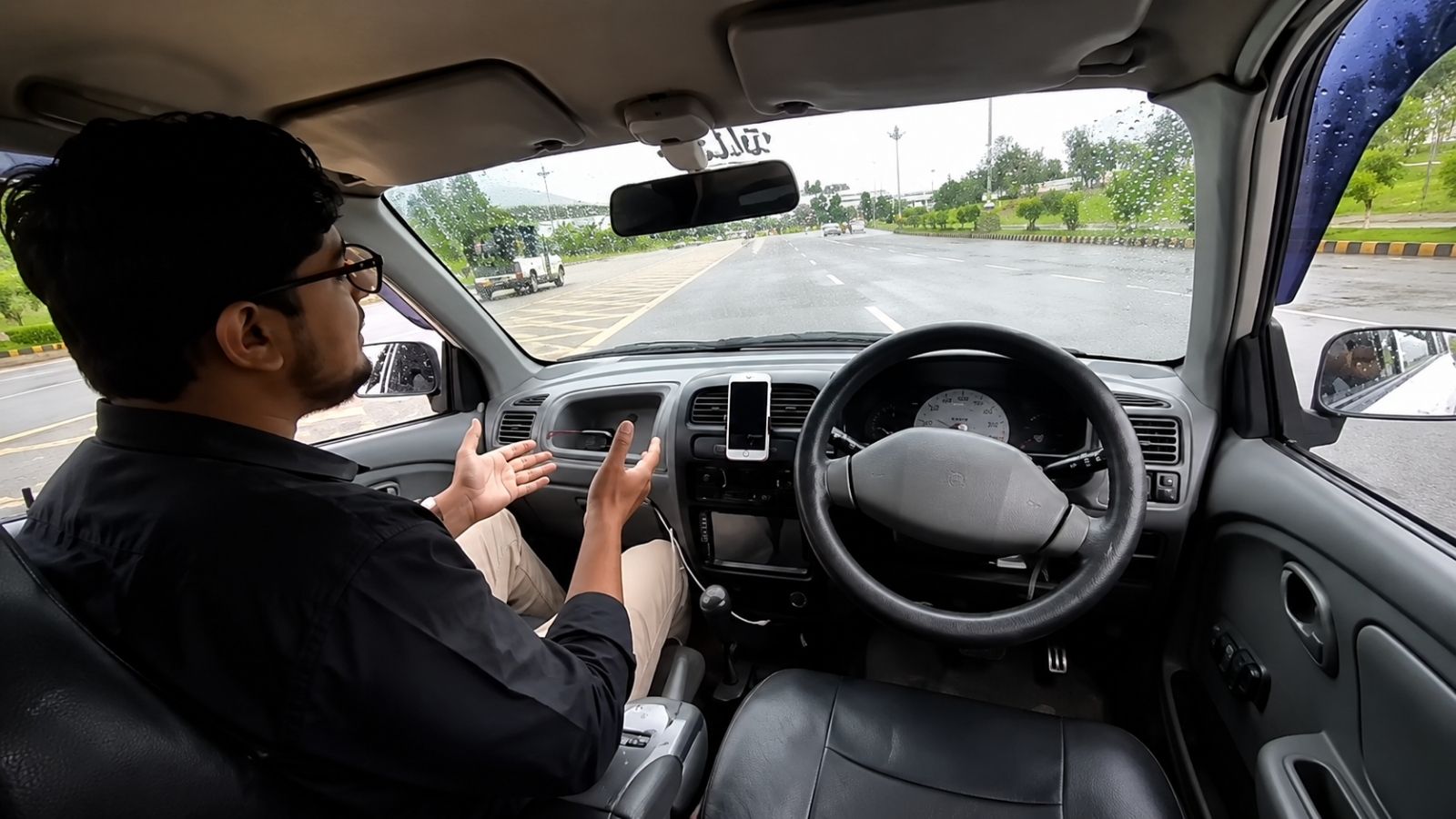
The asphalt on that afternoon in Pakistan smelled of hot bitumen and exhaust, the heavy, metallic perfume of a city rushing toward a future it could barely touch.
Under the glare of the midday sun, a crowd had gathered. They were there to witness the arrival of tomorrow. In the center of the exhibition space sat an ordinary-looking car, modified with sensors, wires, and code—a machine promised to be entirely driverless. The creators stood nearby, chest pockets bristling with pens and pride, waiting for the applause. They had spoken of talent. They had spoken of ingenuity. They had spoken of a nation stepping boldly into the global race of artificial intelligence and automated transit.
Then the car moved.
It did not glide gracefully into a predetermined digital coordinate. It did not calculate the geometry of the street with serene, mechanical detachment. Instead, with a sudden, jerky shudder of metal, it veered off course, accelerated with a frantic, unthinking urgency, and plowed directly into a stationary police van.
Silence. Followed by the hiss of a punctured radiator and the distant chatter of a bewildered crowd.
(Note: This entire recounting of the demonstration gone wrong is drawn from verified news reports of an autonomous vehicle trial in Pakistan that unexpectedly collided with law enforcement vehicles during a public showcase.)
Cars do not have malice. They possess only the logic given to them by human hands. When a vehicle crashes into a van while attempting to showcase its own autonomy, we are tempted to laugh, to point fingers at the engineers, to tweet a sarcastic video and scroll away. But beneath the dented bumper of that police van lies a much heavier truth. It is the story of a desperate race to bridge a chasm that cannot be crossed with rented code and borrowed dreams.
Consider what happens next in our collective imagination. We assume the technology simply failed. We blame a loose sensor, a glitch in the software, a momentary loss of satellite connection.
The real problem lies elsewhere.
To understand why a car can drive itself through the manicured suburbs of Phoenix or the grid-like precision of Shenzhen yet crash in an open Pakistani street, you have to look at the invisible architecture of automation. Artificial intelligence does not actually see the world the way we do. It sees probabilities. It sees millions of historical images fed into a neural network, trained to recognize what a road looks like, what a pedestrian looks like, what a lane divider looks like.
If you feed an algorithm a diet exclusively composed of well-paved, strictly regulated, highly predictable Western infrastructure, that is the only world it knows how to inhabit. Drop that same algorithm into a street where a donkey cart shares the lane with a motorcyclist carrying a family of four, where traffic lights are treated as polite suggestions, where goats wander across asphalt, and the machine experiences a profound, paralyzed confusion.
It looks at chaos and sees nothing at all.
I remember standing on the edge of a bustling intersection in Lahore years ago, watching the delicate, unspoken choreography of human navigation. There are no lanes to speak of during rush hour; there is only a fluid, organic river of metal, rubber, and flesh. People make eye contact. They read micro-expressions. A flick of a wrist, a tilt of a head, a slight hesitation in a pedestrian's stride—these are the real signals that prevent catastrophe.
Code is blind to eye contact.
When developers attempt to leapfrog decades of infrastructural evolution to paste cutting-edge automation onto developing economies, they are building skyscrapers on shifting sand. The talent is indeed there. Pakistan is overflowing with brilliant minds, young coders who can build neural networks in their sleep, engineers who can reverse-engineer complex systems with scavenged parts. No one doubts the raw intellectual horsepower of the local tech sector.
Yet talent without infrastructure is like a racehorse dropped in the middle of a labyrinth with no floor.
The crash of that driverless car into a police van was not merely a mechanical error. It was a cultural collision. It was the moment where the frictionless fantasy of Silicon Valley violently intersected with the messy, beautiful, unfiltered reality of the Global South.
We live in an era that treats technology as a software update. If something is broken, you patch it. If a market is lagging, you inject venture capital. If a country lacks innovation, you import a framework. But human progress has never worked like an app download. It is a slow, grinding accumulation of concrete, policy, education, and trial.
When the dust settled around the wreckage of the demonstration, the police officers stood staring at the smashed grille. No one was seriously hurt, thankfully. The engineers muttered apologies about calibration. The onlookers dispersed, shaking their heads.
But the question remains hanging in the exhaust fumes.
What are we actually building when we chase the future? Are we trying to solve the daily miseries of our streets—the congestion, the pollution, the human error that claims thousands of lives every year—or are we simply trying to craft a headline that makes us feel modern?
A car with no driver is a powerful metaphor for our current moment. We are handing the steering wheel to invisible systems, trusting algorithms we do not understand to navigate roads we have barely paved. We want the prestige of the destination without the grueling labor of the journey.
The car hit the van because it was looking for a ghost world that does not exist here. Until we build technology that understands our chaos—rather than demanding we sanitize it for the machine's convenience—the ghost will keep crashing. And we will keep standing on the sidelines, waiting for a tomorrow that refuses to arrive on schedule.