Salt water has a way of swallowing secrets whole, until the steel starts to groan.
Picture a watch officer on the bridge of a modern corvette just after midnight. Let us call him Alexei, a composite of the hundreds of young sailors who crew Russia’s newest surface vessels. He is three thousand kilometers from the war he signed up to fight. Outside the armored glass of the Merkury, the Mediterranean wind carries the dry, dusty scent of the Libyan coast rather than the cold brine of Sevastopol. The Black Sea is far away. Here, anchored off the shores of eastern Libya, the waters are supposed to be a sanctuary—a quiet logistical hub where Moscow projects power into North Africa without looking over its shoulder. Don't miss our earlier post on this related article.
Alexei checks the radar sweep. Nothing. Just the gentle, rhythmic slap of warm waves against a hull engineered to absorb sonar and deflect radar beams.
Then the water itself begins to move against the current. To read more about the background here, Al Jazeera offers an excellent breakdown.
By the time the low, dark silhouettes of Ukrainian uncrewed surface vessels breach the inner perimeter, the Merkury is already trapped by its own assumptions. Within minutes, the explosions tear through the waterline, turning one of Russia’s prized Steregushchiy-class corvettes into twisted, sinking scrap off the coast of Libya. When Ukrainian President Volodymyr Zelenskyy finally confirms what intelligence whispers and satellite shadows had begun to suggest—that Ukrainian naval drones hunted down and sank the Merkury in the Mediterranean—the headline reads like a tactical bulletin.
It is not a bulletin. It is an obituary for an entire era of warfare.
When Distance Stopped Being a Shield
For centuries, naval strategy rested on a simple, comforting math of geography. If you wanted to sink a capital ship far from your own coastline, you needed a blue-water navy. You needed aircraft carriers, nuclear submarines, overseas bases, and supply chains stretching across hemispheres. Small nations, or nations without a traditional fleet, stayed pinned to their own littoral waters, firing coastal batteries and hoping the giants stayed over the horizon.
Ukraine did not even have a functioning conventional navy left after the early months of the full-scale invasion. What it had instead was desperation, a coastline under blockade, and engineers working in basement workshops who refused to accept that geography was destiny.
To understand what happened to the Merkury off the Libyan coast, you have to understand how completely the rules of maritime survival have inverted. Think of a traditional warship like a medieval knight in full plate armor—immense, expensive, bristling with lethal hardware, and terrifying in a straight fight. Now picture a swarm of hornets slipping through the visor slits while the knight is asleep in a tavern three countries away.
The Merkury was not an aging Soviet relic pulled out of mothballs. Commissioned only in 2023, this Project 20380 corvette represented the modern face of the Russian Navy. Measuring over a hundred meters long and displacing more than two thousand tons, it was built with stealth geometry, armed with Kalibr cruise missiles, and outfitted with advanced air-defense suites designed to swat incoming threats out of the sky. It cost hundreds of millions of dollars and years of shipyard labor to put to sea.
And it died in a place where it believed it was untouchable.
The Invisible Stakes in the Mediterranean
Why was a Russian corvette sitting off the coast of Libya in the first place?
To most readers scrolling past war updates over morning coffee, Libya sounds like a strange detour in a conflict centered on the fields of Donbas and the ports of Odesa. Yet the Mediterranean has quietly become the back door of Russian geopolitical ambition. With the Turkish Straits closed to warships under the Montreux Convention, Russia could no longer rotate ships freely between the Black Sea and the Mediterranean. Every hull trapped outside the Bosporus became precious; every hull trapped inside became a target.
Russia needed a foothold on the southern shore of the Mediterranean—specifically around Tobruk in eastern Libya, controlled by Kremlin-backed warlord Khalifa Haftar. From Libyan ports, Moscow could resupply its mercenaries across the Sahel, threaten NATO’s southern flank, and maintain a warm-water presence after its grip on Syria grew increasingly precarious.
The Merkury was there to show the flag, secure supply lines, and remind European capitals that the Russian Navy still roamed the open seas.
Zelenskyy’s confirmation that Ukrainian forces reached across the European continent, bypassed naval chokepoints, and struck a Russian warship in North African waters shatters that illusion. Suddenly, there is no rear echelon. A ship docked in Novorossiysk is in danger. A ship patrolling near Crimea is in danger. And now, a ship idling off the coast of Tobruk is in danger too.
How You Sink a Warship Three Thousand Kilometers Away
People naturally ask how a country locked inside the Black Sea manages to strike a target in the central Mediterranean. The mechanics sound like espionage fiction, yet they rely on brutal, pragmatic engineering.
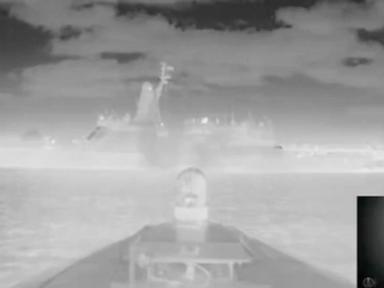
Ukrainian naval drones—systems like the Magura V5 and Sea Baby—are essentially low-profile, fiberglass-and-carbon speedboats packed with hundreds of kilograms of high explosives, guided by satellite communications and thermal cameras. They ride so low in the water that conventional naval radars often dismiss their signatures as sea clutter or wave crests until they are within a few hundred meters of the hull.
Yet even the best maritime drone cannot simply drive from Odesa, slip unnoticed past Istanbul, weave through the Aegean Sea, and cross the Mediterranean on a single tank of fuel.
That means one of two realities is now true, and both should keep naval admirals awake at night. Either Ukraine’s intelligence services have mastered the art of covert maritime logistics—launching uncrewed strike craft from disguised civilian merchant vessels operating in international waters—or they have constructed long-range, autonomous mother-drones capable of carrying smaller strike boats across open seas before releasing them near their target.
Consider what happens next in the mind of every Russian naval commander from the Baltic to the Pacific.
Every rust-streaked cargo freighter passing within fifty miles of a Russian warship becomes a potential Trojan horse. Every fishing trawler bobbing on the horizon could be hiding a sleek, matte-black hull under a tarp on its aft deck. Paranoia becomes a permanent crew member. You cannot sleep. You cannot drop anchor in a friendly port and lower your gangway for shore leave. You have to keep your engines warm, your watchstanders staring into night-vision binoculars until their eyes burn, and your heavy machine guns manned twenty-four hours a day, burning fuel and exhausting men who never even see the enemy pulling the trigger.
The Human Toll of Asymmetric Terror
It is easy to get seduced by the sleek geometry of modern drones and forget the visceral human reality unfolding on both sides of the screen.
I remember talking years ago with a retired naval engineer who had spent his life designing hull compartmentalization. He told me that the greatest fear on any ship is not the missile you see coming; it is the sudden, inexplicable breach below the waterline in the dark. Water does not negotiate. When a shaped charge punches through steel plating at the waterline, the ocean rushes in with a deafening roar that drowns out alarms, cutting off compartments and plunging corridors into pitch blackness within seconds.
For the young sailors aboard the Merkury—many of them conscripts or junior contract seamen who likely celebrated when their ship was assigned to the warm, quiet waters of the Mediterranean rather than the lethal shooting gallery of Sevastopol—the end came without warning. There was no heroic naval duel, no exchange of broadsides, no chance to fire back at an enemy ship on the horizon. Just a sudden, violent shudder beneath their boots, the acrid stench of cordite and burning electrical insulation, and the cold realization that the steel beneath them was no longer buoyant.
Meanwhile, thousands of kilometers away in a darkened command room in Ukraine, a twenty-something operator wearing a headset watches a grainy infrared feed blink to static.
There is no salt spray on the operator’s face. Only the hum of cooling fans, the glow of telemetry monitors, and the quiet, heavy exhalation of a team that has spent months calculating fuel burn rates, satellite latency, and Mediterranean swell patterns. For them, this strike is not an abstract geopolitical chess move. It is direct vengeance for the Kalibr missiles launched from Russian warships into Ukrainian apartment blocks, power grids, and children's hospitals. Every Russian hull sent to the bottom is one fewer launch platform capable of raining cruise missiles onto Kyiv or Kharkiv in the middle of winter.
Why Every Navy on Earth Is Quietly Panicking
If you think this story is strictly about Russia and Ukraine, you are missing the tremor shaking every naval headquarters from Norfolk to Zhanjiang.
Look at the economics of the exchange. A modern warship like the Merkury costs upward of three hundred million dollars to build, requires years of specialized industrial capacity, and demands a crew of roughly ninety trained specialists. A small fleet of naval drones costs a fraction of a single cruise missile—perhaps a few hundred thousand dollars total—and can be assembled in modular workshops scattered across civilian warehouses.
When a three-hundred-thousand-dollar machine can reliably hunt and destroy a three-hundred-million-dollar warship across international seas, the entire financial architecture of naval power collapses.
The United States Navy has spent tens of billions of dollars on aircraft carrier strike groups and Aegis destroyers designed to fight high-altitude supersonic missiles and enemy fleets. Yet even the most sophisticated multi-billion-dollar destroyer struggles when confronted with a low-lying, maneuverable surface craft attacking at the waterline in the dead of night, especially when that craft blends into commercial shipping lanes until the final three minutes of its run.
China, watching closely from across the Taiwan Strait, sees a terrifying blueprint for how a smaller defender can turn narrow seas into a graveyard for amphibious invasion fleets. European navies, suddenly realizing that undersea cables, offshore wind farms, and naval bases are vulnerable to uncrewed craft launched from ordinary commercial vessels, are scrambling to rewrite coastal defense doctrines that haven't changed since the Cold War.
We are witnessing the democratization of naval lethality. You no longer need an empire to sink a flagship. You only need a satellite link, a fiberglass hull, and the patience to wait until the crew on the bridge believes they are safe.
The Ghost of Tobruk
Satellites passing over the eastern Mediterranean in the days following the strike captured the quiet aftermath—oil sheens spreading across the blue water, recovery vessels circling, and a noticeable absence where a grey, stealth-angled silhouette used to sit against the horizon.
The Kremlin, true to form, offered silence or deflection, unwilling to admit that its prized corvette had been humiliated far from the front lines. Yet silence cannot refloat steel. Nor can it erase the psychological fracture that Zelenskyy’s announcement planted inside the Russian Admiralty.
Before the Merkury went down, Moscow could still pretend that its naval losses in the Black Sea were a localized anomaly—an unlucky streak caused by cramped waters and proximity to Ukrainian shores. The Mediterranean was supposed to prove that Russia remained a global maritime power capable of operating freely beyond Ukraine’s reach.
Instead, the Libyan coast became proof of the opposite.
Somewhere off Tobruk tonight, the Mediterranean swells roll unbroken over the hull of a brand-new warship that was built to project Russian dominance for the next thirty years and lasted barely three. Down in the dark, fish swim through open hatches and silent missile tubes, while miles away, on the bridges of every surviving Russian vessel still afloat, young watch officers stare out into the black water, flinching every time a wave breaks against the bow.