The global struggle for artificial intelligence supremacy is currently mismeasured by a preoccupation with foundational model benchmarks while ignoring the structural divergence between innovation and implementation. The assumption that the nation producing the most sophisticated Large Language Models (LLMs) will inherently dominate the economic outcome ignores the historical precedent of the "Innovation-Execution Gap." While the United States maintains a lead in raw compute power and algorithmic breakthroughs, China is constructing a superior ecosystem for mass-market deployment. The critical pivot point for global leadership rests not on who builds the most parameters, but on who reduces the marginal cost of intelligence enough to integrate it into the physical economy.
The Bifurcation of Intelligence: Foundational vs. Applied
The current AI landscape is splitting into two distinct industrial philosophies. To understand the trajectory of this competition, we must categorize AI development into two primary functions:
- Frontier Innovation: The discovery of new architectures (e.g., Transformers), the scaling of massive compute clusters, and the pursuit of General Intelligence. This is currently capital-intensive and concentrated in the U.S.
- Downstream Implementation: The process of fine-tuning, quantifying, and embedding models into specific industrial, logistical, and consumer workflows. This is where China is focusing its structural advantages.
The U.S. strategy relies on a high-cost, high-performance model. The focus is on the creation of "God-models" that require massive energy and $H100$ GPU clusters. Conversely, the Chinese strategy emphasizes "Efficiency-First" engineering. Because export controls have restricted access to the latest silicon, Chinese firms have been forced to optimize. They are mastering the art of achieving 90% of GPT-4’s performance at 10% of the operational cost. In a global market, the entity that provides "good enough" intelligence at a fraction of the price often captures the majority of the value chain.
The Three Pillars of Implementation Dominance
China’s potential to outpace the U.S. in the "Age of Use" is driven by three structural pillars that the U.S. currently lacks the political or industrial will to replicate.
The Data Feedback Loop in Dense Urbanism
AI models require feedback to improve. While the U.S. has superior "clean" data from the internet (Reddit, Wikipedia, ArXiv), China has superior "real-world" data. The density of Chinese cities and the total integration of digital payments (WeChat Pay, AliPay) create a continuous stream of behavioral data that informs autonomous logistics, facial recognition, and predictive retail. This "closed-loop" data environment allows for rapid iteration of applied AI that transcends mere text generation.
Regulatory Compulsion and Infrastructure
The U.S. regulatory environment is fragmented and reactionary, often characterized by litigation over copyright or fears of displacement. China’s regulatory framework is prescriptive. When the state identifies a sector—such as humanoid robotics or autonomous trucking—as a strategic priority, the barriers to testing and deployment are removed. This creates a "Deployment Sandbox" where AI can fail fast in the physical world, a luxury rarely afforded to Western developers.
The Hardware-Software Symbiosis
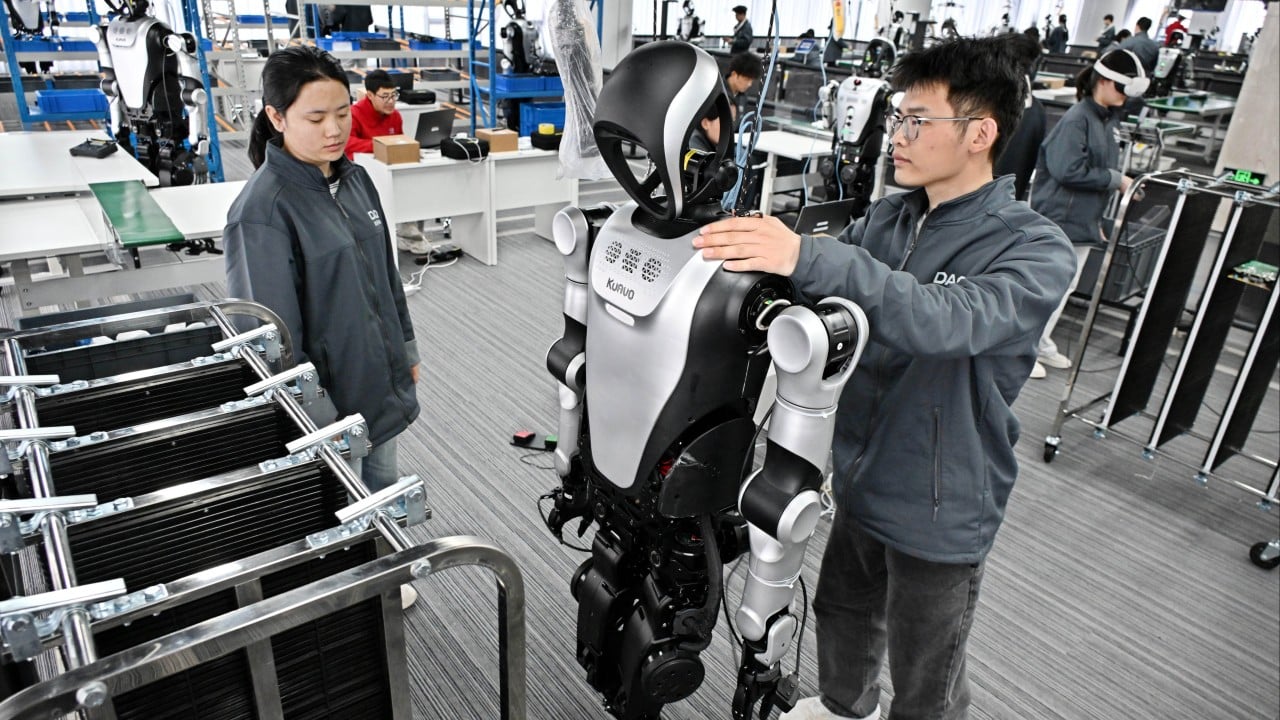
AI is increasingly a hardware problem. The U.S. designs the best chips, but China manufactures the devices those chips live in. If the future of AI is "Edge Intelligence"—AI running locally on drones, cars, and factory arms—the proximity of software engineers to the manufacturing floor is a decisive advantage. The speed at which a developer in Shenzhen can iterate a model based on hardware telemetry from a nearby factory creates a tighter development cycle than the 6,000-mile gap between Silicon Valley and its assembly lines.
The Cost Function of Intelligence
The true metric of victory is the Unit Cost of Inference. In the early stages of a technology, performance is the only metric that matters. In the mature stage, cost becomes the only metric.
The U.S. is currently winning the Performance War. However, the American model of AI development faces a looming "Compute Tax." Massive models are expensive to train and even more expensive to run. If U.S. firms cannot find a way to monetize $20-a-month subscriptions at scale, they risk a capital-expenditure bubble.
China’s constraint—limited access to the highest-end silicon—has served as a forced optimization function. They are leading in techniques like:
- Model Distillation: Taking a large, "smart" model and using it to train a smaller, faster model.
- Low-Rank Adaptation (LoRA): Efficiently fine-tuning models on consumer-grade hardware.
- Specialized SLMs (Small Language Models): Building 3-billion to 7-billion parameter models that outperform 100-billion parameter models in specific niches like coding or legal analysis.
The Silicon Bottleneck: A Temporary Moat
The primary argument for continued U.S. dominance is the hardware lead. By restricting China's access to the most advanced photolithography (EUV) and high-bandwidth memory (HBM), the U.S. aims to freeze Chinese models in a previous generation of performance.
However, this strategy assumes that AI capability scales linearly with compute forever. If the industry hits "Diminishing Returns on Scaling," where adding 10x more compute only yields a 2% improvement in logic, the U.S. hardware advantage evaporates. Once models reach a "Utility Plateau"—a point where they are smart enough for 99% of human tasks—the competition shifts entirely to who can deploy them most aggressively.
The Geopolitical Risk of the "Innovation Trap"
The U.S. risks falling into an "Innovation Trap": inventing the future but failing to own its utility. This happened with high-speed rail, 5G, and commercial drones—all technologies where the fundamental research was Western, but the scale and economic benefits were captured by Chinese implementation.
In the AI context, this would look like American companies holding the patents for the most advanced neural networks, while Chinese companies use those (often open-sourced) architectures to automate their entire manufacturing base, reduce their exports' costs, and dominate global logistics.
Strategic Realignment: The Shift to Physical AI
To counter the implementation gap, the focus of analysis must move away from chatbot benchmarks and toward "Physical AI" metrics.
- Metric 1: Industrial Integration Rate. How many AI agents are currently controlling physical actuators in manufacturing?
- Metric 2: Latency-at-the-Edge. Can the AI make decisions locally without a cloud connection?
- Metric 3: Energy-to-Intelligence Ratio. How much electricity is required for a model to complete a complex reasoning task?
On all three metrics, the gap is closing. While the U.S. produces the "Brains" of the new economy, the "Body"—the sensors, the robots, and the integrated city grids—is being built elsewhere.
The strategic play is no longer about building a larger model. The play is the vertical integration of AI into the hard sciences and heavy industry. The nation that successfully moves AI from the screen to the street will dictate the economic terms of the 21st century. This requires a move away from "Software as a Service" (SaaS) and toward "Intelligence as an Infrastructure." The U.S. must prioritize the physical deployment of AI-ready hardware, or it will find itself as the R&D department for a world that runs on Chinese implementation.