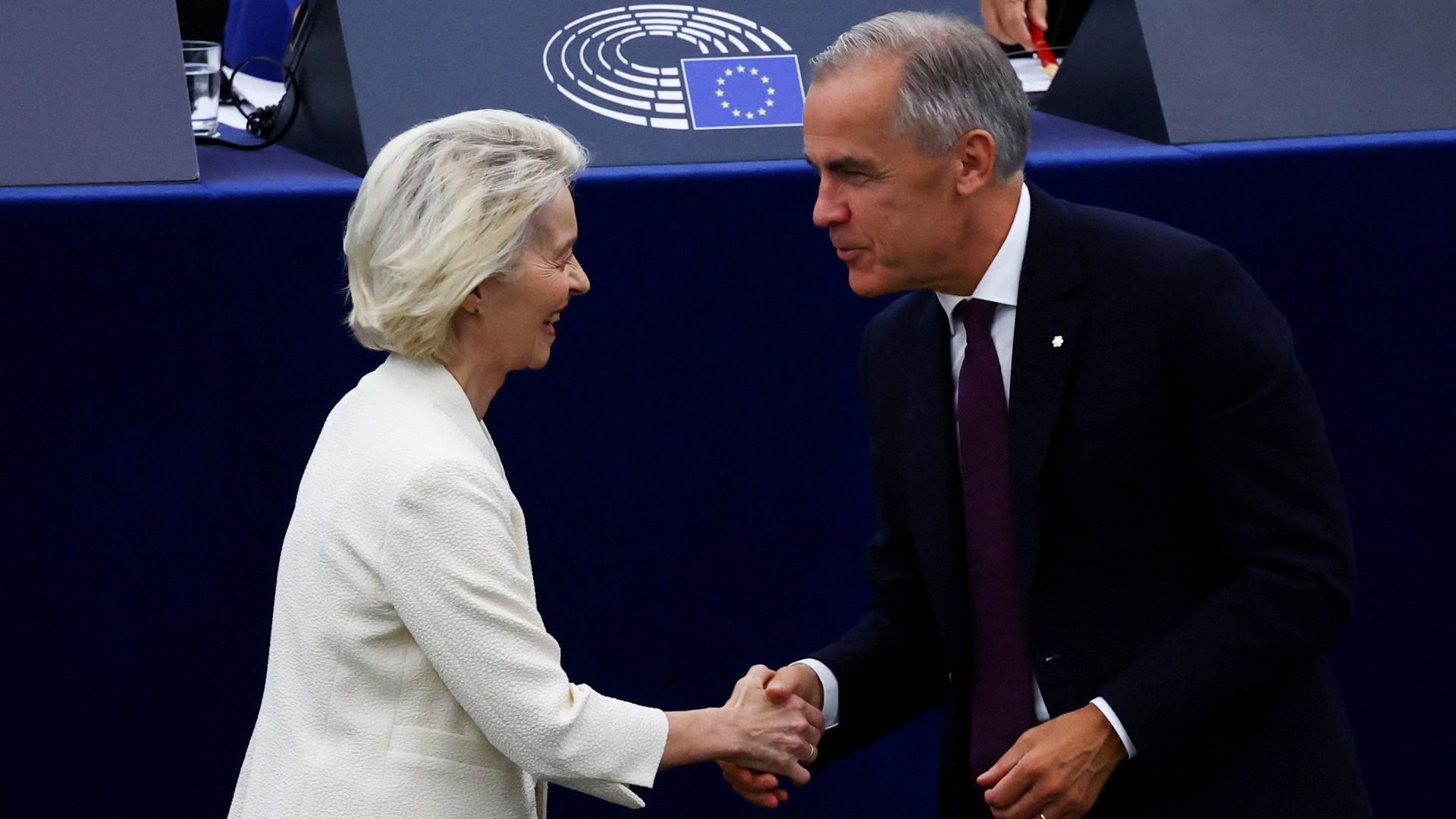
National economic models built on decades of frictionless continental integration face structural rupture when the dominant partner weaponizes trade access. For Canada, the return of aggressive protectionist tariffs and explicit threats of economic coercion under the Trump administration exposed an existential vulnerability: an export economy structurally tethered to a single southern market consuming over seventy percent of its outward trade. The subsequent diplomatic initiative led by Prime Minister Mark Carney to pivot toward Brussels and negotiate an unprecedented institutional framework with the European Union represents a profound realignment of Western trade policy. Moving beyond conventional free trade agreements, the proposal to establish Canada as the European Union’s first associate member signals a fundamental re-engineering of state survival strategies in an era of transactional superpower hegemony.
The Cost Function of Bilateral Dependence
Economic gravity dictates that geographic proximity dictates trade patterns. For generations, Canada optimized its industrial supply chains, logistical corridors, and regulatory frameworks to maximize frictionless movement across the forty-ninth parallel. This high degree of integration generated vast wealth, but it created an asymmetric power dynamic. When Washington deployed sweeping tariffs and raised the specter of annexation rhetoric, the cost function of this hyper-dependence became mathematically unsustainable.
A single-market concentration functions as a single point of failure in national risk management. When a dominant trading partner imposes arbitrary penalties, the targeted nation experiences severe macroeconomic friction. Capital investment stalls, currency values fluctuate under the weight of trade deficits, and domestic industries find themselves stripped of predictable planning horizons.
To break this vulnerability, a sovereign state must absorb immediate short-term restructuring costs to build alternative market conduits. Canada’s strategic turn toward Europe is not merely a diplomatic gesture; it is an exercise in sovereign risk mitigation. By diversifying its trade counterparties, Ottawa aims to establish a structural floor beneath its economy, ensuring that no single foreign administration can unilaterally dictate domestic economic trajectories through executive decree.
The Mechanics of the Alliance for the Future
The framework advanced during the bilateral summits between Canadian leadership and European Commission President Ursula von der Leyen establishes a blueprint for deep institutional integration short of full political accession. While initial diplomatic drafts toyed with the explicit label of associate membership, political sensitivities among several European member states prompted a subtle shift toward defining an ever-closer association. Nomenclature notwithstanding, the operational mechanisms embedded within the agreement span multiple critical sectors.
Regulatory Harmonization and Competition Policy
Traditional trade agreements focus primarily on tariff reductions, leaving non-tariff barriers and regulatory divergence as persistent friction points. The emerging Canada-European Union framework bypasses this limitation through a second-generation competition agreement. By aligning antitrust enforcement and anti-competitive practices oversight, both jurisdictions reduce compliance overhead for cross-border enterprises. Furthermore, digital trade negotiations establish mutual recognition frameworks in digital credentials, artificial intelligence conformity assessments, and cybersecurity standards. This regulatory convergence allows technology and industrial firms to operate across the Atlantic without duplicating compliance expenditures.
Critical Minerals and Capital Allocation
Industrial policy in the twenty-first century is anchored by control over critical raw materials. Canada possesses vast reserves of lithium, nickel, cobalt, and rare earth elements essential for energy transition and advanced manufacturing. However, domestic extraction historically lacked the downstream processing and capital depth required to retain high-value supply chain tiers.
The agreement bridges this gap through a formalized financing structure involving the European Investment Bank. European capital flows directly into Canadian critical mineral extraction, refining, processing, and recycling infrastructure. This capital injection serves a dual purpose. Europe secures a reliable, democratic supply of strategic inputs free from adversarial geopolitical choke points, while Canada accelerates its industrial upgrading, transforming from a raw exporter of unprocessed commodities into a high-value manufacturing node.
Research, Supercomputing, and Technological Sovereignty
National power increasingly derives from technological infrastructure. Under the new arrangements, Canada integrates deeply into European scientific and computational ecosystems. Participation in advanced supercomputing initiatives, such as the European High-Performance Computing Joint Undertaking, alongside targeted access to advanced research programs, prevents technological isolation. As research grants and cross-border academic programs face tightening restrictions in traditional North American channels, institutionalizing ties with European research networks preserves scientific capacity in artificial intelligence, quantum computing, and aerospace engineering.
Energy Security and Infrastructure Corridors
Energy connectivity represents another pillar of the transatlantic architecture. Feasibility studies regarding Canadian liquefied natural gas exports to Europe, coupled with modernization of nuclear cooperation agreements through Euratom, establish long-term offtake arrangements. Simultaneously, the planning of new subsea telecommunications and energy cables directly connecting North America, Europe, and Asia bypasses traditional southern routing dependencies. Gateway-to-gateway cooperation across Atlantic, Pacific, and Arctic maritime trade routes institutionalizes resilient supply chain corridors capable of withstanding continental blockades or protectionist blockages.
Geopolitical Friction and Strategic Retaliation
Any major realignment of global trade architecture invites intense pushback from incumbent hegemonic powers. Washington reacted to the burgeoning partnership with overt hostility. White House officials characterized Canada's deepening ties with Europe as a potential hostile act, issuing warnings regarding prospective retaliatory tariffs on European goods if the arrangement proceeded.
This dynamic highlights the precarious balancing act required of middle powers in a fractured global order. The United States views its immediate geographic periphery as an exclusive sphere of economic influence. When a neighbor seeks institutional shelter with an external superpower block, it challenges the foundational premise of regional dominance.
However, European capitals face internal strategic calculations of their own. While northern and western European states recognize the mutual benefit of securing Canadian resources and aligning democratic supply chains, certain member states harbor reservations regarding the legal precedent of granting associate status to a non-European nation. The debate over whether to formalize the title of associate membership or rely on functional integration reflects the tension between institutional purity and pragmatic geopolitical necessity. European leaders must weigh the diplomatic friction generated in Washington against the long-term imperative of securing robust democratic alliances in an era of rising authoritarian trade mercantilism.
Systemic Limitations and Implementation Bottlenecks
Despite the grand strategic vision articulated by Ottawa and Brussels, significant structural obstacles threaten to impede execution. Trade agreements signed on paper do not automatically redirect entrenched corporate supply chains or redirect private capital flows.
Logistical distance remains an immutable constraint. Moving physical commodities, energy resources, and manufactured goods across the Atlantic incurs higher baseline transport costs and carbon accounting hurdles than moving them across an integrated continental landmass. While marine shipping corridors and Arctic route development offer future efficiencies, the immediate freight economics favor north-south overland routes.
Furthermore, domestic political cycles in both Canada and European member states introduce policy volatility. Long-term industrial strategy requires sustained capital expenditure across multiple electoral cycles. If political leadership shifts, or if domestic industries balk at the harmonization costs associated with European regulatory standards—particularly in agriculture and environmental compliance—implementation velocity will decelerate.
The success of the arrangement ultimately hinges on execution discipline. Establishing joint business councils and sectoral roadmaps is straightforward; translating those bureaucratic mechanisms into private-sector investment decisions requires continuous, predictable policy alignment.
Capitalize on structural diversification by prioritizing sectors where regulatory alignment yields immediate cost advantages, specifically in digital trade infrastructure and critical mineral processing. Direct state-backed investment vehicles to co-finance European-backed industrial facilities in eastern and western Canadian logistics hubs, bypassing traditional southern export bottlenecks. Concurrently, institutionalize research partnerships through long-term funding commitments that insulate scientific talent from bilateral political shocks, securing technological autonomy for the next decade.