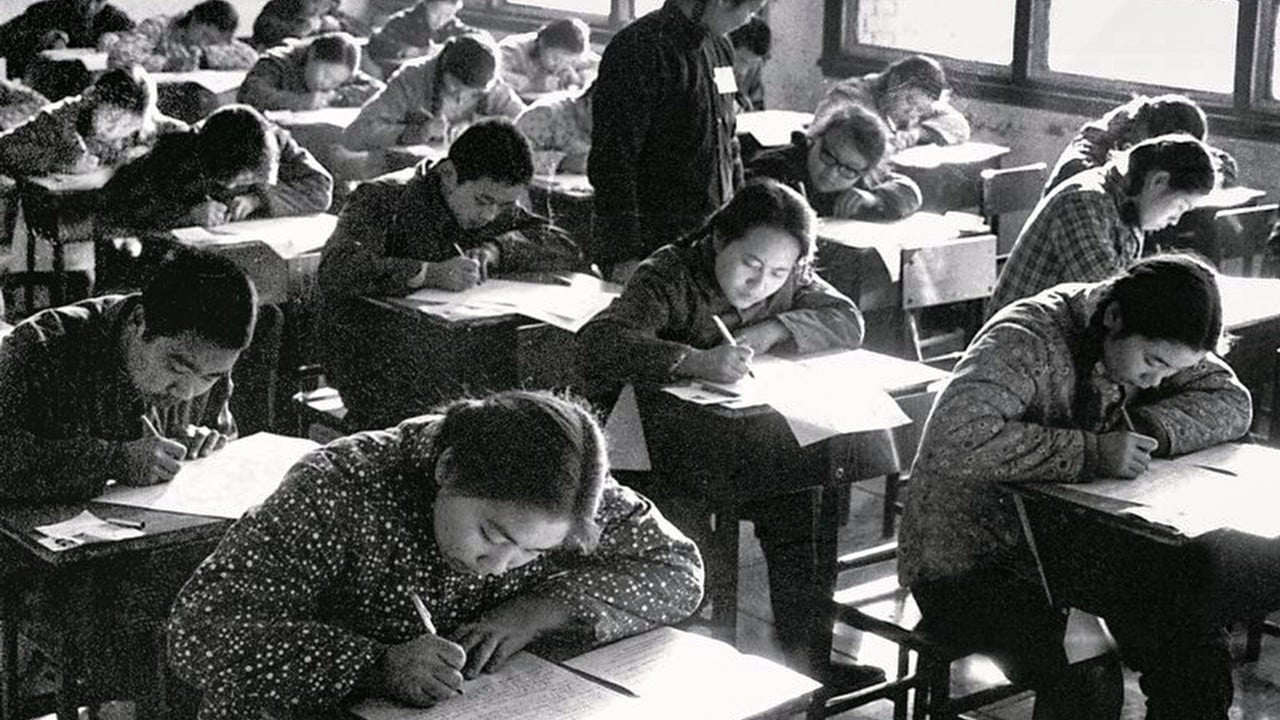
Imagine a single exam that dictates where you live, how much money you make, and who you marry. Every June, China basically grinds to a halt for it. Construction sites go silent near testing centers. Traffic is rerouted. Police escorts rush stressed teenagers who forgot their ID cards to exam halls.
This is the Gaokao.
It's the world's largest standardized test, and calling it high-stakes doesn't even do it justice. For over 10 million students every year, this grueling three-day ordeal is the definitive finish line of a 12-year academic marathon. But the Gaokao is not just an educational hurdle. It's a massive, state-sponsored sorting mechanism that dictates social mobility and shapes human aspirations across the world's second-largest economy. If you want to understand how modern China actually works behind the shiny GDP numbers, you have to look at this test.
The Ghost of the Imperial Court
To understand why the Gaokao holds such a vice grip on the Chinese psyche, you have to realize this isn't a modern invention. It's the direct descendant of the keju—the imperial civil service examination system established around 600 CE during the Sui dynasty.
For over 1,300 years, the keju was the only way a peasant boy from a rural village could theoretically rise to become a high-ranking imperial official. It created a deep, foundational cultural belief: education, measured by an objective and brutal test, is the ultimate equalizer.
When the Communist Party resumed the Gaokao in 1977 after the chaos of the Cultural Revolution, it tapped right back into that ancient DNA. Economists Ruixue Jia and Hongbin Li, authors of the landmark 2025 study The Highest Exam, describe the system as a "centralized hierarchical tournament." You aren't just trying to pass; you're trying to out-rank every other soul in your province.
The transparency of a single, cold score is exactly why the public trusts it. In a society where people often worry about guanxi (personal connections) and corruption favoring the wealthy, a standardized test score can't be bribed or sweet-talked. It is viewed as a brutal but fair game.
The Illusion of Perfect Meritocracy
But here's what most people get wrong about the Gaokao: they think it's perfectly fair just because everyone takes the same test on the same day. Honestly, it's not that simple. The system hides massive structural inequalities right in plain sight.
The biggest culprit is the provincial quota system. The central government allocates a specific number of university slots to each province. Elite universities, like Tsinghua and Peking University, are based in Beijing. Unsurprisingly, they allocate a disproportionate number of spots to students with Beijing residency (hukou).
A student with a Beijing residency can score dozens of points lower on the exact same exam than a student from a rural province like Henan or Shandong and still get into a top-tier university.
This creates an intense regional lottery. If you are born in a resource-starved province with a massive population, your path to upward mobility is exponentially steeper.
Furthermore, wealthy urban parents don't just sit back and rely on raw talent. They engage in a hyper-competitive arms race of private tutoring, elite high school placements, and test-prep strategies known as shuati (flooding the student with endless practice drills). Urban kids are essentially armed with high-tech gear, while rural kids are fighting the same tournament with basic tools.
The Mental Toll of Involution
You can't talk about the Gaokao without talking about neijuan—a term often translated as "involution." It basically means hyper-competition where everyone pumps in massive amounts of extra effort, but the total number of rewards stays exactly the same. It's running on a treadmill that keeps getting faster.
Students routinely study 12 to 14 hours a day. The pressure is crushing. A famous 2010 study by researcher Hesketh and colleagues found that 81% of Chinese schoolchildren worried "a lot" about exams. This stress doesn't magically disappear when they turn 18. The intense focus on rote memorization and test-taking algorithms means that creative passions are ruthlessly shelved. Dancers, painters, and musicians frequently abandon their talents because those skills won't give them a competitive edge on the general exam track.
What Happens When the Ladder Breaks
For decades, the unwritten social contract in China was straightforward: survive the Gaokao, get into a good university, and secure a comfortable middle-class life. That contract is fracturing.
With the massive expansion of university enrollment over the last two decades, a college degree no longer guarantees a lucrative career. Young graduates are facing a tough job market, leading to a phenomenon called "Kong Yiji"—named after a famous fictional scholar who refused to take off his academic robes even though he lived in poverty.
Yet, despite the diminishing financial returns of a college degree, families still pour their life savings into Gaokao prep. Why? Because the alternative feels like a drop into the economic abyss. The exam has evolved from a proactive pathway toward unimaginable wealth into a reactive fallback mechanism to prevent falling down the social ladder.
Interestingly, recent longitudinal data shows that educational aspirations remain incredibly high among Chinese youth, particularly among young women. Girls consistently report higher educational aspirations than boys, viewing academic achievement as their absolute best shot at autonomy and self-actualization in a traditionally patriarchal framework.
Your Next Moves If You Want to Truly Understand the System
If you're looking at this from the outside and trying to grasp how this system impacts global talent, business, and policy, don't just look at aggregate test scores. Focus on these concrete realities instead:
- Watch the internal migration patterns: Wealthy families are increasingly engaging in "Gaokao migration," buying apartments in provinces or cities with lower admission cutoffs just to give their kids an edge.
- Track the surge in overseas studies: As the domestic tournament becomes a pressure cooker of involution, a growing segment of upper-middle-class families are opting out entirely, choosing international schools and foreign universities as a parallel pathway.
- Monitor the vocational tracking shifts: The government is actively trying to divert about 50% of students into vocational tracks during junior high school to ease the academic bottleneck, a move that is met with massive resistance from parents who see it as a premature end to their children's social mobility aspirations.
The Gaokao remains the ultimate mirror of Chinese society. It is simultaneously an engine of incredible national development, a psychological pressure cooker, and a brilliant tool of state governance that keeps the population invested in a singular, standardized definition of success.