Walk into any suburban sports bar in Austin, Columbus, or Charlotte on a crisp autumn Saturday, and you know exactly what you will find. The air smells of fryer grease and draft beer. A dozen screens flash with the blinding neon of American college football. The crowd moves in a choreographed, tribal unison, fueled by generations of regional loyalty.
But if you walked into one of those same bars on a random Tuesday morning in the summer of 2024, or a Saturday morning in the spring of 2026, you would have witnessed a quiet, seismic shift.
The screens were still on. The people were still shouting. But the ball was round. The grass was green, not marked by yard lines every ten paces. And the accents screaming from the speakers belonged to Manchester, Madrid, and Munich.
For decades, sports executives spoke about soccer in the United States the way meteorologists talk about a low-pressure system on the horizon. It was always coming. "The sport of the future," they called it, a patronizing title that safely kept it from disrupting the present.
That future arrived while we were looking the other way. It didn't happen because of a sudden corporate marketing blitz, and it didn't happen overnight. It happened on the ground, in the living rooms of families who realized their weekends had been entirely rewritten.
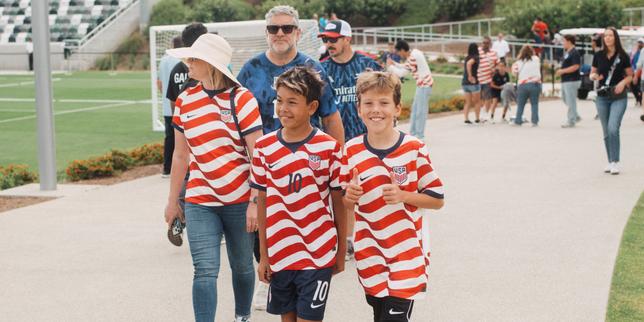
Let us look at a family like the Millers. They live just outside Atlanta. Ten years ago, Tom Miller spent his autumns obsessing over SEC football. His Saturdays were sacred, dictated by kickoff times and tailgate menus. Today, Tom still watches those games, but his alarm clock is set for 7:30 AM every Saturday for a different reason. His thirteen-year-old daughter, Maya, is already awake, wearing a vibrant pink Inter Miami jersey. Together, they watch a tiny, aging magician from Argentina pull off miracles in south Florida, before sprinting out the door so Maya can make her own 11:00 AM club match.
Tom’s Saturdays are no longer defined by the gridiron. They are measured in halves, pitches, and nil-nil draws that somehow feel like life or death.
The Illusion of the Empty Stadium
The skeptics always pointed to the domestic league. Major League Soccer (MLS), founded in the wake of the 1994 World Cup, spent its infancy playing in cavernous, mostly empty American football stadiums. The sight of five thousand fans rattling around a seventy-thousand-seat arena created a persistent illusion of failure.
It was a branding scar that took decades to heal.
What the critics missed was the structural foundation being poured beneath the surface. Soccer did not conquer America by forcing people to love MLS; it conquered America by giving them access to the global stage.
The turning point was structural and digital. When NBC acquired the broadcast rights to the English Premier League in 2013, they did something radical. They didn't relegate the games to obscure, premium channels. They put them on mainstream television on Saturday and Sunday mornings. Suddenly, American sports fans discovered a beautiful loophole in their weekend schedules. You could watch world-class, high-stakes sports at 8:00 AM, feel the adrenaline spike, and still have your entire afternoon free.
It became a lifestyle hack.
By the time streaming platforms took over the media landscape, the appetite had grown voracious. Apple TV’s massive ten-year deal with MLS, signed ahead of the 2023 season, proved that tech giants saw the sport not as a niche hobby, but as a primary engine for subscriber growth.
Then came the catalyst.
When Lionel Messi signed with Inter Miami in the summer of 2023, the abstract concept of "soccer growth" became an undeniable reality. Ticket prices for standard league matches skyrocketed from forty dollars to thousands. Celebrities who wouldn't be caught dead at a traditional soccer match suddenly occupied courtside-style seats in Fort Lauderdale.
But the Messi effect was just a symptom of a deeper, structural evolution. The real metrics of the sport's American takeover are found in the shifting demographics of wealth and youth.
The Boardroom and the Playground
Consider the money. Traditional American sports leagues are closed shops, heavily regulated by salary caps and draft systems. They are predictable businesses. European football, by contrast, is a high-stakes, wild-west ecosystem driven by promotion, relegation, and global transfer markets.
American billionaires looked across the Atlantic and saw an undervalued asset class.
Today, a staggering number of English Premier League clubs are owned, either wholly or through significant minority stakes, by American investors. From Liverpool and Manchester United to smaller clubs like Bournemouth, American capital is driving the global game. These investors are not operating out of charity or a sudden love for the offside rule. They see a sport that is completely uncoupled from the geographic limitations of the NFL or MLB. A baseball team in Cincinnati struggles to find fans in Tokyo. A football club in London can cultivate millions of loyal followers in Jakarta, New York, and Lagos simultaneously.
At the same time, the domestic youth landscape underwent a quiet revolution.
For generations, the standard American youth sports trajectory was simple: Little League baseball in the spring, pop warner football in the fall. But as medical data regarding concussions and chronic traumatic encephalopathy (CTE) became impossible for parents to ignore, the football pipeline began to fray at the edges. Parents who grew up nursing their own sports injuries looked at the fluid, continuous movement of soccer and saw a safer, more dynamic alternative for their children.
According to data from the Aspen Institute’s Project Play, soccer has consistently ranked as one of the most popular team sports for children under the age of twelve. But for years, there was a disconnect. Children played soccer until they hit high school, then abandoned it to watch the NBA or the NFL. The sport was a babysitting tool, not a cultural obsession.
That disconnect has vanished.
The kids who played in the early 2000s are now thirty-something parents with disposable income. They didn't drop the sport. They brought it into their homes, passed it to their children, and made it a core component of their identity. They are a generation that grew up playing FIFA on their Xbox consoles, learning the names of obscure Spanish midfielders before they knew the roster of their local baseball team.
The Great Cultural Convergence
To understand why football fever has finally taken hold, you have to look at the changing face of the nation itself. The United States is not the same country that hosted the World Cup in 1994. It is more diverse, more interconnected, and far more receptive to global culture.
The Hispanic population in the U.S. has grown exponentially over the last three decades. For millions of these citizens, soccer is not a new trend to be analyzed; it is a cultural inheritance. The passion for Liga MX, the top Mexican division, routinely draws television ratings in the United States that rival or surpass standard MLB or NBA regular-season games.
This isn't a subculture anymore. It is the mainstream.
When you walk through the streets of Los Angeles, Miami, or New York, the jerseys tell the story. You see the classic white of Real Madrid, the blue and red of Barcelona, the black and gold of LAFC. They are worn as fashion statements, badges of cultural literacy, and symbols of a connected world.
The old argument was that Americans would never love a game that could end in a 0-0 tie. We are a nation of excess, the critics said. We want points, explosions, constant commercial breaks, and statistical overloads.
But that critique misread the modern American consumer.
In an era of fractured attention spans, where every piece of media is interrupted by ads and algorithms, soccer offers something increasingly rare: ninety minutes of uninterrupted, continuous narrative. There are no timeouts. There are no commercial breaks during play. The game forces you to present, to watch the space develop, to appreciate the tension that builds over forty minutes of tactical chess before exploding into a single, breathtaking moment of release.
It is the ultimate reality television.
The Invisible Stakes of 2026
All of this brings us to a moment of historical convergence. The United States, alongside Canada and Mexico, is hosting the 2026 FIFA World Cup.
This is not 1994. When the tournament arrived thirty-two years ago, the organizers had to explain the basic rules of the tournament to the public. The event was treated like a traveling circus—spectacular, exotic, but ultimately foreign.
The 2026 tournament arrives in a country that is already primed, intoxicated, and waiting.
The stakes are no longer about proving that soccer can survive in America. The stakes are about determining just how much of the traditional sports landscape it will consume. The tournament will feature forty-eight teams, hundreds of thousands of international travelers, and matches played in the secular cathedrals of American sports—structures like MetLife Stadium and AT&T Stadium, built for American football, now temporarily converted into temples for the global game.
Consider what happens when a child watches their city become the epicenter of the sporting universe.
Imagine a ten-year-old boy in Philadelphia, walking past Lincoln Financial Field, seeing tens of thousands of fans from Brazil, France, or Japan singing in the streets. That child does not see a foreign sport. He sees the world coming to his doorstep. He sees the ultimate expression of human drama, played out on a patch of grass.
The old guard of American sports broadcasting is watching this shift with a mixture of awe and anxiety. The NFL remains an undisputed titan, a cultural monopoly that dominates television ratings like nothing else in American life. But monopolies are vulnerable to shifts in generational taste. The young audiences that advertisers covet are increasingly turning away from five-hour baseball games and four-hour football broadcasts punctuated by endless truck commercials.
They want speed. They want global relevance. They want a sport that reflects the diverse, interconnected world they inhabit online every single day.
The Final Whistle
The transformation is visible in the smallest details. It is in the craft beer bar in Portland that opens at 6:00 AM on a rainy November morning, its stools filled with people shivering in wool scarves. It is in the community fields in Atlanta where late-night adult leagues play under temporary floodlights long after the baseball diamonds have gone dark.
It is in the way we talk, the shirts we wear, and the dreams our children have when they close their eyes.
We spent decades debating whether soccer would ever make it in America, looking for a single definitive moment—a specific match, a signing, a television rating—that would signal its arrival.
But culture doesn't move in a straight line, and it doesn't wait for permission.
The debate is over because the landscape has already been reset. The fever didn't just take hold; the patient changed entirely. The United States is no longer an island isolated from the passions of the rest of the planet. We are part of the global roar.
The next time you hear the distant sound of a crowd chanting in unison early on a Saturday morning, don't mistake it for a passing trend. It is the sound of an empire's sporting soul being quietly, permanently rewritten.