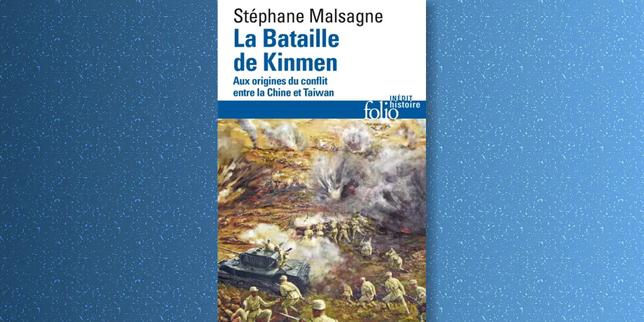
In late October 1949, just weeks after Mao Zedong proclaimed the founding of the People's Republic of China in Beijing, the Chinese Communist Party suffered a devastating, bloody defeat on a barren speck of rock two miles off the coast of Fujian. The Battle of Kinmen—known in mainland China as the Battle of Guningtou—halted the People's Liberation Army (PLA) cold, saved Chiang Kai-shek's retreating Nationalist regime from total annihilation, and drew the geopolitical fault line across the Taiwan Strait that still threatens global stability today.
French historian Stéphane Malsagne recently brought this overlooked clash back into focus, examining how a three-day amphibious bloodbath birthed the modern China-Taiwan conflict. Yet looking closely at the military mechanics, intelligence failures, and post-battle mythmaking reveals something far deeper than a simple Nationalist upset. Kinmen was not merely a lucky defensive stand. It was a catastrophic failure of Communist hubris colliding with desperate Nationalist adaptation—and a tactical blueprint whose lessons both Beijing and Taipei still misread at their peril.
The Myth of the Unstoppable Tide
To understand why the PLA walked into a meat grinder at Kinmen, you have to strip away decades of victorious Communist historiography. By October 1949, the PLA's Third Field Army, commanded by General Su Yu and operationally led in Fujian by General Ye Fei, was drunk on momentum. They had shattered Nationalist armies across Manchuria and the Huaihai plain. Cities were falling without a shot fired. Nationalist commanders were defecting in droves, taking entire divisions with them.
From Ye Fei's headquarters in Xiamen, Kinmen looked like an afterthought. The island sat barely ten kilometers from the mainland coast, practically blocking the mouth of Xiamen Bay. Leaving it in Nationalist hands was intolerable, both militarily and psychologically. Beijing wanted the remnant Nationalist forces wiped out before they could consolidate on Taiwan, roughly 130 miles to the east.
That overconfidence bred fatal sloppiness. PLA planners treated Kinmen as just another river-crossing operation, similar to the Yangtze crossing earlier that spring. They ignored the brutal reality of open-water amphibious warfare.
They had no dedicated landing craft. None. Instead, the PLA requisitioned roughly 300 wooden fishing junks and sampans from local Fujianese fishermen, many of whom were pressed into service against their will. The troops slated for the assault—drawn from the 28th Army—were battle-hardened inland infantrymen from Shandong and northern China. Most had never seen the ocean, let alone practiced disembarking under machine-gun fire in treacherous coastal tides.
Three Days of Mud, Tide, and Steel
The assault began in the pitch dark of October 25, 1949, at 2:00 AM. Approximately 9,000 PLA troops pushed off toward the northern coast of Kinmen, aiming for the beaches around Guningtou.
Everything that could go wrong did.
Strong northeastern winds and unfamiliar currents scattered the wooden flotilla. Units lost cohesion before they even saw the shoreline. Worse, PLA intelligence had completely misjudged the island's garrison. Communist commanders believed Kinmen was held by roughly 12,000 demoralized, broken Nationalist troops ready to surrender at the first sign of pressure. In reality, Chiang Kai-shek had quietly reinforced the island with the 12th Army Group under General Hu Lian, bringing the defending force to roughly 40,000 men—including battle-tested units equipped with American-supplied M5A1 Stuart light tanks.
The first wave hit the beaches and immediately ran into a wall of fire. At low tide, the wooden junks grounded on the tidal flats. As the tide receded further, those vessels were left stranded in the mud. At dawn, Nationalist air and naval units swept in, systematically bombing and shelling the immobilized boats to splinters.
Those 9,000 PLA soldiers on the beach were now completely cut off. No reinforcements could reach them. No evacuation was possible.
What followed was fifty-six hours of savage, close-quarters attrition. The PLA fighters, true to their reputation for ferocity, dug into the coastal dunes and the stone villages of Guningtou, fighting house-to-house with grenades, bayonets, and captured ammunition. For a few hours on the first morning, they pushed dangerously close to the island's central command post.
Then came the armor. The Nationalist 3rd Tank Regiment rolled their M5A1 Stuarts straight onto the beaches and into the narrow alleys of Guningtou. The PLA assault force had brought almost no heavy anti-tank weapons; they had expected to capture heavy gear from fleeing Nationalists. Soldiers threw bundle charges and satchels of explosives against the steel hulls, occasionally disabling a tank, but the armor proved decisive. Combined with naval gunfire from Nationalist destroyers offshore and continuous strafing runs by P-51 Mustangs, the tanks broke the back of the landing force.
By the morning of October 27, the surviving PLA troops were pinned against the cliffs at Beishan. Out of ammunition, water, and food, the remnants surrendered or were killed. Roughly 5,000 PLA soldiers died on Kinmen; nearly 4,000 were taken prisoner. For Mao Zedong's forces, it was the single worst defeat of the entire Chinese Civil War.
The Japanese Ghost in the Nationalist Command
One of the most uncomfortable truths scrubbed from official Taipei histories for decades—and a detail historians like Malsagne help bring out of the shadows—is who actually helped plan the defense of Kinmen.
Chiang Kai-shek's army in 1949 was crippled by systemic corruption, fractured command chains, and chronic incompetence. Yet at Kinmen, the Nationalist defense exhibited tight coordination between infantry, armor, artillery, and air support. Part of that credit belongs to General Hu Lian, one of the few genuinely capable field commanders in the Republic of China (ROC) army.
Another part belongs to the White Group (Baituan).
In 1949, desperate for competent military planners, Chiang secretly recruited former officers of the Imperial Japanese Army—men who had fought against China only four years earlier. Led by former Lieutenant General Hiroshi Nemoto, who arrived on Kinmen under a Chinese alias just weeks before the battle, these Japanese advisers analyzed the terrain, predicted the exact landing beaches around Guningtou, and reorganized the island's defensive fire zones.
Nemoto understood amphibious defense from the Pacific War. He knew that an attacker lacking naval and air supremacy had to be destroyed at the water's edge before they could establish a deep perimeter. The tactical placement of the Stuart tanks and the pre-registered artillery zones bore the unmistakable fingerprint of Japanese doctrine. Both Beijing and Taipei had strong political reasons to bury this fact—Beijing to avoid admitting it lost to its old imperial enemy, and Taipei to preserve the myth of a purely Nationalist triumph—but the operational reality is indisputable.
How Kinmen Rewired Cold War Geopolitics
The immediate tactical result of the Battle of Kinmen was the survival of the Nationalist government. Had Kinmen fallen in October 1949, Xiamen Bay would have been completely open. The PLA would have immediately pivoted its entire southern staging apparatus toward Taiwan. At that exact moment, Washington had effectively written Chiang Kai-shek off. The Truman administration had published its infamous "China White Paper" in August 1949, washing its hands of the Nationalist regime and expecting Taiwan to fall by mid-1950.
Kinmen bought Chiang eight months.
Those eight months changed the world. By June 1950, when North Korea invaded South Korea, Taiwan was still standing. President Harry Truman reversed course overnight, ordering the U.S. Seventh Fleet into the Taiwan Strait to neutralize the conflict and prevent a Communist invasion. Without the bloody sandbar victory at Kinmen, there would have been no Republic of China left on Taiwan for the Seventh Fleet to protect.
Yet Kinmen also trapped both sides in a bizarre, decades-long geographic paradox.
Look at a map of the Taiwan Strait today. Kinmen sits right in mainland China's backyard—you can literally see the skyscrapers of Xiamen across the water with the naked eye—while Taipei lies nearly two hundred miles away across rough open sea. Militarily, Kinmen was an exposed salient, nearly impossible to supply under a full blockade. Politically, however, Chiang Kai-shek refused to abandon it. To Chiang, holding Kinmen and the nearby Matsu islands proved the Republic of China was still a mainland power, not merely an island exile.
This stubbornness sparked the First and Second Taiwan Strait Crises in 1954 and 1958, when Mao unleashed massive artillery barrages onto Kinmen—firing nearly half a million shells in forty-four days during 1958 alone—bringing the United States and the Soviet Union to the brink of nuclear confrontation.
The Dangerous Lessons Beijing and Taipei Still Draw
Modern military analysts love historical analogies, and the Battle of Kinmen gets trotted out every time tensions flare in the Indo-Pacific. Usually, both sides draw the wrong conclusions.
In Taiwan, Kinmen has been romanticized into a comforting national myth—proof that a smaller, determined democratic force can throw a massive Chinese invasion back into the sea. That narrative is dangerously outdated. The PLA of 1949 was a peasant infantry army crossing the water in wooden fishing boats with zero air cover and no naval artillery. The modern PLA Rocket Force, Navy, and Air Force possess thousands of precision ballistic missiles, advanced amphibious assault ships, long-range drones, and overwhelming electronic warfare capabilities. Relying on the spirit of Guningtou against modern combined-arms warfare is a recipe for disaster.
At the same time, Beijing's strategists face the exact same fundamental physics that doomed Ye Fei's troops in 1949—only scaled up by orders of magnitude.
Amphibious invasions remain the most complex, unforgiving military operations in human history. The geography of the Taiwan Strait has not changed. Predictable weather windows, violent currents, limited viable landing beaches, and the sheer logistical nightmare of sustaining tens of thousands of troops across open water under fire remain brutal constraints. In 1949, the PLA underestimated the water, misread the defender's resolve, and assumed political collapse would do the heavy lifting for their infantry.
Today, Kinmen itself is a quiet, surreal place. Tourists buy kitchen knives forged from the steel of unexploded 1958 Communist artillery shells. Ferries run back and forth between Kinmen and Xiamen carrying commuters and shoppers, knitting the island's local economy tightly to the mainland just across the channel. In the event of a modern conflict, Kinmen would likely be bypassed, isolated, or swallowed within hours.
Its real legacy sits further east, across the deep water of the Strait. Every time Beijing calculates the cost of a cross-strait invasion—weighing the terrifying attrition of contested beaches against the political catastrophe of a failed landing—the ghosts of 9,000 stranded soldiers on the mudflats of Guningtou are still sitting at the planning table.