The identification of Anne Boleyn’s physical likeness is not an aesthetic debate but a problem of forensic reconstruction hindered by a 16th-century state-sponsored damnatio memoriae. When Henry VIII executed his second queen in 1536, the subsequent systematic destruction of her portraits created a vacuum in the historical record. Modern attempts to "find" Anne’s face must navigate a hierarchy of evidence that ranks contemporary artifacts against posthumous propaganda. To determine what she actually looked like, we must apply a logical filter to the surviving visual data, categorizing sources by their proximity to the subject and their mechanical reliability.
The Hierarchy of Visual Evidence
Analyzing Anne Boleyn's appearance requires a three-tiered classification of extant sources. Most popular historical discussions fail because they weight all portraits equally, neglecting the political and social incentives that dictated how an image was produced.
- Tier 1: Contemporary Primary Sources. These are objects created during Anne's lifetime (1501/7–1536) where she was the intended subject. This category is the smallest but carries the highest evidentiary weight.
- Tier 2: Contemporary Written Descriptions. Verbal accounts from those who saw her provide a check against idealized portraiture, though these are often skewed by the observer's political bias.
- Tier 3: Posthumous Elizabethan Reconstructions. These portraits were painted during the reign of her daughter, Elizabeth I. While they likely drew on lost originals, they served a specific dynastic function: rehabilitating Anne’s image to legitimize Elizabeth's crown.
The Moost Happi Medal: The Only Definitive Anchor
The 1534 "Moost Happi" medal, currently held in the British Museum, represents the only undisputed contemporary image of Anne Boleyn. Because it is a prototype for a commemorative coin, its purpose was mass-reproduction of her profile. Unlike a painting, which can be altered or misidentified over centuries, the medal’s inscription identifies the subject explicitly.
The medal reveals a specific cranial and facial structure:
- Prominent Cheekbones: The high relief shows a defined zygomatic arch.
- Strong Jawline: A squared mandibular structure that contradicts the softer, oval faces favored in Tudor beauty standards.
- Slightly Receding Chin: A distinctive profile trait that appears consistent across more reliable later copies.
The physical condition of the medal is poor; it is worn and damaged. However, in 2011, facial recognition researchers and historians utilized high-resolution 3D scanning to reconstruct the profile. This data provides a biometric baseline. Any portrait claiming to be Anne Boleyn must correlate with these specific skeletal markers.
The Hever and National Portrait Gallery Discrepancy
The most famous "B" necklace portraits—housed at the National Portrait Gallery (NPG) and Hever Castle—are the primary sources of the public’s mental image of Anne. These are Tier 3 sources, painted decades after her death.
The NPG portrait displays a long, thin face with dark hair and eyes. However, dendrochronological analysis (tree-ring dating of the wood panels) proves these were painted in the late 16th century. This creates a logical bottleneck: these are not snapshots, but interpretations. The artist's objective was to portray a "Queen Mother" for the Elizabethan era.
The "B" necklace itself is a point of contention. While it serves as a helpful identifier, it also functions as a visual brand. In Tudor semiotics, jewelry often signaled status or lineage rather than individual likeness. The prevalence of this specific image suggests it was based on a lost original from the 1530s, likely one of the few that escaped Henry VIII's purge.
The Holbein Drawings: A Failure of Attribution
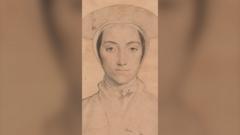
Hans Holbein the Younger was the preeminent documentarian of the Tudor court. His sketches are renowned for their brutal realism, often capturing facial flaws that stylized paintings ignored. Two specific sketches in the Royal Collection are frequently debated as potential likenesses of Anne Boleyn.
The Parker Drawing
Labelled "Anna Bollein Queen" in a later hand, this sketch shows a woman in a nightgown with a relatively soft, rounded face. Skeptics argue that the facial structure does not match the Moost Happi medal. The chin is too full, and the nose lacks the specific bridge structure seen in the 1534 profile. Furthermore, the label was added long after the drawing was made, likely during the reign of Edward VI or Mary I, when the scribes were already working from memory or hearsay.
The Wyatt Drawing
A second Holbein sketch, often associated with the Wyatt family (Anne’s close associates), shows a woman with more angular features. The cheekbone structure aligns more closely with the 1534 medal. However, without a definitive contemporary label, this remains a statistical probability rather than a proven fact.
Written Accounts and the "Plainness" Variable
We must reconcile the visual record with contemporary descriptions, specifically those of the Venetian Ambassador, Francesco Sanuto. Writing in 1532, Sanuto described Anne as "not one of the handsomest women in the world," noting her "swarthy complexion" and "long neck."
This creates a conflict with the porcelain-skinned versions found in the Elizabethan portraits. The term "swarthy" in a 16th-century context often meant she was olive-skinned or darker than the pale ideal of the time. This suggests that Anne’s appeal was not based on the traditional symmetry of beauty but on "esprit"—animation, intelligence, and presence.
The presence of a "sixth finger" or large moles, frequently cited in Catholic propaganda (notably by Nicholas Sanders), can be dismissed as political fiction intended to frame her as a witch. No contemporary medical or court records mention physical deformities, which would have been impossible to hide in the high-stakes environment of the Queen's chambers.
The Cost Function of Identification: Genetic and Digital Frontiers
The search for Anne’s face has shifted from art history to forensic science. There are two primary avenues for future verification:
- Facial Recognition Mapping: Algorithms can now compare the "Moost Happi" medal’s geometry against every unidentified Tudor-era portrait. This process has already suggested that several "Unknown Lady" paintings in private collections may actually be Anne, based on the distance between the eyes, the height of the forehead, and the angle of the jaw.
- The DNA Limitation: While the remains of those buried in the Chapel of St. Peter ad Vincula were exhumed in the 19th century, they were poorly handled. Identifying Anne’s specific remains would require mitochondrial DNA testing against known descendants of her sister, Mary Boleyn. Even then, the ethical and legal hurdles of disturbing a Royal Chapel make this unlikely.
The Strategic Assessment of Identity
To understand Anne Boleyn's appearance, one must move past the desire for a photographic likeness and accept a composite reality. The most accurate reconstruction is achieved by overlaying the skeletal data of the 1534 medal with the coloring and features described by Sanuto, while using the NPG portraits only as a guide for her fashion and status markers.
The "true" Anne Boleyn was likely a woman of sharp, unconventional features and a darker complexion than the Elizabethan "White Queen" myth suggests. Her image was a tool of statecraft both in life and death; her husband destroyed it to erase her, and her daughter recreated it to survive.
The final strategic takeaway for historians and enthusiasts is to prioritize the Moost Happi medal as the only high-integrity data point. Any portrait that deviates significantly from that medal's jaw and cheekbone structure is a later fabrication or a misattribution. When assessing Tudor iconography, the mechanical evidence of a struck medal consistently outclasses the subjective brushstrokes of a posthumous tribute.