The press release cycle for the "world's first flying car" is the most successful recurring scam in the history of Silicon Valley.
Every eighteen months, a new startup emerges from a hangar in San Jose or Santa Clara, backed by a billionaire who grew up watching The Jetsons, claiming they have finally solved the commute. This time, it’s Alef Aeronautics. Before that, it was Joby. Before that, Terrafugia. The narrative is always identical: "Tired of gridlock? Just lift off and glide over the peasants in their Toyotas."
It’s a seductive lie. It’s also a physical and regulatory impossibility that ignores the most basic laws of fluid dynamics and urban planning.
The industry wants you to believe we are on the cusp of a transportation revolution. In reality, we are just watching the rebranding of the helicopter—only this time, it’s less efficient, harder to certify, and built on a foundation of venture capital hallucinations.
The Physics of Failure
The fundamental problem with the "flying car" is that it tries to be two things and ends up being terrible at both.
To be a good car, a vehicle needs weight for stability, crumple zones for safety, and a gearbox that can handle stop-and-go friction. To be a good aircraft, a vehicle needs to be incredibly light, aerodynamic, and capable of generating massive amounts of lift. These two sets of engineering requirements are diametrically opposed.
When you try to merge them, you get a "car" that is too heavy to fly efficiently and an "aircraft" that is too fragile to drive on a highway.
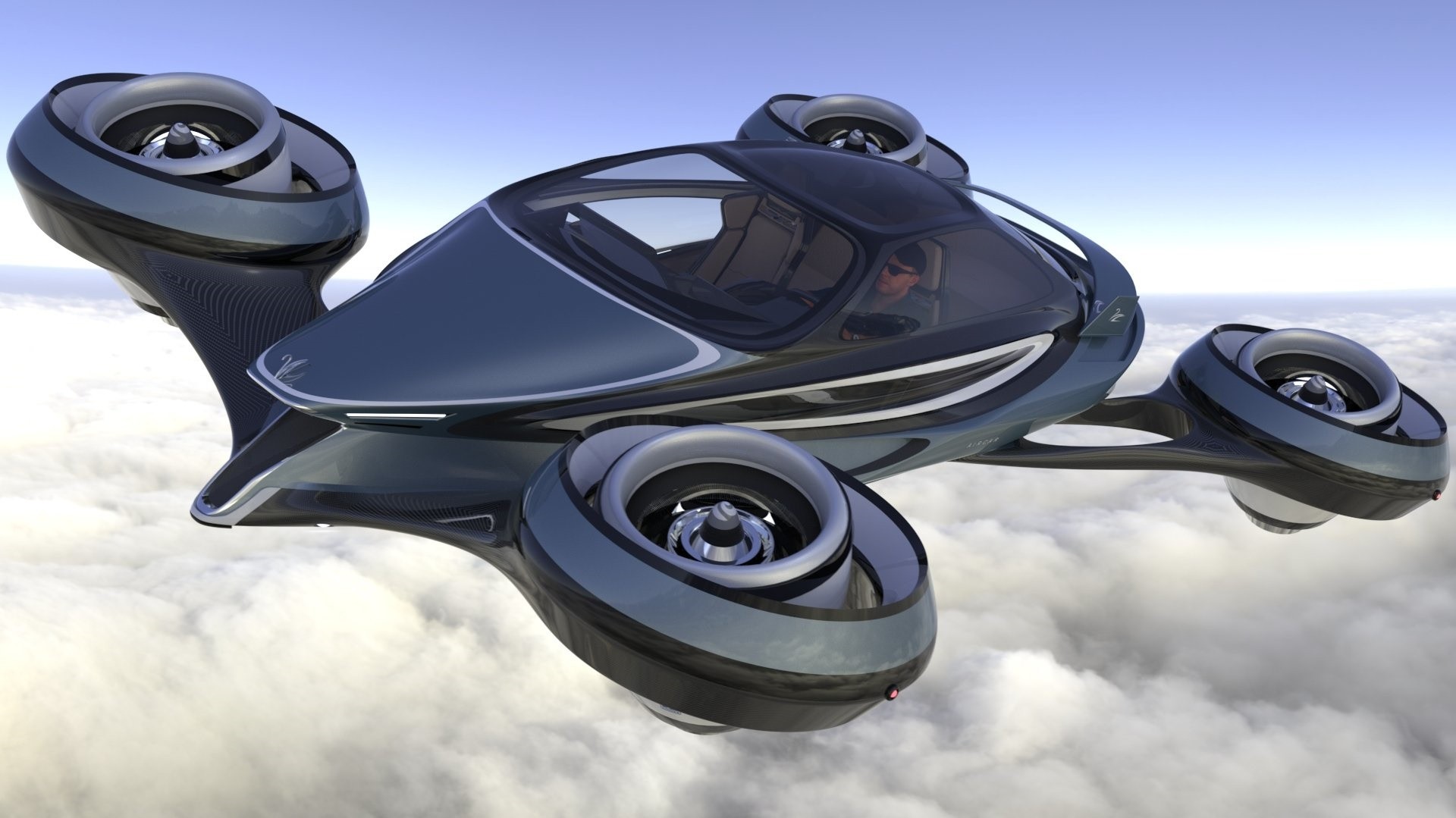
Take the Alef Model A, the current darling of the California tech press. It looks like a sleek, mesh-covered sports car that hides eight propellers beneath its skin. The marketing says it can lift off vertically and then pivot to fly forward. It’s a beautiful concept. It’s also a nightmare of power-to-weight ratios.
Generating enough vertical thrust to lift a 2,000-pound object from a dead stop is an energy-intensive process. A standard electric vehicle (EV) battery is already struggling with the weight of its own cells just to move laterally. Now, ask that same battery to overcome Earth's gravity entirely.
The math doesn't work. The energy density of current lithium-ion batteries is roughly $250 \text{ Wh/kg}$. For a truly viable, long-range flying car, you would need closer to $1,000 \text{ Wh/kg}$ just to make it past the safety reserves required by the FAA.
Unless these companies have secretly cracked cold fusion, your "flying car" will have the range of a glorified golf cart the moment it leaves the ground.
Why eVTOL Is Just a Fancy Way to Say "Loud Helicopter"
The industry has moved away from the term "flying car" and toward eVTOL (Electric Vertical Takeoff and Landing). It sounds smarter. It sounds more clinical. It sounds like something that belongs in 2026.
But it’s just a helicopter with more points of failure.
- Noise Pollution: If you think your neighbor's lawnmower is annoying at 7:00 AM, imagine twenty thousand eVTOLs buzzing over your neighborhood. The pitch of high-frequency electric motors is arguably more grating than the low rumble of a traditional turbine.
- The Downwash Problem: Physics dictates that to stay in the air, you must push air down. A lot of it. Launching a three-ton vehicle from a suburban driveway would sandblast the paint off every car on the block and turn your lawn into a dust bowl.
- The "One-Bird" Rule: Helicopters are notoriously difficult to fly and maintain. Adding more rotors doesn't necessarily make things safer; it just adds more complexity. Each motor, speed controller, and propeller blade is a potential point of catastrophic failure.
I’ve spent a decade watching venture capitalists throw money at "disruptive" hardware. I saw $100 million evaporate in the early days of personal jetpacks. I saw the Hyperloop become a glorified sewer pipe for Teslas. The eVTOL sector is the same movie, just with a different soundtrack.
The FAA Does Not Care About Your IPO
The biggest hurdle for the California dreamers isn't gravity; it’s the Federal Aviation Administration (FAA).
Silicon Valley’s "move fast and break things" philosophy is a death sentence in aviation. In the software world, if your app crashes, you restart the server. In the aviation world, if your craft "crashes," people die.
The FAA is one of the most conservative regulatory bodies on the planet for a reason. Their certification process for a brand-new type of aircraft—especially one that intends to fly over densely populated urban areas—takes years, if not decades.
- Type Certification: Proving the design is safe.
- Production Certification: Proving you can build every single one exactly the same way.
- Airworthiness: Proving each individual unit is fit to fly.
The "flying car" startups are currently stuck in the first phase. Even if they get a special airworthiness certificate (which some have), that’s essentially a "learner’s permit" that restricts where, when, and how you can fly. It’s a far cry from the "door-to-door" promise they use to lure in pre-orders.
The Sky Is Not an Empty Highway
The most persistent myth in the flying car narrative is that the sky is "empty space" waiting to be used.
It’s not.
The National Airspace System (NAS) is a highly choreographed, invisible infrastructure managed by Air Traffic Control (ATC). It’s designed for predictable flight paths between established airports.
If you introduce ten thousand "commuter" vehicles into a city's airspace, you create a logistical nightmare that current technology cannot handle.
- Collision Avoidance: We don't even have self-driving cars that can handle a rainy Tuesday in Seattle. How can we trust a fleet of autonomous flying cars to navigate wind shears, birds, and other aircraft in three-dimensional space?
- Infrastructure: Where do these things land? You can’t just land a flying car at a Starbucks. You need "vertiports." And those vertiports need charging grids, fire suppression systems, and security.
- The Class B Ceiling: Major cities like Los Angeles, New York, and San Francisco have restricted airspace. You can't just hop over the 405 without talking to a controller.
Imagine a scenario where thousands of affluent commuters are all trying to "merge" into the same low-altitude corridor at 8:15 AM. It wouldn't be a shortcut; it would be a mid-air bottleneck.
The Class Divide in the Clouds
Let’s be honest about who these vehicles are for.
The pre-order price for the Alef Model A is roughly $300,000. That’s not a solution for the masses; it’s a toy for the 1%.
When we talk about "solving traffic" with flying cars, we aren't talking about fixing the commute for the nurse, the teacher, or the construction worker. We’re talking about allowing the tech elite to literally fly over the crumbling infrastructure they don't want to pay taxes to fix.
Investing in flying cars is a massive distraction from the boring, proven solutions that actually work. A high-speed rail line can move fifty thousand people per hour. A flying car moves one or two.
The math of urban transit is about throughput. The flying car is the ultimate anti-throughput device. It’s an incredibly inefficient way to move a very small number of people. It’s the "private jet" of the suburbs—a status symbol wrapped in a thin veneer of "innovation."
The "Pre-Order" Mirage
Why is the media so obsessed with these companies if the tech is so flawed?
Because pre-orders are the cheapest form of marketing. When a company announces they have "$250 million in pre-orders," they aren't saying they have that money in the bank. They are saying they have a list of people who put down a refundable $150 deposit.
It’s a vanity metric designed to pump up the valuation for the next round of funding.
I’ve seen this play out with companies like Lilium and Archer. They go public via SPAC (Special Purpose Acquisition Company), the early investors get their exit, and the retail investors are left holding the bag when the reality of FAA delays and battery physics sets in.
If you really want to see the future of transportation, stop looking at the sky and start looking at the ground. Look at ebikes. Look at dedicated bus lanes. Look at the "boring" tech that actually scales.
The Fatal Flaw Nobody Mentions: Human Error
Most people can't parallel park a Honda Civic without hitting a curb. Now, we expect them to manage a multi-rotor aircraft during a crosswind?
The response from the industry is "autonomous flight." But true autonomy in aviation is significantly harder than on the ground. A car can just stop if it’s confused. An aircraft has to keep flying or it falls out of the sky.
The moment a single "flying car" malfunctions and crashes into a preschool, the entire industry will be regulated into oblivion. One mistake—one mechanical failure or software bug—and the public trust will vanish.
Aviation safety is built on a "blood-written" rulebook. Every safety regulation we have today is the result of a past tragedy. The flying car industry is trying to bypass that history with slick renders and 3D animations.
The "California company" selling you a flying car isn't selling you a vehicle. They are selling you a feeling. They are selling you the idea that you are special enough to escape the reality of the 21st-century city.
The truth is much grimmer. Even if you buy one, you won't be flying it to work. You'll be sitting in your garage, waiting for a software update, staring at a piece of machinery that is too heavy to be a car and too dangerous to be a plane.
Stop waiting for the sky to open up. Fix the roads. Expand the trains.
The dream of the flying car is a dead end.