The territorial dispute between Guyana and Venezuela represents a collision between the 19th-century colonial boundary settlements and 21st-century hydrocarbon extraction incentives. At its core, the conflict is not merely a disagreement over maps, but a struggle over the legal validity of the 1899 Paris Arbitral Award. The current proceedings at the International Court of Justice (ICJ) serve as the terminal phase of a decades-long diplomatic failure, where the "Good Offices" process of the United Nations reached its functional limit. This analysis deconstructs the geopolitical architecture of the claim, the technicalities of international law governing the dispute, and the economic variables that have transformed a dormant border friction into an existential regional crisis.
The Tripartite Framework of the Dispute
To understand the current escalation, one must categorize the conflict into three distinct operational layers: the Juridical, the Resource-Economic, and the Domestic Political.
1. The Juridical Foundation: 1899 vs. 1966
The legal crux rests on the validity of the 1899 Arbitral Award. Venezuela contends the award is "null and void," citing evidence of collusion between the British and Russian judges. Guyana’s position is anchored in the 1966 Geneva Agreement, which provided a framework for resolving the dispute without specifically nullifying the 1899 borders.
The Geneva Agreement did not settle the border; instead, it created a mechanism for settlement. When bilateral negotiations failed, the UN Secretary-General exercised his authority under Article IV of the Agreement to refer the matter to the ICJ. Venezuela’s primary legal hurdle is the principle of Res Judicata—the concept that a matter has already been adjudicated by a competent court and may not be pursued further. By challenging the ICJ's jurisdiction, Venezuela attempts to revert to bilateral negotiations where its superior military and economic weight provides greater leverage than a court of law.
2. The Resource-Economic Incentive
The discovery of the Stabroek Block offshore Guyana—estimated to contain over 11 billion barrels of oil equivalent—shifted the dispute from a symbolic territorial claim to a high-stakes economic confrontation.
- The Maritime Extension: International law generally dictates that maritime boundaries are an extension of land borders. If Venezuela successfully challenges the land border, it gains a legal basis to claim the corresponding maritime exclusive economic zone (EEZ).
- Revenue Projection: Guyana’s GDP growth, driven by the Liza Phase 1 and 2 projects, has rendered it one of the fastest-growing economies globally. Venezuela, facing systemic economic contraction and sanctioned oil infrastructure, views the Essequibo as a potential long-term hedge against its own domestic production decay.
3. Domestic Political Utility
For the Maduro administration, the Essequibo claim functions as a "Rally 'Round the Flag" mechanism. It is the only issue in Venezuelan politics that commands near-unanimous support across both the Chavista and opposition spectrums. By elevating the rhetoric, the Venezuelan government creates a high-intensity nationalist environment that can be used to justify internal security measures and distract from macroeconomic volatility.
The Mechanism of Legal Nullity: Analyzing the Mallet-Prevost Memorandum
The Venezuelan claim of "nullity" regarding the 1899 award rests heavily on the posthumous memorandum of Severo Mallet-Prevost, a lawyer for the Venezuelan side. He alleged that the 1899 decision was a political compromise rather than a legal judgment.
From a rigorous legal standpoint, a memorandum written decades after the fact by a single participant faces a high evidentiary bar at the ICJ. To overturn an established international boundary, the court requires "probative evidence" of fraud or a fundamental breach of the terms of the arbitration. Guyana’s strategy relies on the stability of borders (the principle of Uti Possidetis Iuris), arguing that a century of settled administration cannot be upended by anecdotal claims of bias.
Asymmetric Escalation: The December 2023 Referendum
Venezuela’s December 2023 consultative referendum marked a shift from legal maneuvering to administrative annexation. The creation of the "Guayana Esequiba" state and the appointment of a military governor for a territory it does not physically control represents a transition into "Grey Zone" warfare.
This strategy involves:
- Legal Parallelism: Establishing domestic laws that contradict international legal proceedings to create a "fait accompli" in the eyes of the Venezuelan public.
- Psychological Deterrence: Conducting military exercises near the border (Operation General Domingo Sifontes) to increase the risk premium for international oil companies operating in Guyanese waters.
- Diplomatic De-escalation as a Stall Tactic: The Argyle Declaration, signed in Saint Vincent and the Grenadines, saw both nations agree not to use force. However, for Venezuela, this agreement serves as a temporary cooling mechanism to avoid regional isolation while maintaining the domestic narrative of "reclaiming" the land.
The Role of External Power Blocks
The dispute is no longer a bilateral issue; it is a node in global geopolitical competition.
- The United States: Through the Department of Defense and Southern Command (SOUTHCOM), the U.S. has intensified flight operations and joint exercises with the Guyana Defence Force (GDF). The U.S. interest is twofold: protecting the operations of ExxonMobil and Hess, and maintaining regional stability against an adversary (Venezuela) aligned with Russia and China.
- Brazil: Under President Lula, Brazil has moved from a neutral observer to a mediator with a significant security stake. The deployment of Brazilian armored vehicles to the border at Pacaraima signals that Brasilia will not tolerate a kinetic conflict that would destabilize the Mercosur region.
- China: China occupies a complex position. It is a major creditor to Venezuela but also holds a 25% stake in Guyana’s Stabroek Block through CNOOC. This dual-exposure makes China a silent but influential proponent of the status quo; any actual conflict would jeopardize its massive energy investments in Guyanese waters.
Operational Limitations and Risk Factors
Despite the heightened rhetoric, several structural factors inhibit a full-scale kinetic invasion by Venezuela.
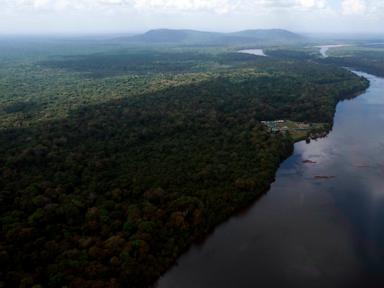
- Topographical Barriers: The Essequibo region is characterized by dense, primary rainforest and lacks road infrastructure connecting Venezuela to the heart of the territory. A conventional ground invasion would require transiting through Brazilian territory, which would trigger a massive regional military response.
- Naval Capability Gaps: While Venezuela possesses a nominally superior navy, its operational readiness is hampered by maintenance issues. Guyana, though lacking a traditional navy, is supported by U.S. intelligence, surveillance, and reconnaissance (ISR) assets.
- Sanction Sensitivity: The U.S. Treasury’s Office of Foreign Assets Control (OFAC) uses oil licenses (such as General License 44) as leverage. Any overt military move into the Essequibo would likely result in the immediate revocation of these licenses, collapsing Venezuela’s fragile attempt at economic stabilization.
The Probable Trajectory of ICJ Proceedings
The ICJ is currently examining the merits of Guyana’s case. The timeline for a final ruling typically spans three to five years.
Venezuela’s refusal to recognize the court’s jurisdiction does not halt the proceedings. Under Article 53 of the ICJ Statute, if one party does not appear or fails to defend its case, the other party may call upon the Court to decide in favor of its claim. However, the Court must satisfy itself that it has jurisdiction and that the claim is well-founded in fact and law.
The most likely juridical outcome is a ruling that upholds the 1899 Award. This would leave Venezuela with two choices: accept a definitive legal defeat or continue a policy of non-compliance and localized escalation.
Strategic Recommendation for Regional Actors
Guyana must continue its "Internationalization of Security" strategy. By integrating its defense interests with those of the U.S., Brazil, and the UK, it creates a cost-benefit reality where a Venezuelan incursion becomes prohibitively expensive.
Venezuela, conversely, is likely to maintain a "permanent state of tension." This allows the government to utilize the Essequibo issue as a lever in negotiations with the U.S. regarding sanction relief. The territory is more valuable to Caracas as a contested claim than as a conquered province, as the latter would invite a level of international intervention that the Maduro administration cannot survive.
The resolution of the dispute will not come from the jungle or the sea, but from the cumulative weight of the ICJ’s final judgment and the continued economic integration of the Essequibo into the global energy market. The window for Venezuela to alter the map through diplomacy is closing; the window to do so through force is blocked by a phalanx of global energy interests and regional security imperatives.


