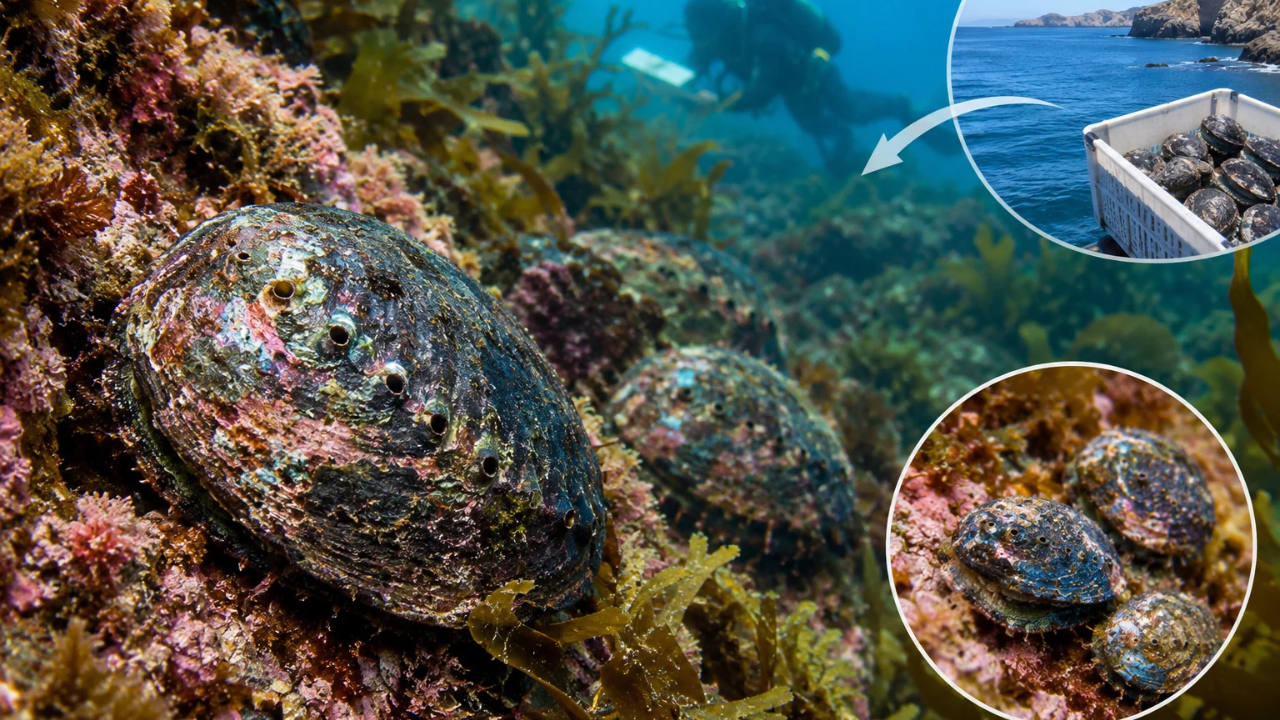
Moving 246 endangered abalone in 2023 and watching site counts climb from 54 to 302 with juvenile sightings by 2026 proves that physical relocation is easy, whereas building a self-sustaining population requires solving spatial density, broadcast-spawning mechanics, and habitat bottlenecks. Standard conservation headlines treat a count jump from 54 to 302 as a clean victory. That framing conflates accounting with ecology. A headcount can rise through post-release observation bias, immigration from adjacent reefs, or survival of large adults without establishing a reproductive engine that replaces mortality over decades. This analysis deconstructs the translocation logic implied by the 2023 to 2026 trajectory, separates verified mechanics from educated hypotheses, and lays out an operational blueprint for evaluating and scaling endangered abalone recovery in California.
Why Headcounts Alone Mislead Recovery Audits
Headline metrics in marine conservation rarely distinguish between stock inventory and demographic momentum. When a program relocates 246 individuals in one year and later reports counts rising from 54 to 302 alongside juvenile detections, four distinct mechanisms can produce that curve:
- Detection and survey effort shifts: Early post-release surveys often cover narrower transects or occur before divers refine search images, while later surveys expand coverage or benefit from repeatable site markers.
- Cohort retention versus net survival: A count of 302 three years after moving 246 animals does not automatically mean a high survival rate unless baseline counts, loss adjustments, and site boundaries are explicitly reconciled against the initial 246.
- Immigration and local redistribution: Mobile or semi-sessile mollusks adjust positions along reef ledges and crevices after placement, moving into or out of monitored plots.
- Early recruitment signals: Finding juveniles is a vital qualitative indicator of local larval settlement or successful nursery conditions, yet juvenile presence alone does not prove that the site has crossed the density threshold required for long-term replacement.
A rigorous evaluation separates census inventory (how many animals are seen in a given survey window) from demographic viability (whether births, settlements, and growth outpace natural and environmental losses). Treating a 54-to-302 jump as proof of permanent recovery skips the hardest part of marine restoration: verifying that the population can reproduce reliably without continuous human intervention.
The Population Viability Equation for Broadcast Spawners
Endangered abalone species such as white abalone (Haliotis sorenseni) and black abalone (Haliotis cracherodii)—alongside conservation-managed populations of red abalone (Haliotis rufescens) where thermal and trophic stress have compressed numbers—face a structural biological constraint known as the Allee effect. Unlike species with internal fertilization or pair bonding, abalone are broadcast spawners. Males and females release gametes directly into the water column, relying on water motion, timing, and close proximity for fertilization to occur before gametes dilute and lose viability.
When adult density drops too low, sperm and eggs disperse rapidly in turbulent coastal currents. Even if dozens of healthy adults survive on a reef, wide spacing can depress fertilization success toward zero. Moving 246 abalone into a single expanse without concentrating them at biologically meaningful spacing risks scattering reproductive potential across too much bottom area. Conversely, packing animals too tightly into a small patch can intensify competition for drift kelp and expose a high fraction of the cohort to a single localized disturbance, such as a storm surge, predator spike, or thermal anomaly.
Four Operational Variables Governing Translocation Outcomes
Evaluating or designing an abalone translocation program requires tracking four coupled operational variables rather than relying on a single post-release headcount:
- Nearest-neighbor spacing and aggregation geometry: Broadcast fertilization depends on local adult clustering during spawning windows, not merely total individuals per hectare.
- Microhabitat shelter and crevice complexity: Abalone rely on rock overhangs, fissures, and ledges to buffer wave energy and reduce predation from crabs, octopuses, sea stars, and fishes.
- Drift macroalgae supply and trophic balance: Abalone feed primarily on attached and drift kelp, which depends on light, water temperature, nutrients, and grazing pressure from sea urchins.
- Thermal and disease exposure: Warm-water marine heatwaves reduce kelp availability and metabolic margin, while withering syndrome threatens susceptible abalone species when water temperatures remain elevated.
Because exact site-level survival, fertilization rates, and juvenile origin are not established from a headline alone, treating juvenile sightings as proof of full self-sustainability is an educated hypothesis that requires genetic or size-class verification. A juvenile found near translocated adults could reflect local spawning by the relocated cohort, settlement of larvae drifting from nearby reefs, or cryptic juveniles already present in deep crevices that became easier to spot as observers searched more thoroughly.
Cause-and-Effect Chains Standard Reporting Misses
Popular summaries often present conservation interventions as linear sequences: move animals, wait three years, count more animals, and observe juveniles. Real coastal systems operate through feedback loops and lagged responses.
The Kelp-Urchin-Abalone Trophic Loop
Abalone recovery is tightly coupled to the health of nearshore kelp ecosystems. When ocean warming and trophic imbalances allow purple sea urchins (Strongylocentrotus purpuratus) to proliferate unchecked, urchins can graze kelp holdfasts and convert productive rocky reefs into urchin barrens. In an urchin barren, food drops sharply and shelter structures shift. Even if abalone are physically placed onto a reef, sparse drift kelp slows somatic growth and reduces gonad development, lowering reproductive output even when survival looks acceptable in the short term.
Conversely, where kelp canopy persists or recovers, drift algae supplies energy for both growth and gamete production. Yet restoration teams face a timing mismatch: restoring kelp and managing urchin pressure takes time and continuous effort, while translocated animals begin experiencing reef conditions from hour one.
The Lag Between Juvenile Sighting and Breeding Recruitment
Finding juveniles in 2026—three years after a 2023 move—is an encouraging milestone because early life stages are notoriously difficult to detect and vulnerable to predation. Still, a juvenile is not yet a reproducing adult. Abalone growth rates vary by species, temperature, and food supply, and reaching sexual maturity takes multiple years. A cohort observed as juveniles in 2026 must still survive several more years of predation, storms, and temperature swings before contributing gametes to the next generation.
A second bottleneck lies in connectivity. A single restored patch can act as a demographic sink if mortality exceeds local replacement, or as a stepping-stone source if larvae disperse to adjacent reefs. Without multi-site monitoring, managers cannot tell whether one patch's count increase reflects a resilient local nucleus or a temporary concentration.
Practical Comparison of Two Deployment Approaches
Consider two hypothetical managers deploying 246 abalone along a rocky coastline over a three-year evaluation window.
Manager A spreads the 246 animals evenly across six separate reef sites to maximize geographic coverage and minimize the chance that one localized event wipes out the entire effort. Surveys return a total count of 302 across monitored areas by year three, with juveniles spotted at two sites. While geographic spread reduces single-site catastrophic risk, low local density at individual sites could limit fertilization success during spawning events, and higher search effort across six sites could inflate relative counts compared to initial baselines.
Manager B concentrates the 246 animals into two high-shelter, kelp-supported sites with deliberate local clustering to support broadcast spawning, while maintaining a small sentinel group elsewhere. By year three, counts reach 302 across monitored plots with juveniles documented in sheltered crevices. Manager B achieves higher local reproductive density and clearer cause-and-effect tracking, but accepts higher exposure to a localized storm, disease outbreak, or predator concentration at those two primary sites.
Neither approach is universally superior. Spreading reduces correlated catastrophe risk; clustering improves fertilization mechanics. Optimal design balances spatial diversification against local reproductive density.
A Step-by-Step Framework for Auditing and Scaling Translocations
Practitioners and analysts evaluating abalone recovery programs can apply a five-step operational sequence to separate noise from durable progress:
- Reconcile the accounting baseline. Document exact release counts, exact survey boundaries, consistent search effort per unit area, and size-class breakdowns for every survey year so post-move totals are never compared apples-to-oranges against partial early counts.
- Audit spatial clustering at spawning scale. Measure nearest-neighbor distances and patch density within release sites rather than reporting only coarse site-wide averages, verifying that animals are positioned where gamete release can achieve meaningful fertilization.
- Verify microhabitat and food availability. Record crevice depth, wave exposure, drift kelp abundance, and sea urchin density alongside abalone counts to diagnose whether growth or survival is food-limited or shelter-limited.
- Separate recruitment origins. Track juvenile size distributions and spatial proximity to adult clusters over consecutive years to distinguish local settlement from immigration or observer bias.
- Stress-test against environmental shocks. Model how marine heatwaves, disease pressure, and storm surge could affect the cohort before committing additional stock, adjusting site selection and stocking density accordingly.
Limitations and Risks No Translocation Program Can Eliminate
Even a well-engineered translocation program carries structural limitations. First, oceanographic variance is outside operational control. Currents, upwelling, and marine heatwaves shift rapidly, meaning a site that looks ideal during a mild year can face severe thermal or food stress two summers later.
Second, small-number dynamics amplify statistical and biological risk. Working with hundreds rather than tens of thousands of animals means a handful of deaths, a single predator hotspot, or a localized survey miss can swing percentages dramatically. High percentage gains from small starting numbers look impressive on paper while leaving the total population fragile against stochastic shocks.
Third, monitoring costs scale faster than budgets. Underwater surveys require specialized dive teams, vessel time, weather windows, and rigorous protocols. Without sustained multi-year funding, programs risk declaring success after an early uptick and cutting monitoring right before a delayed bottleneck—such as poor juvenile-to-adult survival or thermal stress—erodes the gain.
Strategic Play for the Next Recovery Cycle
Treat the 2023-to-2026 trajectory as a proof of operational execution and an early ecological signal, not a finished recovery, and shift immediate resource allocation toward high-density broodstock clustering paired with standardized cohort-and-kelp tracking before expanding total headcounts. Reallocate marginal funding from broad, low-density releases into paired metrics: nearest-neighbor spacing audits during spawning season, standardized per-hour survey effort across fixed plots, and concurrent kelp-and-urchin habitat checks. That shift turns a promising count increase and juvenile sighting into verifiable demographic momentum—and exposes any hidden bottleneck while the population is still small enough to protect.