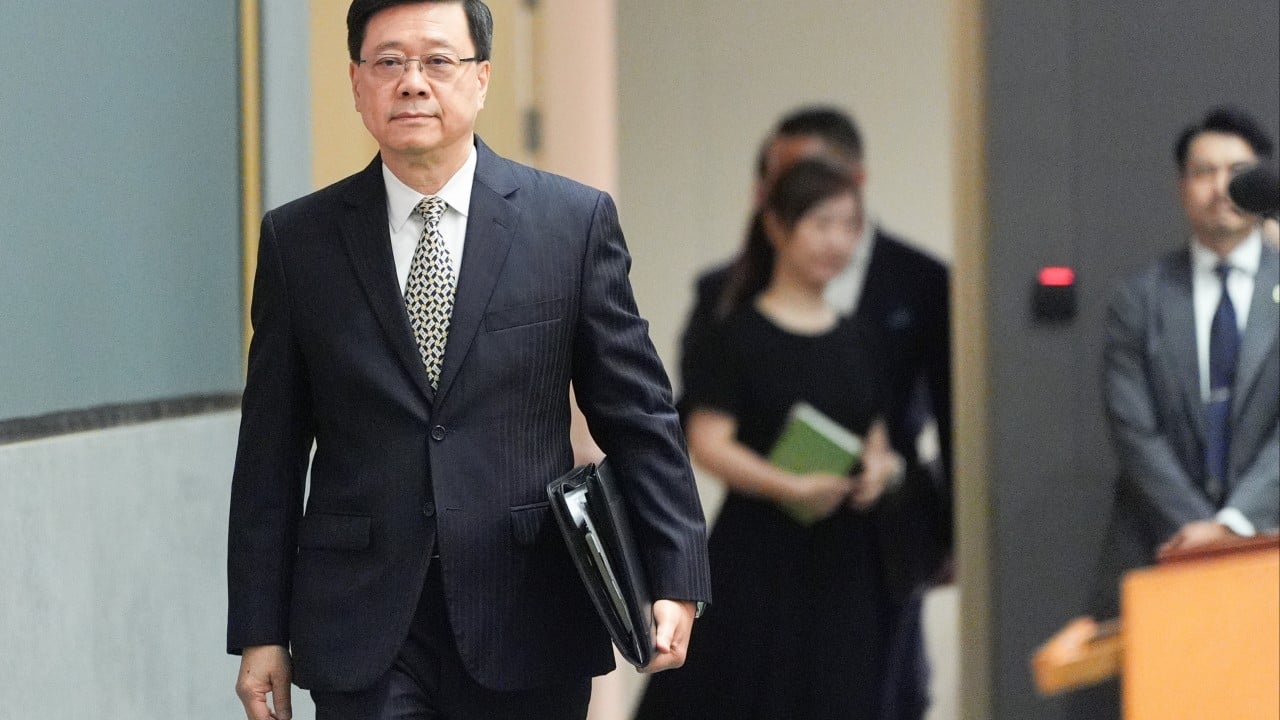
John Lee is rewriting the DNA of the Hong Kong Civil Service. The Chief Executive recently unveiled a revamped performance management system designed to strip away the lethargy often associated with the city's 170,000-strong workforce. While the official narrative frames this as a benevolent move toward "improvement rather than blame," the mechanics suggest something far more clinical. This isn't just about making sure the trains run on time or that housing permits are processed faster. It is a fundamental shift in how power is exercised within the administrative heart of the financial hub.
For decades, the Hong Kong Civil Service was the gold standard of colonial and post-colonial efficiency. It operated on a principle of "positive non-interventionism" and a rigid, almost sacred adherence to procedure. But procedure can be a hiding place for the indecisive. Lee, a former career police officer, views these bureaucratic stalls not as neutral administrative hurdles but as failures of execution. The new system introduces a "KPI culture" into a space that previously rewarded longevity and risk avoidance. By lowering the threshold for dismissing underperformers and streamlining the disciplinary process, the government is signaling that the era of the "iron rice bowl"—a job for life regardless of output—has ended.
The Mechanics of the New Accountability
The shift hinges on the updated Civil Service Code and a streamlined mechanism for removing officers whose work does not meet the mark. In the old world, firing a civil servant was a marathon of paperwork, union consultations, and appeals that could stretch for years. It was often easier for a manager to transfer a low-performer to another department than to try and let them go. The new rules change the math. The government has drastically shortened the "observation period" for those under review. If an employee is found wanting, the path to the exit is now direct and fast.
This creates a high-pressure environment that mirrors the private sector. Department heads are now required to set specific, measurable targets. If a housing project is delayed, there is now a paper trail that leads to a specific desk. Critics argue this will lead to "target-chasing," where officials prioritize hitting a number over the quality of the service. However, the administration maintains that without these metrics, the public has no way to hold the government to account.
Breaking the Iron Rice Bowl
The "iron rice bowl" was more than a perk; it was a stabilizer. It ensured that civil servants could give frank, honest advice to their superiors without fear of losing their livelihood. When you make it easier to fire people, you naturally increase the incentive for those people to agree with their bosses. This is the hidden friction in Lee's plan. While it may solve the problem of laziness, it risks creating a culture of "yes-men."
High-level administrators now find themselves in a precarious position. They must navigate the technical demands of a complex global city while staying perfectly aligned with the shifting political priorities of the executive branch. The speed of the disciplinary process means that a single political misstep could be framed as a performance failure. This ambiguity is where the real power lies. It is an effective tool for ensuring total alignment from the top of the pyramid to the entry-level clerks.
The Cost of Efficiency
There is a tangible tension in the offices of the North Point Government Offices and the Central Government Complex. Recruiting and retaining talent has become a significant hurdle. Since 2020, the civil service has seen a spike in resignations, particularly among mid-career professionals in their 30s and 40s. These are the people who keep the gears turning—the engineers, the legal counsel, and the urban planners.
When you combine a more demanding performance system with a tightened political environment, the private sector starts to look much more attractive. Why deal with the scrutiny of a government KPI system when you can make 40% more at a law firm or a multi-national bank? The government is betting that "patriotism" and a sense of duty will fill the gap, but the numbers tell a different story. The vacancy rate in certain departments has hit double digits, forcing the government to widen its recruitment net to university students in mainland China.
Redefining the Public Servant
The new system also redefines what it means to be a "good" civil servant. In the past, the ideal was a neutral administrator. Today, the ideal is a "proactive achiever." This sounds positive on the surface, but proactivity in a government context is a double-edged sword. It requires a clear direction from the top. If the direction is flawed, a proactive civil service simply accelerates the mistake.
Consider the recent push for "mega-events" to revive the city’s economy. Civil servants are now judged on their ability to attract and execute these events. When an event fails—like the high-profile no-show of a football superstar—the machinery of accountability kicks in. But who is really at fault? Is it the mid-level officer who followed the instructions, or the leadership that set an unrealistic target? Under the new system, the mid-level officer is the one with the target on their back.
A System of Incentives and Fear
The administration insists that there are rewards for excellence, not just punishments for failure. They point to new award schemes and fast-track promotions for "exemplary" staff. This is the "carrot" to the disciplinary "stick." Yet, in any large bureaucracy, the fear of the stick usually outweighs the desire for the carrot.
The pressure to perform is also being felt at the district level. The newly "improved" District Councils are now heavily integrated with the civil service apparatus. This means that local issues—trash collection, bus routes, neighborhood safety—are now part of the executive’s KPI matrix. This top-down approach ensures that local grievances are addressed quickly, which is a win for the average citizen. But it also means that local governance has lost its autonomy. It is now just another branch of the executive's performance review.
The Regional Context
Hong Kong is not operating in a vacuum. This move toward a more disciplined, responsive, and loyal civil service is a direct reflection of the governance style in Beijing. The "meritocratic" system used on the mainland is being imported and adapted for Hong Kong's common law environment. It is a hybrid model. It seeks the economic agility of a capitalist hub with the political discipline of a centralized state.
This transition is the most significant administrative overhaul since the 1997 handover. It marks the end of the "British style" civil service that was characterized by its distance from politics. The new Hong Kong civil servant is an active participant in the city's political and national development. Their performance is no longer just about how many files they process, but how well they contribute to the "stability and prosperity" of the region.
The Efficiency Paradox
If the goal is purely to improve the lives of citizens, then a more accountable civil service is a net positive. Anyone who has waited months for a simple government reply knows that the old system needed a jolt. The danger is that the jolt becomes a permanent state of high-voltage stress.
When a system becomes too focused on "not being blamed," it often stops innovating. Innovation requires the freedom to fail. If the new accountability system is as rigorous as John Lee suggests, the fear of being "improved" right out of a job will lead to a very safe, very boring, and very rigid bureaucracy. Officials will do exactly what is required to hit their KPIs and not a single thing more. They will follow the letter of the law to avoid the disciplinary hammer, even if the spirit of the law requires a different approach.
The real test will come during the next crisis. Whether it is an economic downturn or a public health emergency, we will see if a KPI-driven workforce can adapt. Or will they be too busy checking their performance metrics to see the bigger picture? The iron rice bowl has been shattered, and in its place is a glass one—clearer, perhaps, but much easier to break.
Success for John Lee’s administration won't be measured by how many civil servants are fired. It will be measured by whether the city's best and brightest still want to work for the government at all. If the talent drain continues, no amount of disciplinary streamlining will fix the fundamental problem of a shrinking pool of competent leaders. The government has built a faster engine, but it remains to be seen if anyone is willing to drive it.
Government is not a business, and citizens are not customers. When you treat them as such, you lose the essential nuance of public service. The pursuit of efficiency is noble, but the pursuit of total control under the guise of efficiency is a different beast entirely. Hong Kong's civil servants are now walking a tightrope, and the safety net has been removed.