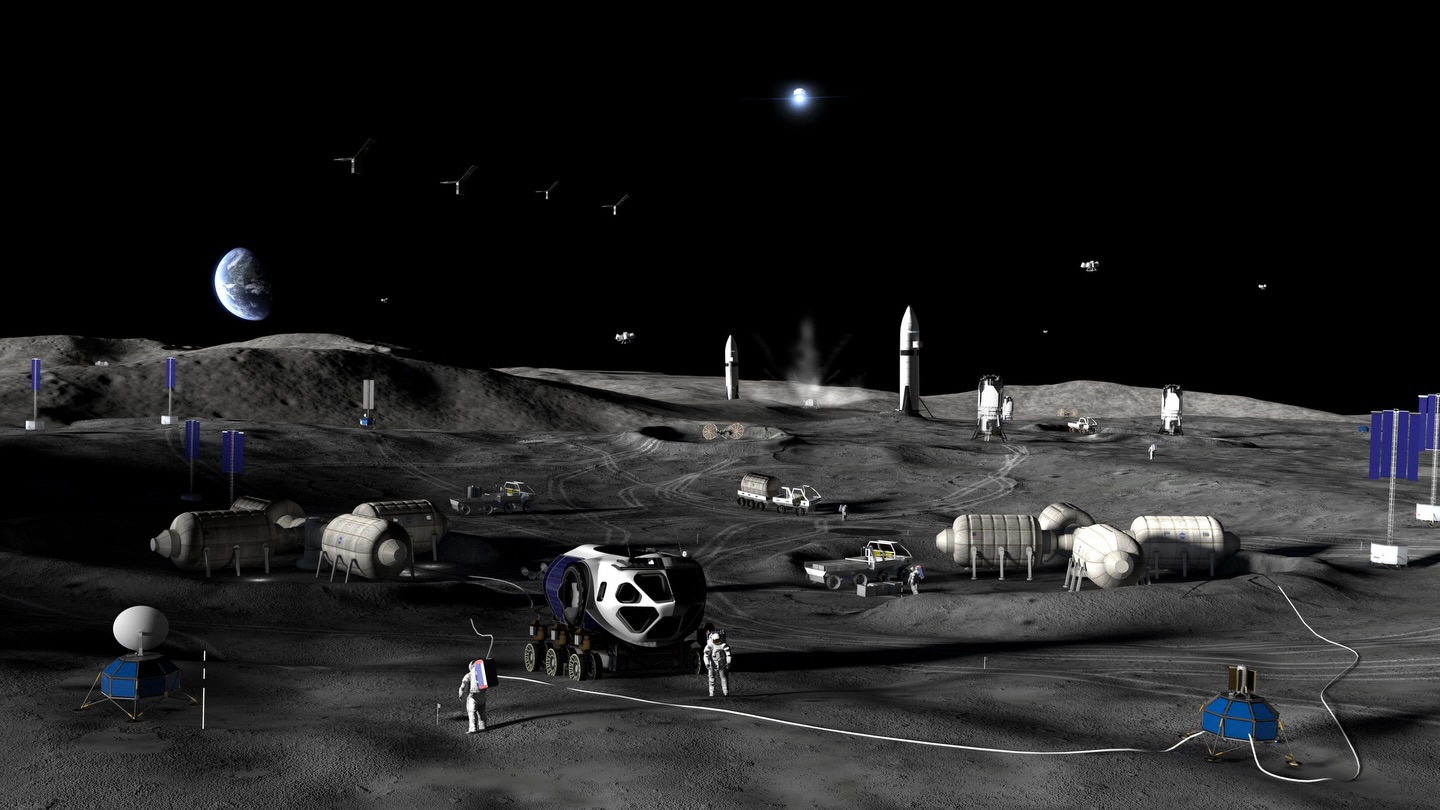
NASA’s stated objective to establish a permanent lunar presence and execute crewed landings by the late 2020s represents a fundamental shift from temporary exploration to permanent infrastructure deployment. The institutional transition from the Apollo-era single-destination model to the Artemis-era logistics network alters the economics of spaceflight. Evaluating the viability of this timeline requires analyzing three interdependent variables: launch vehicle cadence, cislunar orbital logistics, and surface resource utilization kinetics.
The primary bottleneck for sustained lunar operations is not technological capability, but mass-to-orbit cost efficiency. Establishing a baseline infrastructure requires a critical mass of payload delivered to the lunar surface annually. This analysis deconstructs the operational architecture required to sustain a permanent human presence on the Moon, identifying structural vulnerabilities and the economic frameworks dictating success.
The Tri-Centric Architecture of Lunar Sustainability
Sustaining humans on the lunar surface indefinitely requires a shift from a closed-loop supply chain originating entirely on Earth to an open-loop, self-sustaining system. The architecture rests on three distinct operational layers, each introducing independent failure modes and compounding cost functions.
[Earth Launch Systems] ---> [Cislunar Orbit / Gateway] ---> [Lunar Surface Base]
       ▲                                                          │
       └─────────────────── In-Situ Resource Feedback ◄───────────┘
1. The Heavy-Lift Launch Matrix
The mass required to build a permanent surface base exceeds the single-launch capacity of any operational or planned rocket. Consequently, NASA's architecture relies on distributed launch profiles and in-orbit propellant transfer.
The Space Launch System (SLS) provides high-reliability, high-energy direct insertion for the Orion crew capsule, but its low flight cadence—constrained by core-stage manufacturing timelines and high per-launch costs—limits its utility for cargo deployment. Commercial launch providers fill this gap using high-cadence, partially or fully reusable vehicles to deliver infrastructure components to low Earth orbit (LEO) or near-rectilinear halo orbits (NRHO).
The critical vulnerability in the heavy-lift matrix is the orbital refueling ratio. For a methane- or hydrogen-based upper stage to transition from LEO to the lunar surface with a meaningful payload, it must be refueled in orbit by multiple tanker flights. The cost function of lunar payload delivery is directly tied to the boil-off rate of cryogenic propellants during these docking sequences. If the tanker cadence drops below a critical threshold, thermal management systems degrade, causing propellant loss that destabilizes the economic baseline of the entire mission profile.
2. Cislunar Logistics and the NRHO Gateway
Rather than inserting directly into low lunar orbit, the current architecture uses a Near-Rectilinear Halo Orbit as a staging ground. The Gateway station serves as a multi-modal transit hub. The physics of an NRHO offer specific operational trade-offs:
- Orbital Stability: NRHO requires minimal station-keeping propellant because it balances the gravitational gradients of the Earth and Moon. This provides a long-term parking orbit for infrastructure.
- Communication Line-of-Sight: The high altitude ensures nearly continuous line-of-sight communication with Earth, eliminating the blackouts associated with low lunar orbits.
- Delta-V Penalties: While NRHO optimizes orbital stability, it introduces a significant delta-v penalty for surface descent and ascent cycles. A landing craft must expend more energy to decelerate from NRHO to the lunar surface than it would from a low lunar orbit, increasing the propellant mass fraction required for the lander.
The Gateway acts as a high-altitude buffer, decoupling the Earth-to-orbit launch schedule from the lunar landing schedule. This setup creates a structural dependency: every kilogram of payload destined for the surface must tolerate extended storage times in deep space, increasing the requirement for radiation shielding and autonomous thermal regulation.
3. Surface Infrastructure and Thermal Cycle Survival
The lunar surface environment imposes severe engineering constraints that dictate the mass requirements of a permanent base. The primary challenge is the lunar night, which lasts 14 Earth days in non-polar regions, dropping temperatures to -130°C.
To bypass this thermal constraint, initial permanence profiles target the lunar south pole, specifically crater rims near Shackleton Crater. These topographies provide areas of near-permanent sunlight, allowing for continuous solar power generation, alongside permanently shadowed regions (PSRs) that hold volatiles like water ice.
Survival at the south pole requires managing low sun angles, where horizontal solar arrays lose efficiency due to terrain shadowing. Vertical solar arrays and surface-deployed nuclear fission reactors are needed to maintain baseline power during partial eclipses. Without a continuous power source exceeding 10 kilowatts per habitat module, environmental control and life support systems (ECLSS) fail, causing thermal structural cracking in the habitat hulls.
The Cost Function of Lunar Mass Transport
To understand the economic pressures on the 2028 timeline, we must model the cost per kilogram of useful payload delivered to the lunar surface. The traditional aerospace model calculates costs based on dry mass procurement and expendable hardware. The modern framework must account for the Propellant Mass Fraction ($M_f$) and the Payload Fraction ($P_f$), defined by the Tsiolkovsky rocket equation:
$$\Delta v = v_e \ln \left( \frac{m_0}{m_f} \right)$$
Where $v_e$ is effective exhaust velocity, $m_0$ is initial mass, and $m_f$ is final mass. When applied to a multi-stage cislunar transit network, the compounding exponent means that for every kilogram of structural habitat placed on the lunar surface, an order of magnitude more mass must be launched into LEO solely as propellant.
+--------------------------------------------------------------------------+
| Cislunar Mass Multipliers                                                |
+--------------------------------------------------------------------------+
| Earth LEO Insertion:    [1.0 kg Payload] requires ~20-30 kg Gross Mass    |
| Trans-Lunar Injection:  [1.0 kg Payload] requires ~3-4 kg LEO Propellant |
| Lunar Surface Descent:  [1.0 kg Payload] requires ~2-3 kg NRHO Propellant|
+--------------------------------------------------------------------------+
This relationship explains why in-situ resource utilization (ISRU) is a structural requirement for permanence rather than an optional science experiment. Extracting water ice from permanently shadowed regions allows for its conversion into liquid oxygen ($LOX$) and liquid hydrogen ($LH_2$) or methane feedstocks.
Refueling landing craft on the lunar surface flips the mass equation: it eliminates the need to launch return propellant from Earth's deep gravity well. Until ISRU processing plants reach operational maturity, the logistical footprint of a lunar base scales linearly with crew hours, creating an exponential cost curve that limits long-term budget sustainability.
Structural Bottlenecks to a 2028 Human Return
Achieving human landings by 2028 requires resolving several distinct technical and operational dependencies. Delays in any single node propagate through the entire system, shifting the schedule out by multiple launch windows.
Cryogenic Fluid Management in Microgravity
Long-duration storage and transfer of liquid hydrogen and liquid oxygen in orbit remain unproven at scale. Hydrogen molecules, due to their small size, easily leak through standard seals and cause embrittlement in metallic storage tanks.
Furthermore, the absence of gravity prevents natural thermal convection, causing localized boiling and pressure spikes inside propellant tanks. Developing zero-boil-off cryocoolers and automated microgravity docking couplers is the most significant technical hurdle for commercial landing systems that rely on multi-tanker refueling architectures.
Human-Rated Spacesuit Mobility and Dust Mitigation
The lunar regolith consists of sharp, glass-like fragments formed by billions of years of meteorite impacts without atmospheric weathering. This dust is electrostatically charged by solar radiation, causing it to adhere to all surfaces. During the Apollo missions, regolith exposure degraded spacesuit pressure seals within days and abraded camera lenses and visor coatings.
Current exploration spacesuits must incorporate active dust-repelling technologies, such as electrodynamic dust shields embedded in outer fabric layers, alongside robust mechanical seals at the rotary joints. The manufacturing and verification of these suits are highly specialized, meaning production delays directly stall crewed surface operations, even if the launch vehicles and landers are fully certified.
Regulatory and Geopolitical Risk Vectors
The Artemis Accords establish a framework for civil cooperation in space, focusing on creating "safety zones" around lunar operations to avoid harmful interference. However, the lack of an international consensus on property rights for celestial resources introduces legal friction.
Ambiguities in interpreting the Outer Space Treaty regarding resource extraction could create geopolitical friction zones at the high-value real estate of the lunar south pole, where usable crater rims are scarce. These legal uncertainties complicate private investment, as commercial entities require clear asset ownership frameworks before committing capital to long-term resource extraction projects.
The Operational Reality of Lunar Permanence
A clinical assessment of the architecture indicates that a human return by the late 2020s is technically possible but highly dependent on commercial launch cadences and cryogenic flight tests. True permanence will not look like an immediate, self-sustaining city. Instead, it will function as an austere, highly rationed outpost, closely resembling research stations in Antarctica.
The operational phase will likely unfold in a strict sequence:
- Automated Pre-Positioning: Delivering autonomous power systems, regolith-moving rovers, and uncrewed habitats to the south pole to confirm structural integrity before human arrival.
- Sortie Exploration: Short-duration human missions lasting 7 to 14 days, prioritizing the deployment of science instruments and the validation of localized ISRU extraction mechanisms.
- Industrial Consolidation: The transition to extended stays exceeding 30 days, enabled by operational nuclear surface power and closed-loop life support systems that recycle more than 98% of water and oxygen.
The strategic imperative for NASA and its industrial partners is to prioritize the development of standardized, interoperable interfaces. Creating universal standards for power connections, docking rings, and propellant transfer valves allows the architecture to absorb component failures. This approach prevents single-vendor dependencies and ensures the cislunar logistics network can scale to match long-term operational demands.