Silence.
That is the thing nobody ever tells you about gunfire in a city—not the deafening crack that splits the humid evening air, nor the frantic wail of sirens converging from three different precincts, but the sudden, suffocating vacuum that swallows the block in the half-second right after the last shell casing hits the asphalt.
In Washington, D.C., where the marble monuments gleamed just a few miles away under a quiet night sky, five people became statistics in less than ten seconds. One dead. Four injured. A gunman opens fire, police tape goes up, traffic gets rerouted around a residential corridor, and by morning, the headline has already been compressed into eight sterile words meant to be skimmed over a cup of coffee.
One dead, four injured.
Read those words again, slowly, until the ink stops looking like a police blotter and starts looking like a kitchen table with an empty chair. We have grown dangerously fluent in the shorthand of urban tragedy, absorbing casualty counts the way we absorb weather forecasts, nodding grimly before scrolling down to the sports scores. Yet behind that fleeting news alert lies a sprawling, invisible architecture of grief, survival, and community reckoning that refuses to vanish when the patrol cars turn off their flashing lights.
The Anatomy of an Ordinary Evening
To understand what actually breaks when a gunman pulls a trigger on a D.C. street, picture a composite evening—a hypothetical reconstruction built from dozens of real Metropolitan Police Department timelines and neighborhood testimonies from similar shootings across the District.
Call him Marcus, though he could be any forty-two-year-old delivery driver finishing a double shift in Northeast or Southeast Washington. At 8:45 p.m., the street is still alive with the mundane choreography of a neighborhood exhaling after work. A grandmother is watering potted geraniums on a brick stoop. Two teenagers are arguing good-naturedly over basketball stats outside a corner carryout, the smell of fried chicken wings and sweet mumbo sauce drifting through the propped-open screen door. Marcus is sitting in his idling sedan, checking his phone one last time before walking up the steps to dinner.
Nobody is thinking about ballistics. Nobody is calculating sightlines or exits.
Then comes the sound—sharp, metallic, unmistakably wrong. At first, the human brain resists translating it. Fireworks? A blown transformer? A backfiring muffler? That split second of cognitive denial is universal among survivors of street shootings, a stubborn evolutionary refusal to accept that ordinary space has suddenly turned lethal.
By the third shot, denial collapses into instinct.
Glass shatters. Someone screams a name. People drop behind parked Hondas, scramble into the carryout behind the bulletproof acrylic partition, or freeze entirely as time stretches like pulled taffy. Within moments, the shooter disappears down an alley or speeds away into the grid of avenues, leaving behind five human beings whose lives have just been violently cleaved into a permanent before and an irreversible after.
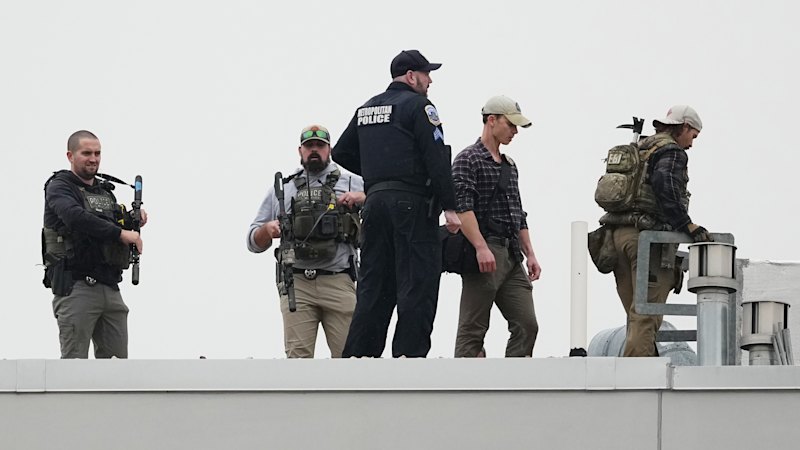
When the first cruisers arrive minutes later, officers find chaos compressed into a fifty-yard radius. One victim lies motionless near the curb, beyond the reach of tourniquets and chest seals. Four others—a bystander caught in the crossfire, a neighbor stepping out onto a porch, two young men who never saw the barrel raised—are bleeding on the pavement, conscious enough to feel the cold shock setting in, terrified enough to grip the hands of strangers pressing wadded-up T-shirts against their wounds.
What the Police Blotter Leaves Out
Standard news reports stop where the real story begins.
According to data tracked by the Metropolitan Police Department and public health researchers studying gun violence in the nation's capital, the immediate casualty count is merely the epicenter of an earthquake whose aftershocks travel outward for years. When a shooting leaves one person dead and four wounded in Washington, D.C., emergency rooms at MedStar Washington Hospital Center or Howard University Hospital immediately shift into trauma triage.
Surgeons work under harsh overhead lights to extract deformed lead, repair perforated organs, and stabilize blood pressure. Even when all four injured victims survive—and medical advances in urban trauma centers have dramatically improved survival rates over the past two decades—survival is rarely a clean victory.
Consider what happens next to those four survivors.
One might walk out of the hospital in three days with a grazed shoulder and a lifetime of flinching every time a car door slams too loudly. Another faces six months of physical therapy, a colostomy bag, chronic nerve pain, and mounting medical bills that no victims' compensation fund fully covers. They lose wages. They lose sleep. They lose the basic, taken-for-granted comfort of walking down their own block after sunset without scanning every parked car for tinted windows.
And what of the one who did not survive?
In D.C., a single homicide ripples through an estimated seventy to one hundred close relatives, friends, coworkers, and classmates. Mothers become archivists of memory, keeping bedrooms untouched like shrines. Children learn to measure their lives in anniversaries of loss. Neighbors who watched paramedics work under the streetlamps carry a quiet, lingering guilt—wondering if calling 911 ten seconds earlier could have changed the outcome, even when logic says otherwise.
I have stood on sidewalks like these after the yellow tape was rolled up and tossed into the back of a squad car. What stays with you is not the drama, because the drama leaves with the television news vans. What stays is the chalky residue of dry chemical powder used to wash blood off the concrete, the way parents instinctively pull their kids inside when a strange sedan slows down at the corner, and the exhausting vigilance that settles over a block like humid August air.
Two Washingtons, One Zip Code
People outside the District often struggle to grasp how a city synonymous with federal power, Secret Service motorcades, and heavily guarded embassies can simultaneously endure bursts of sudden, devastating street gunfire.
The confusion is understandable. If you visit Washington as a tourist, you experience one of the most heavily policed square miles on earth. Uniformed officers stand on nearly every corner between the Capitol and the Lincoln Memorial.
Walk two or three miles east or north, however, and you enter neighborhoods where municipal life looks much like any other dense American city—rowhouses, corner barbershops, charter schools, Metrobus stops—navigating decades of uneven economic investment, housing pressure, and the stubborn circulation of illegal firearms.
Think of the city like a house with a grand, immaculate marble foyer and a back porch whose floorboards have been quietly rotting for thirty years. Visitors admire the chandeliers in the front hall and assume the whole structure is solid. Residents living on the back porch know exactly where the wood gives way underfoot.
According to federal tracing data from the Bureau of Alcohol, Tobacco, Firearms and Explosives, the vast majority of firearms recovered at D.C. crime scenes were never legally purchased inside the District, which maintains some of the strictest gun laws in the United States. Instead, those weapons flow northward along the I-95 corridor—the notorious "Iron Pipeline" stretching from states with looser purchasing rules into Mid-Atlantic cities.
When an argument escalates, or when a targeted retaliation unfolds on a crowded block, that steady supply of easily accessible handguns turns an impulsive burst of rage or a neighborhood dispute into a mass-casualty event in seconds. A fistfight leaves bruises. A semi-automatic pistol with an extended magazine leaves one person dead and four fighting for their lives.
The Invisible Shift in How a Neighborhood Breathes
When news breaks of a shooting in Washington, D.C., public conversation usually splits down predictable, exhausted tracks. One side demands tougher sentencing, more officers on foot patrol, and faster pretrial detention. The other points toward poverty, trauma, broken opportunity pipelines, and the flood of guns entering the city.
Both arguments miss something immediate and human happening on the ground the morning after the shooting.
Violence alters the geometry of daily life. Urban sociologists call it collective efficacy—the invisible web of trust that makes neighbors willing to watch each other's kids, sweep shared sidewalks, and intervene when something feels off. Gunfire shreds that web overnight.
When bullets fly on a residential block, porches empty. Evening walks stop. Small corner businesses see foot traffic dry up after dusk, squeezing margins that were already razor-thin. Children are told to play in the hallway instead of the front yard. Every closed front door makes the street a little darker, a little quieter, and paradoxically, a little less safe—because empty streets have fewer eyes watching over them.
Yet if you stay long enough after the headlines fade, you also witness a stubborn, unglamorous resistance that rarely makes the evening broadcast.
In neighborhoods across D.C., violence interrupters—many of them former offenders who once lived by the code of the street—walk into the exact blocks where shootings occur within hours of the police clearing the scene. They don't carry badges or handcuffs. They carry credibility, phone numbers, and hard-won wisdom. Their job is to talk down the friends and cousins of the victims before grief curdles into retaliation, interrupting the cycle before another five names get added to next week's police report.
Alongside them are mothers' groups holding candlelit vigils at dusk, pastors opening church basements for late-night youth programs, and neighbors who refuse to surrender their stoops to fear, dragging their lawn chairs back out onto the concrete the very next evening just to prove the street still belongs to them.
Why We Cannot Afford to Skim Past the Headline
It is tempting, when reading another brief dispatch about a shooting in Washington, D.C., to feel a wave of helplessness and turn the page. What can one reader do about a gunman opening fire miles away?
First, refuse the numbness.
The moment we treat "one dead, four injured" as background noise—a routine cost of city living rather than an urgent human emergency—we grant violence a permanence it has not earned. Data from cities that have successfully driven down shooting rates, including periods in D.C.'s own history over the past thirty years, proves that surges in gun violence are neither mysterious nor inevitable. They respond to targeted intervention: interrupting retaliatory chains, disrupting illegal gun trafficking networks, investing in high-risk young adults before a crisis hits, and keeping emergency trauma care accessible.
Second, look closer at the frame whenever a tragedy is reduced to numbers. Behind every dry police summary is a specific corner, a specific family trying to afford a funeral without going bankrupt, and four survivors relearning how to walk, breathe, and trust the world outside their front doors.
By midday on the day after the shooting, sanitation crews usually finish washing down the pavement in Washington, D.C. Commuters drive over the asphalt without slowing down. Delivery trucks double-park near the corner carryout, and the city's relentless machinery keeps churning forward as if nothing happened.
Look down at the curb on that block at twilight, though, and you will still see the melted wax from last night's vigil candles pooling in the cracks of the concrete—quiet proof that five lives collided with a bullet there, and that the people who loved them are still standing guard in the dark.