The winter air in Seoul carries a biting chill that cuts straight through wool coats, but the cold pressing against the old woman’s shoulders is of a different kind entirely. It is memory. It is time. It is the heavy, suffocating silence of decades spent waiting for a sentence that has never quite arrived.
She sits by the window, hands folded over a woolen blanket, watching the gray light fade behind towering glass facades that symbolize an economic miracle. That miracle built a modern society out of the ashes of war. Yet, beneath the polished concrete and the neon glow of a capital obsessed with tomorrow, yesterday refuses to stay buried. Across a narrow stretch of sea, in Tokyo, another generation of leaders looks at the same calendar and sees only an inconvenience to be managed, a ledger to be closed, an equation to be balanced and forgotten.
History is rarely a clean line. More often, it is a knot of raw nerves pulled tight by pride, politics, and the relentless ticking of a clock.
To understand why two vibrant democracies, bound by shared security fears and economic interdependence, remain locked in a perpetual diplomatic frost over an issue born in the 1930s and 1940s, we have to step away from the podiums and press conferences. We have to look at what it means to inherit a wound.
Consider what happens when a government tries to legislate closure. In 2015, Tokyo and Seoul signed a landmark agreement aimed at resolving the "comfort women" dispute once and for all. It was hailed in Western capitals as a diplomatic triumph. Funds were pledged. Apologies were offered, guarded and conditional, wrapped in the careful syntax of statecraft. For a brief moment, diplomats breathed a sigh of relief.
Then came the human reality.
Treaties are signed by men in dark suits who measure time in election cycles. Trauma is measured in heartbeats. The survivors—the women who were coerced into Japanese military brothels as teenagers—looked at the handshakes across conference tables and felt invisible. An agreement brokered without their full consent felt less like a resolution and more like a silencing. Governments can exchange billions of yen and issue carefully vetted statements, but dignity cannot be transferred via bank wire.
This is the central friction of the Japan-South Korea relationship today. It is a collision between diplomatic pragmatism and historical justice.
On one side stands Tokyo, operating from a doctrine of legal finality. From the perspective of Japanese officialdom, the 1965 normalization treaty and subsequent accords settled financial claims arising from the colonial period. To revisit these issues perpetually, they argue, is to chase a vanishing horizon where no concession will ever be deemed sufficient. There is a palpable fear of opening the floodgates to endless moral and financial liability in a neighborhood where historical grievances are weaponized for domestic political gain.
On the other side stands Seoul, where public sentiment is forged in the enduring embers of colonial subjugation. The Japanese occupation from 1910 to 1945 was not merely a period of geopolitical realignment; it was an systematic erasure of language, culture, and bodily autonomy. For generations of South Koreans, the mistreatment of these women stands as the ultimate metaphor for that violation. When politicians in Tokyo downplay coercion or seek to revise textbook accounts, it triggers a visceral national reflex. It feels like the injury is happening all over again, live on television, in slow motion.
Can they move past it? The question itself is flawed. It assumes that history is a hurdle to be cleared rather than a landscape we must inhabit.
Moving forward requires a radical shift in perspective. It demands that leaders in both capitals stop treating historical memory as a zero-sum game where one side’s acknowledgment is interpreted as the other’s defeat. True reconciliation cannot be outsourced to bureaucrats or sealed behind closed doors. It requires an active, empathetic engagement with the remaining witnesses of that era while they are still here to speak.
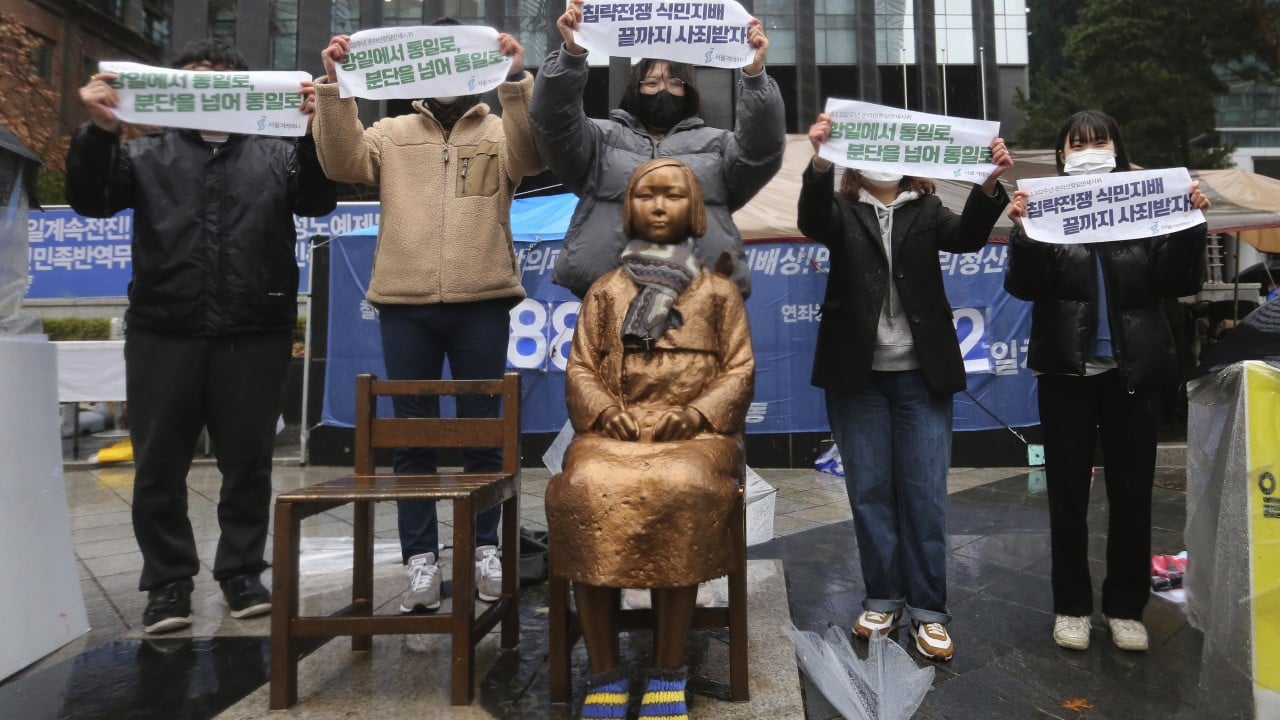
There is a profound urgency to this moment. The women who bore this unimaginable weight are vanishing. Every year, empty chairs multiply at the Wednesday demonstrations outside the Japanese embassy in Seoul. Soon, there will be no living voices left to demand accountability, leaving the battlefield entirely to politicians, historians, and ideologues.
When the last survivor passes away, the monuments of bronze and stone will remain. But stone cannot feel. Stone cannot look a skeptical diplomat in the eye and bear witness to the truth.
If Seoul and Tokyo are to truly transcend this generational impasse, they must build a framework that honors memory without weaponizing it. This means moving beyond transactional apologies and toward a shared educational and cultural architecture where the darkest chapters of the twentieth century are confronted honestly, without evasion or defensiveness. It means recognizing that security alliances built on radar frequencies and trade pacts are inherently fragile if they rest upon a foundation of unacknowledged pain.
The sun dips below the horizon in Seoul, casting long shadows across the courtyard where the bronze statue of a young girl sits, gazing perpetually toward an embassy that refuses to look back. The wind rattles the winter branches, a sharp reminder that time is running out. Two nations stand at the precipice of a future they must build together, yet they remain tethered to an unresolved past, waiting for the courage to finally look each other in the eye.