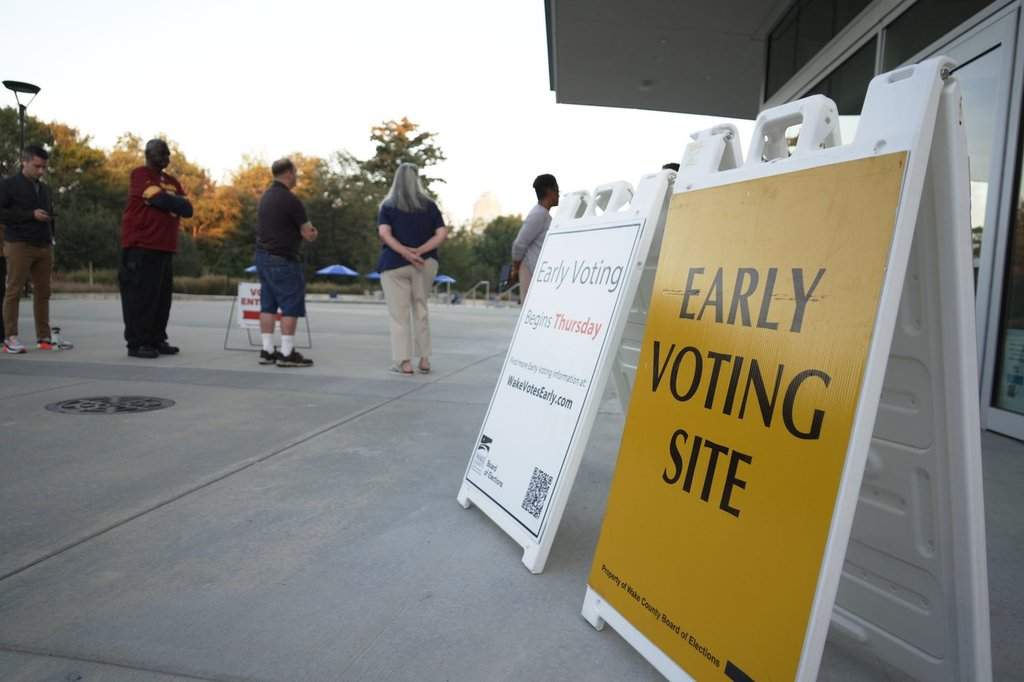
Early voting surges before American midterm elections because state-level election laws have permanently shifted how ballots are cast, turning what used to be a single Tuesday event into a multi-week administrative operation. Millions of voters now cast ballots before Election Day through expanded no-excuse mail-in systems, extended early in-person voting windows, and automated voter registration rolls, rather than waiting for traditional precinct lines.
Headline writers love a surge. Whenever pre-election ballot tallies climb past previous records, cable news panels and campaign press releases immediately treat the raw numbers as a crystal ball for November outcomes. That instinct misses the structural reality of modern American election administration. A jump in early voting rarely measures a sudden wave of new political enthusiasm on its own; more often, it measures cannibalization—voters who would have shown up on Election Day simply shifting their participation onto an earlier calendar date.
Understanding the real mechanics behind early voting requires separating logistical changes from partisan momentum, examining how state legislatures rewrote the rules over the last two decades, and looking closely at the operational bottlenecks that emerge when millions of ballots arrive weeks ahead of schedule.
The Structural Shift Behind Early Voting Numbers
For most of American history, voting was an acute, single-day logistical sprint. You went to a neighborhood school basement or church hall on the first Tuesday after the first Monday in November, signed a paper ledger, and pulled a lever. That model began fracturing in the late twentieth century, first in Western states like Oregon, Washington, and Colorado, which transitioned to universal mail-in balloting, and later across the Sun Belt, where states like Texas, Florida, and Georgia built extensive early in-person voting infrastructures.
The major inflection point arrived during the 2020 election cycle, when public health restrictions prompted dozens of states to temporarily waive excuse requirements for absentee ballots or mail ballot applications directly to registered voters. While several state legislatures subsequently tightened drop-box rules or shortened mail-ballot request windows, the behavioral habit stuck. Voters discovered that casting a ballot on a Saturday afternoon at a county library or dropping an envelope into a secure slot on the way to work beat standing in line in the rain on a Tuesday morning.
According to election administration researchers and data tracked by the University of Florida Election Lab, pre-Election Day voting has stabilized at a permanently higher baseline than in pre-2020 midterm cycles. Even in states that did not significantly expand mail voting, early in-person turnout routinely accounts for half or more of the total electorate.
Convenience Versus Turnout Expansion
Political scientists have studied the relationship between early voting and overall turnout for decades, and their findings consistently complicate the popular narrative. Expanding the calendar window makes voting significantly easier for shift workers, parents, travelers, and elderly citizens. However, academic research—including foundational studies by political scientists Barry Burden, David Canon, Kenneth Mayer, and Donald Moynihan—has shown that early voting on its own produces only modest net increases in total turnout, and in some isolated cases can slightly depress turnout if campaigns diffuse their mobilization budgets over too many weeks instead of concentrating on a single get-out-the-vote climax.
What early voting undeniably changes is turnout certainty. Once a voter casts an early ballot, their participation is locked in. A sudden November snowstorm, a flat tire, a sick child, or a late-breaking work emergency can no longer prevent that vote from being counted. For campaign strategists, every early ballot cast is one fewer name on the precinct chase list, allowing field teams to redirect phone banks and door-knockers toward lower-propensity voters who have not yet participated.
How Partisan Strategy Reshaped the Early Vote
For years, early voting patterns followed predictable demographic and partisan grooves. Older voters, rural residents, and military personnel disproportionately used traditional absentee mail ballots, while urban voters and union households favored early in-person sites. That equilibrium broke apart in 2020, when mail-in voting became a focal point of intense partisan debate.
During that cycle and the 2022 midterms, Democratic campaigns aggressively pushed mail-in and early in-person voting, building massive early ballot advantages in battleground states while Republican voters overwhelmingly waited until Election Day. That dynamic created predictable reporting illusions on election night—phenomena political analysts termed the "blue shift" and "red mirage," depending on whether a state processed mail ballots before or after Election Day precinct totals.
By the 2024 cycle and heading into subsequent midterm elections, party strategists across the ideological spectrum recalibrated. Republican national and state committees launched dedicated "bank your vote" initiatives, actively urging their voters to use mail ballots and early in-person centers rather than risking single-day weather delays or machine malfunctions on Election Day.
The Danger of Reading Early Party Registration Data
When journalists report that millions more Americans have voted early, those stories almost always include breakdowns by party registration in states that track partisan affiliation, such as Pennsylvania, North Carolina, Florida, and Nevada. Political observers treat these daily spreadsheets like box scores. They are not.
Party registration numbers in early voting reports reveal who has voted so far, not whom they voted for, and certainly not who is left in the pool. Consider a hypothetical example to see how easily raw early numbers mislead:
Suppose a swing state has one million registered Democrats and one million registered Republicans, and historical turnout in a midterm is 60 percent for each party—meaning 600,000 Democrats and 600,000 Republicans will ultimately vote. If 450,000 Democrats vote early, Democrats hold a massive early lead on paper, with only 150,000 of their expected voters remaining for Election Day. If only 200,000 Republicans vote early, their early numbers look sluggish, yet they still have 400,000 expected voters waiting in reserve for Tuesday. At the end of Election Day, both parties still finish at 600,000 votes.
Furthermore, party registration itself has grown increasingly disconnected from voting behavior in several regions. Ancestral Democrats in rural counties who have voted Republican for twenty years still show up as "D" on early ballot return files, just as suburban voters who left the GOP without updating their registration forms still show up as "R." Unaffiliated or independent voters, who make up the fastest-growing segment of the electorate in states like Arizona, Colorado, and North Carolina, offer no partisan signal at all until their ballots are actually tabulated.
Inside the Administrative Bottlenecks of Early Voting
Behind the public surge in early ballots lies a complex, labor-intensive logistical operation run largely by county clerks, municipal boards of elections, and temporary poll workers. Moving millions of votes out of Tuesday precincts does not reduce the workload on election offices; it stretches that workload across a month and introduces distinct points of failure.
Every mail-in ballot requires a multi-step chain of custody that does not exist for in-person voting:
- Application Verification: Election staff must match the voter's request against registration databases, checking addresses, driver's license numbers, or the last four digits of a Social Security number.
- Outbound Printing and Mailing: Ballots must be printed with precinct-specific local races—down to school board districts and municipal bond measures—inserted into uniquely barcoded envelopes, and handed off to the U.S. Postal Service.
- Inbound Signature Verification: When the ballot returns, bipartisan teams or automated optical scanners compare the signature on the outer affidavit envelope against the voter's signature on file, which may have been captured years earlier on a digital DMV pad.
- Ballot Curing: If a signature is missing, mismatched, or a secrecy sleeve is omitted, states with "cure" laws must notify the voter via mail, phone, or email so the voter can verify their identity before the statutory deadline.
- Tabulation Preparation: Envelopes must be sliced open, ballots extracted, flattened so they do not jam high-speed optical scanners, and fed through tabulators under bipartisan observation.
Why Some States Count Slowly While Others Finish Fast
The speed at which early voting surges translate into election night results depends entirely on state statutory timelines—specifically, pre-processing laws.
States like Florida and Arizona allow election officials to begin verifying signatures, opening envelopes, and scanning early ballots weeks before Election Day, though actual vote totals remain encrypted and locked until polls close. As a result, when polls close in Florida, millions of early and mail ballots are reported within minutes, giving the public an immediate, comprehensive picture of the race.
Conversely, states like Pennsylvania and Wisconsin have historically prohibited election workers from even opening mail ballot envelopes until the morning of Election Day. When millions of voters in those states utilize mail-in voting, county election boards face a physical mountain of paper envelopes that cannot be legally touched until 7:00 a.m. on Tuesday, while the exact same staff is simultaneously managing live in-person precincts. Delays in reporting results under those rules are not evidence of irregularity; they are the inevitable mathematical consequence of state laws prohibiting pre-canvassing.
The Hidden Costs of the Long Campaign
Expanding the voting calendar has also fundamentally altered how political campaigns spend money and communicate with the public. Under the traditional single-day model, campaigns built toward an October crescendo, saving their sharpest television advertisements and direct mailers for the final ten days before November.
Today, there is no single Election Day; there are thirty or forty consecutive election days.
In states where mail ballots drop in early October, millions of voters make their decisions before the final candidate debates even take place. Late-breaking news stories—whether an economic report, an international crisis, or a candidate scandal in the final week of October—cannot move votes that have already been sealed in an envelope and dropped in a mailbox.
To adapt, campaigns have been forced to front-load their spending. Media buyers now purchase expensive broadcast and digital ad inventory in September to reach early mail voters, stretching campaign budgets thin across two months instead of two weeks. Field organizers must run parallel operations simultaneously: running digital persuasion ads for undecided voters while deploying canvassers to knock on the doors of reliable partisans whose mail ballots are still sitting on their kitchen counters.
Voter Fatigue and Ballot Roll-Off
There is also a quieter consequence to extended voting periods that rarely makes the evening news: voter fatigue and down-ballot roll-off.
When campaigns bombard households with text messages, phone calls, and mailers starting in September to capture early votes, civic engagement can curdle into exhaustion. Election administrators track a metric known as roll-off—the percentage of voters who cast a ballot for the top-of-the-ticket race, such as U.S. Senate or Governor, but leave state legislative races, judicial retention questions, or local ballot initiatives blank.
Early mail voters have the advantage of sitting at home with a search engine to research obscure local judges and complex constitutional amendments, which often reduces roll-off on dense ballots. Early in-person voters, however, sometimes encounter longer lines during peak weekend hours at consolidated vote centers—locations where any county resident can cast a ballot, requiring electronic poll books to print hundreds of different ballot styles on demand. When printer queues back up at a busy library on the final Saturday of early voting, frustrated voters occasionally abandon the line, trading Tuesday's wait for a weekend wait.
What Actually Matters When Early Voting Numbers Climb
When early voting totals jump ahead of a midterm election, observers looking for signal amid the noise need to look past raw aggregate volume and focus on three specific indicators:
1. Share of the Total Expected Electorate
Raw numbers without a denominator mean nothing. One million early votes in a state with ten million registered voters represents a fundamentally different dynamic than one million early votes in a state with three million registered voters. Analysts compare current early returns against the same calendar day—measured in days out from Election Day—from the prior midterm cycle, adjusting for changes in state voting laws.
2. Demographic and Geographic Distribution
If early voting surges in high-income suburban counties while lagging in urban centers or rural districts, that geographic divergence tells a concrete story about relative enthusiasm and organizational reach. Looking at age cohorts—specifically whether voters under 30 are returning ballots at higher rates than in previous midterms—provides far clearer insight than top-line totals, because younger voters historically exhibit the widest turnout swings between presidential and midterm years.
3. Drop-Off Among Low-Propensity Voters
Campaigns and data firms categorize every registered voter by their past voting history. High-propensity voters—those who vote in every presidential and midterm election—will almost always cast a ballot regardless of whether they do it on October 15 or November 3. The true indicator of a genuine turnout surge is whether low-propensity voters—people who skipped the previous midterm or newly registered citizens—are showing up in the early ballot files.
A surge driven entirely by high-propensity regulars simply means the electorate is voting early. A surge driven by first-time midterm voters means the electorate itself is expanding. Until those ballots are sorted by voter history and counted after the polls close, the headline numbers remain just a calendar shift—a massive, expensive, permanent reorganization of how Americans show up to govern themselves.