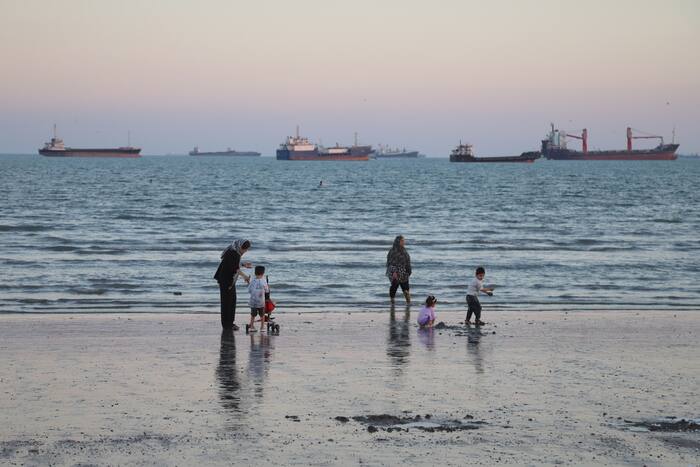
Salt sticks to your skin in Aden before you even step off the tarmac. It is a heavy, clinging heat, the kind that smells of diesel exhaust, dried fish, and the flat, unforgiving glare of the Gulf of Aden. For years, the people living along this jagged southern coastline have learned to read the wind not for rain, but for the distant thud of artillery and the low hum of drones.
Wait.
Listen closely to the outskirts of the city right now, and you will hear a different sound. It is the grinding of heavy earthmovers, the clanking of tank treads, and the barked orders of commanders digging trenches into the volcanic rock north of the port. Saudi-backed forces in Yemen are quietly, methodically fortifying the perimeter around Aden, building a wall of steel and sand to deter a renewed Houthi offensive.
If you only read the wire reports, this looks like another dry footnote in a decade-long war. A troop movement here. A defensive perimeter there. A brief mention of regional negotiations stalling in the background. When you live through the reality of a port city caught in the crosshairs of proxy warfare, however, you know that sandbags are never just sandbags. They are a physical manifestation of dread, a recognition that the fragile quiet holding the region together is fraying at the edges.
The Weight of a Port City
To understand why a few miles of reinforced trenches outside Aden matter to someone sitting thousands of miles away, you have to picture the geography of a bottleneck.
Imagine a hypothetical dockworker named Tariq—let us call him Tariq to stand in for the thousands of men who load and unload cargo along Aden’s Ma’alla terminal every single day. Tariq does not care about geopolitical chessboards. He cares about whether the cranes keep moving, whether his brother in Sanaa can afford flour, and whether the electricity stays on long enough for his daughter to sleep without heat rash. Yet Tariq stands at the exact pressure point where local survival collides with global trade.
Aden sits just east of the Bab el-Mandeb Strait, the narrow maritime throat connecting the Red Sea to the Indian Ocean. Roughly twelve percent of global trade—oil tankers, container ships carrying electronics, vessels loaded with grain—squeezes through that corridor. When Houthi forces in northern Yemen began targeting commercial shipping in the Red Sea in late 2023 and throughout 2024, the world suddenly remembered where Yemen was on a map. Shipping costs exploded. Vessels detoured thousands of miles around the southern tip of Africa. Insurance premiums skyrocketed.
Now, consider what happens if the land war flares back up around Aden itself.
Aden serves as the de facto capital for Yemen’s internationally recognized government, a fragmented coalition propped up by Saudi Arabia and the United Arab Emirates. If Houthi fighters—emboldened by years of asymmetric warfare, hardened by mountainous combat, and armed with ballistic missiles and long-range drones—push south toward the coast, they do not just capture a city. They secure the entire eastern bank of the Bab el-Mandeb. They turn a maritime chokepoint into a permanent stranglehold.
That is why the earthmovers are running day and night. Saudi military planners and their local Yemeni allies—including the Presidential Leadership Council and the Southern Transitional Council, rivals who often barely tolerate one another—are forced to set aside their internal friction and look north. They are building deep defensive lines along the Abyan and Lahij governorates, the mountainous buffers that separate the Houthi-controlled highlands from the coastal plains of Aden.
The Illusion of the Quiet Front
Wars rarely end with a neat signature on a parchment. More often, they rot into an uneasy paralysis that outsiders mistake for peace.
Since the United Nations-brokered truce technically expired in late 2022, Yemen has existed in a twilight zone of "no war, no peace." Full-scale ground offensives largely froze. Saudi Arabia and the Houthis engaged in direct, behind-the-scenes talks in Riyadh and Muscat, searching for an exit ramp that would allow the kingdom to extricate itself from a costly intervention that began in 2015. For a brief window, it felt as though the exhausting arithmetic of attrition had finally forced everyone to the table.
Then the regional tectonic plates shifted.
The war in Gaza, the cross-border exchanges between Israel and Hezbollah in Lebanon, the direct strikes between Iran and Israel, and the Houthi blockade of the Red Sea shattered the diplomatic vacuum. Suddenly, the Houthis—or Ansar Allah, as they call themselves—were no longer just an insurgency fighting for control of Sanaa. They had reinvented themselves as the loudest, most aggressive vanguard of the Iran-backed "Axis of Resistance."
Popularity surged for them at home, even among Yemenis who despised their domestic authoritarianism. Recruiting drives filled training camps across northern provinces. Commanders who had spent two years sitting in stagnant trenches suddenly had fresh recruits, battle-tested drone operators, and an ideological rallying cry that resonated across the Arab street.
Meanwhile, on the other side of the front line, the anti-Houthi coalition looked dangerously fractured.
I remember talking to a humanitarian logistics coordinator who had spent years moving medical supplies between Sanaa and Aden. She described the mental toll of crossing the internal checkpoints—a journey that used to take five hours before 2015 and now stretches into an exhausting, two-day ordeal through washed-out mountain passes and desert detours. "You pass five different militias before you even see the ocean," she told me, her voice flat with exhaustion. "Each one has a different flag, a different tax, and a different boss. And every single one of them knows that if the Houthis actually decide to march south, half of them won't have the ammunition to last a week."
Her observation cuts to the bone of the problem. Defensive fortifications around Aden are not being built from a position of overwhelming confidence. They are being built out of necessity because the coalition defending the south has spent years arguing over who gets to rule Aden, rather than preparing for the enemy waiting in the mountains above it.
Anatomy of a Fragile Alliance
Walk through the streets of Aden, and you will see the flags of the former South Yemen—red, white, and black with a light blue triangle and a red star—flying far more prominently than the flag of the unified Republic of Yemen.
This is the central paradox that makes defending the city so maddeningly difficult. The forces bolstering defenses around Aden are not a single, unified army. They are a patchwork of competing agendas stitched together by Saudi money and shared fear.
On one side sits the Presidential Leadership Council, backed heavily by Riyadh, which nominally represents a unified Yemeni state. On the other sits the Southern Transitional Council, backed historically by the United Arab Emirates, which openly demands the secession of southern Yemen and the restoration of the independent state that existed prior to 1990. Add to that mix the Giants Brigades—disciplined Salafi fighters who have proven to be among the most effective ground troops against the Houthis—and the National Resistance forces led by Tareq Saleh along the Red Sea coast.
When you ask these factions to build a unified defensive perimeter, you are asking rivals to share intelligence, coordinate artillery fire, and trust that the militia guarding their flank will not abandon them—or turn on them—when the shooting starts.
History offers a grim warning here. In August 2019, fighting erupted inside Aden itself between the Southern Transitional Council and forces loyal to the internationally recognized government. Tanks rolled through residential neighborhoods. The presidential palace changed hands in days. It took months of frantic Saudi mediation and the eventual formation of the Riyadh Agreement just to stop the allies from tearing each other apart while the Houthis watched from the north.
Riyadh cannot afford a repeat of 2019. Not now. With Saudi Crown Prince Mohammed bin Salman focused on massive domestic economic transformations—projects that require regional stability and investor confidence—a catastrophic collapse in southern Yemen would be a strategic nightmare. If Aden falls, the Houthis do not just gain a port; they gain leverage over Saudi Arabia’s southern border, over Red Sea shipping, and over the entire Arabian Peninsula.
So Saudi advisors are pouring resources into the perimeter. They are paying salaries that had fallen months behind. They are delivering armored vehicles, anti-drone jamming equipment, and heavy artillery. They are trying to turn a fractured coalition into an immovable object before the Houthis decide to test its resolve.
The Invisible Front Lines Across the Middle East
Zoom out from the dusty ridges outside Aden, and the picture grows even more tangled. The fortification of southern Yemen is happening in the middle of a Middle East that feels perpetually one miscalculation away from a wider regional conflagration.
Across the broader region, the old rules of deterrence have eroded. Look at the diplomatic wires running parallel to the news from Yemen: ceasefire negotiations in Gaza remain trapped between irreconcilable demands over permanent troop deployments and hostage releases; Israeli forces and Hezbollah continue a grinding war of attrition along the northern border that has displaced tens of thousands of families on both sides; and fragile political transitions in Syria and Iraq remain vulnerable to sudden spikes in militia violence.
Every one of these flashpoints feeds into the others like a series of connected pressure valves.
When tensions spike in the Levant, Houthi commanders in Sanaa feel compelled to demonstrate solidarity by launching ballistic missiles toward Israel or harassing vessels in the Gulf of Aden. When the United States and the United Kingdom respond with airstrikes on radar installations and weapons depots in northern Yemen, the Houthis absorb the hits, disperse their mobile launchers into mountain caves, and use the strikes to rally domestic support.
It is an exhausting, circular logic. And the people caught inside it are the ones who have the least say in how it ends.
Consider the economic strangulation happening silently behind the headlines. Yemen was already the poorest country in the Arab world before the civil war began. Today, after more than a decade of conflict, the economy has effectively split into two warring financial systems. The Houthis in the north ban newer banknotes printed by the Aden-based central bank, while the southern currency—the Yemeni rial—has collapsed in value, sending food prices spiraling out of reach for ordinary families.
When the Aden central bank tried to pressure Houthi-controlled banks earlier this year by threatening to cut them off from the international SWIFT banking network, the Houthis responded by threatening to strike Saudi airports and oil facilities. Within weeks, under intense international pressure to prevent a broader regional war, the banking restrictions were walked back.
That episode taught everyone a sobering lesson: the Houthis possess a capacity for escalation that can force regional powers to blink. And if economic leverage fails to contain them, the only remaining deterrent is hard steel on the ground.
What Trenches Actually Buy
Let us return to our hypothetical dockworker, Tariq, standing near the cranes in Aden as the sun drops into the Gulf, turning the water the color of bruised plums.
For Tariq, the arrival of new armored convoys and the digging of fresh trenches north of the city brings a deeply conflicted emotion. On one hand, it means soldiers are getting paid, which means money circulates in the local markets. Shopkeepers sell more tea, more flatbread, more phone cards. The presence of Saudi-backed air defenses means a slightly better chance that an incoming drone will be intercepted before it hits a power station or an oil refinery.
On the other hand, Tariq knows what preparations look like. You do not reinforce a roof unless you expect a hurricane.
The tragedy of Yemen has always been that outsiders view it as a buffer zone, a shipping lane, or a proxy battlefield, while millions of human beings simply view it as home. When diplomats talk about "deterrence," they speak in clean, clinical abstractions: force posture, escalation dominance, maritime security. On the ground, deterrence is dusty boots, lukewarm water in plastic jerrycans, and mothers teaching their children which interior wall of the house is thick enough to stop shrapnel.
Does bolstering defenses around Aden prevent a war, or does it merely ensure that the next battle will be bloodier?
Honest military analysts will tell you that nobody knows for sure. Fortifications work until they do not. In modern warfare, where cheap, GPS-guided drones can fly right over trenches and drop munitions onto supply trucks miles behind the front line, static defense lines have severe limitations. Without unified command, reliable intelligence, and genuine political cohesion among the factions defending the south, even the deepest trench is just a line drawn in the sand.
Yet doing nothing is an invitation to collapse. A vacuum in southern Yemen would be filled within weeks, altering the map of the Middle East for a generation and handing control of one of the world’s most vital waterways to an armed movement answerable to no international body.
The Long Night on the Ridge
Night falls fast along the southern coast of Arabia. Without the glow of reliable municipal streetlights, Aden retreats into pockets of generator-powered light—a neon sign outside a pharmacy, the headlights of a pickup truck mounted with an anti-aircraft gun, the faint orange flare of a refinery stack in the distance.
Up in the rocky passes of Lahij and Abyan, where the coastal humidity gives way to sharp, cool mountain air, young men in mismatched uniforms sit behind sandbags piled high against the dark. Many of them are barely twenty years old. They have never known a Yemen that was not at war. They drink sweet, milky tea from dented metal cups, scroll through videos on cracked smartphone screens, and stare out into the black expanse of the mountains where another set of young men, speaking the same language and praying toward the same horizon, sit behind another line of sandbags waiting for orders.
The excavators have stopped for the night. The engines are cooling, ticking softly in the silence. Tomorrow morning, when the sun comes up over the Gulf of Aden and the heat begins to rise off the salt flats once more, they will start digging again.