The rain in Beijing during mid-May has a way of making the massive, gray stones of the Great Hall of the People look even heavier than they are. Outside, the square is an expanse of concrete, scrubbed clean, empty of everyone except the soldiers who stand so still they look like iron statues. Inside, the air smells of plush carpets, faint green tea, and the specific, metallic scent of high-stakes diplomacy.
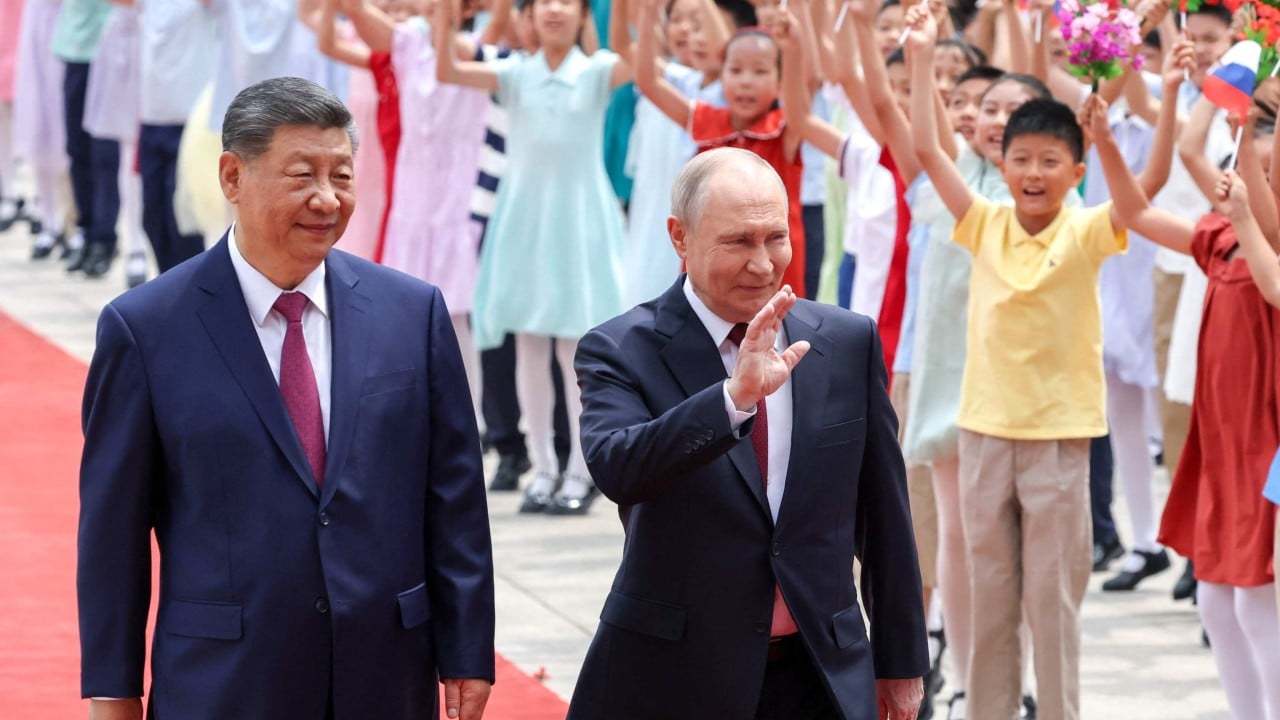
Two men walk down a crimson carpet. One moves with the measured, slow deliberate steps of a man who views time not in election cycles, but in centuries. The other walks with a slight, familiar roll, his eyes scanning the room with the practiced vigilance of an old intelligence officer.
Xi Jinping and Vladimir Putin.
To the Western eye, watching through a television screen thousands of miles away, this looks like a corporate merger. The news tickers scroll with dry figures: trade volumes, energy pipelines, joint military exercises. But if you strip away the teleprompter language, this meeting is not about data points. It is about an intense, calculated, and deeply human gamble. It is a story of two men who believe the current world order is a coat that no longer fits them, and they are determined to rip it apart at the seams.
Imagine standing at the back of that ceremonial hall. The silence between the official translated remarks is where the real history happens. It is in the brief nods, the shared glances, the heavy realization that both leaders have backed themselves into corners where failure is not an option. This is the reality behind the press releases.
The Geography of Solitude
To understand why a Russian president flies to Beijing just days after being sworn in for another six-year term, you have to look at the map through his eyes. For decades, Moscow looked West. It wanted the approval of Paris, London, and Washington. It wanted its oligarchs in Mayfair and its gas flowing into Germany.
That world is gone. The doors are locked. The bank accounts are frozen.
When Vladimir Putin stepped off his plane into the humid Beijing air, it was an explicit admission that Russia’s future now runs through Asia. It is a forced pivot, yes, but one executed with immense theatrical pride. The Kremlin wants the world to see that Russia is not isolated.
But look closer at the power dynamic. It is a masterclass in unspoken leverage.
China is currently throwing a lifeline to a struggling neighbor, but lifelines are never free. In the grand tea houses of Beijing’s leadership compounds, there is a acute awareness that Russia needs China far more than China needs Russia. Russian factories, stripped of Western microchips, now rely on Chinese tech. Russian citizens buy Chinese cars. The ruble is increasingly dependent on the yuan.
For the Chinese leadership, this is a delicate dance. They are hosting a man who is actively waging a war that disrupted global markets, a war that made Europe—China’s massive trading partner—deeply uncomfortable. Yet, they cannot let him fail. A collapsed Russia means a pro-Western government on China’s northern border. That is the nightmare scenario Beijing will spend trillions to avoid.
The Chemistry of the Long Game
We often treat international relations like a chess game played by computers. We forget that the pieces are moved by human hands, driven by human egos and shared grievances.
Xi and Putin have met dozens of times. They call each other "old friend." This is not just diplomatic fluff; it is a shared worldview forged in the fires of the late twentieth century. Both men watched the collapse of the Soviet Union with horror. Both viewed it not as a triumph of democracy, but as a preventable tragedy, a cautionary tale of what happens when a state loses its grip on authority.
Their bond is built on a shared diagnosis of the world’s problems. They believe the United States and its allies have had the microphone for too long. They are tired of being lectured on human rights by nations with their own bloody histories.
Consider the sheer scale of what they signed during these talks. It was a joint statement that ran thousands of words, covering everything from outer space to artificial intelligence. But the subtext of every paragraph was identical: We are building an alternative.
They are constructing a financial parallel universe where the U.S. dollar cannot reach, where sanctions lose their teeth, and where two autocracies can determine the rules of global commerce without asking permission from Wall Street or Brussels.
But do not confuse a shared enemy with a shared destiny.
The Quiet Friction
Behind the toasts and the smiles, there is a deep, historical wariness that no amount of state television coverage can fully erase.
Historically, Russia was the big brother in the communist bloc. In the 1950s, Soviet engineers flooded China to build factories and train technicians. Now, the roles are completely reversed. China’s economy dwarfs Russia’s. China’s tech sector leaves Moscow in the dust.
This shift hurts. It pricks the pride of a Russian elite that still views itself as a superpower.
During the talks, the public focus was on energy. Russia wants to build the Power of Siberia 2 pipeline, a massive artery that would redirect the gas that used to heat Berlin straight into the factories of Shanghai. It sounds like a perfect match. Russia has the fuel; China has the appetite.
Yet, notice what was not announced with grand fanfare. The final, definitive agreement on the pipeline remains elusive. Why? Because Beijing knows it holds all the cards. China can afford to wait, haggling for the absolute lowest price, knowing Russia has no other buyers left for that specific gas. It is a brutal business reality wrapped in the velvet language of a strategic partnership.
Then there is the shadow of Central Asia. For two centuries, Moscow considered the vast steppes of Kazakhstan, Uzbekistan, and Kyrgyzstan its own backyard. Today, Chinese investment is everywhere. New roads, high-speed rails, and deep-water ports are being built with Chinese capital, quietly displacing Russian influence. It is a slow, peaceful conquest, conducted not with tanks, but with checkbooks.
Putin must watch this happen, smile, and shake Xi's hand. He has no choice.
The Human Ripple Effect
It is easy to get lost in the high-altitude politics of Beijing, but the decisions made in those gilded rooms eventually trickle down to ordinary lives in ways that are deeply unpredictable.
Think of a small-scale entrepreneur in Vladivostok, a Russian port city just a stone's throw from the Chinese border. A few years ago, his shop was full of Japanese electronics and European clothing. Today, his shelves are entirely Chinese. His children are learning Mandarin instead of English. His financial survival depends entirely on the stability of a currency regulated by the People's Bank of China.
Or think of a factory worker in Shenzhen, producing industrial machinery that will eventually find its way into a Russian military repair facility. He doesn't care about the geopolitics of the Donbas or the expansion of NATO. He cares about his overtime pay. Yet, his daily labor has become a vital cog in a war machine thousands of miles away, drawing the ire of Western governments that are now threatening to sanction his employer.
The world is decoupling. The globalized marketplace that promised to bring peace through trade is fracturing into distinct blocks. We are being asked to choose sides, even if we don’t realize it yet.
The Mirage of the "No Limits" Alliance
Before the tanks rolled across the Ukrainian border, Xi and Putin declared their friendship had "no limits." It was a phrase that sent chills through Western capitals.
But these Beijing talks proved that limits do exist. They are defined by cold, hard national interest.
China will help Russia survive. It will buy its oil, sell it consumer goods, and shield it from total isolation at the United Nations. But China will not risk its own economic survival for Moscow. Beijing’s banks remain cautious about violating Western sanctions because they cannot afford to be cut off from the U.S. dollar ecosystem. China's leaders are ambitious, but they are pragmatic. They are not ideologues willing to go down with someone else's ship.
The meeting in Beijing was not a celebration of a perfect union. It was a clear-eyed acknowledgement of a mutual need.
As the state dinners concluded and the motorcades sped away through the damp Beijing night, the heavy silence returned to Tiananmen Square. The two leaders left behind a world that is fundamentally different from the one they inherited. They have set a stone rolling down a hill, and neither of them truly knows where it will stop, or who it will crush along the way. All they know is that they are holding the wheel together, for now.