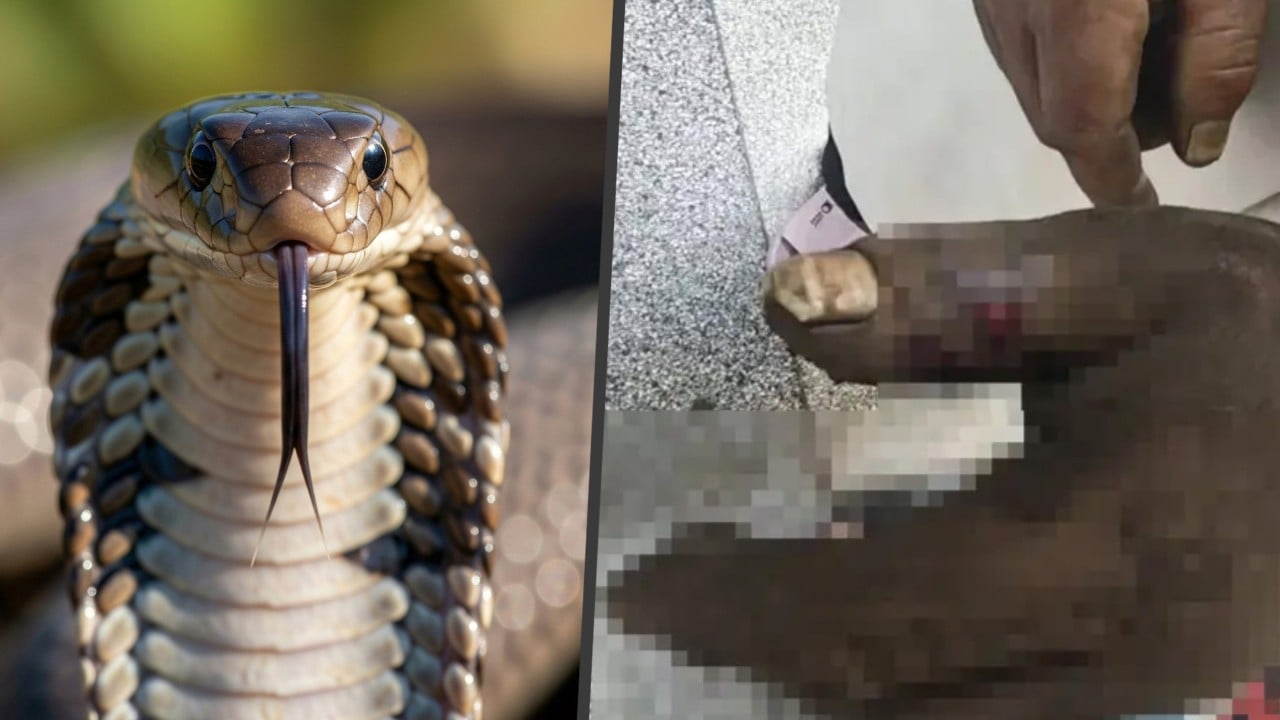
Sucking venom out of a snakebite wound does not save lives. It endangers them. When a woman in China recently made headlines for attempting to extract venom from her husband’s hand following a cobra bite, she became the latest face of a persistent, dangerous medical misconception. Instead of neutralizing the crisis, she ingested the toxins through microscopic tears in her own mouth, resulting in her own immediate hospitalization. This double tragedy underscores a systemic failure in public health education. Decades of cinematic tropes and old wives' tales have deeply ingrained a counterproductive first-aid response that actively accelerates bodily harm.
The reality of snake envenomation requires an understanding of human anatomy that contradicts popular belief. When a venomous snake like a cobra strikes, it does not deposit its toxic payload into a neat, static pool just beneath the surface of the skin.
How Venom Actually Moves Through the Body
Venom delivery is an efficient, highly pressurized subcutaneous or intramuscular injection. The fangs act as hypodermic needles, pushing the fluid deep into tissue planes. Once inside, the venom does not sit idly waiting for a rescuer's mouth or a commercial suction pump. It diffuses rapidly.
The human lymphatic system acts as the primary highway for this transport. Unlike the circulatory system, which pumps blood rapidly via the heart, the lymphatic system relies on interstitial fluid pressure and muscle movement to transport lymph toward the torso. Because venom molecules are often large proteins, they enter the lymphatic capillaries rather than the blood vessels.
Trying to suck this fluid out with human mouth pressure is mechanically impossible. The negative pressure generated by human suction cannot overcome the tissue pressure and cellular binding that occurs almost instantly upon injection. Studies utilizing mock venom have demonstrated that even commercial suction devices remove less than two percent of the injected material, even when applied within three minutes of the strike. By the time a bystander places their lips over a wound, the vast majority of the destructive proteins are already moving through the victim's deep tissue networks.
The Secondary Poisoning Mechanism
The human mouth is filled with microscopic abrasions, minor gum bleeding, and open mucosal pathways. Introducing highly concentrated elapid venom into this environment is a recipe for self-poisoning.
Cobras possess predominantly neurotoxic venom. These toxins target the nervous system, specifically blocking acetylcholine receptors at the neuromuscular junction. This disruption stops communication between nerves and muscles, leading to progressive paralysis. When someone attempts to suck this venom, the mucous membranes of the mouth absorb the toxins with alarming speed.
The savior quickly becomes a second patient. The swelling of the airway, numbness of the tongue, and potential respiratory failure can occur just as rapidly in the rescuer as in the primary victim. This creates a nightmare scenario for emergency medical technicians who arrive on a scene only to find two critical patients instead of one, effectively halving the resources available for immediate stabilization.
The Destructive Legacy of Popular Culture
Western cinema and adventure novels bear a massive responsibility for the survival of this medical myth. For generations, rugged protagonists have been depicted using knives to slash an 'X' over a bite mark and using their mouths to spit out blackish venom. This imagery is deeply embedded in the collective consciousness.
When panic sets in during a real-life crisis, the human brain defaults to these deeply ingrained cultural scripts. Logic takes a backseat to primal survival instincts. The urge to do something overrides the clinical reality that doing nothing is often safer than doing the wrong thing.
The incision-and-suction method actually compounds the local tissue damage exponentially. Slashing the skin opens up new pathways for secondary bacterial infections. The human mouth introduces a swarm of pathogens, including harmful oral flora, directly into an already compromised wound. Furthermore, local tissue destruction from certain venoms, such as those of vipers, causes severe bruising and necrosis. Adding mechanical suction or lacerations to this localized horror show simply accelerates tissue death, frequently leading to unnecessary amputations.
What Modern Protocols Demanded Instead
The evolution of snakebite first aid has moved entirely away from interventionist heroics toward strict stabilization. The gold standard of care focuses on slowing the spread of the venom without causing structural damage to the affected limb.
+------------------------------------------+
|       MODERN SNAKEBITE PROTOCOL          |
+------------------------------------------+
|  1. REMOVE THE VICTIM FROM DANGER        |
|  2. CALM THE PATIENT (LOWERS HEART RATE) |
|  3. IMMOBILIZE THE LIMB AT HEART LEVEL   |
|  4. REMOVE CONSTRICTIVE JEWELRY/CLOTHING |
|  5. TRANSPORT IMMEDIATELY TO ANTIVENOM   |
+------------------------------------------+
Immobilization is the most critical factor under human control. Because venom travels primarily through the lymphatic system, keeping the bitten limb completely still minimizes the muscle contractions that pump lymph toward the vital organs. The limb should be held at a neutral level, neither elevated nor dangling. Elevating the limb can accelerate the systemic spread of the venom, while lowering it can worsen the agonizing local swelling.
The Pressure Immobilization Technique
For specific neurotoxic snakes, like many Australian elapids and certain sea snakes, the Pressure Immobilization Technique is highly effective. This involves wrapping a broad bandage firmly around the entire limb, starting from the fingers or toes and moving upward, at a tightness similar to what you would use for a sprained ankle.
This bandage physically constricts the shallow lymphatic channels, trapping the venom locally and buying precious hours for transport. However, this technique is not universally applicable. For cytotoxic venoms, such as those from many North American pit vipers, trapping the venom in one place can cause localized tissue to liquefy entirely. This divergence in treatment emphasizes why immediate transport to a medical facility with species-specific antivenom is the only definitive cure.
The Global Antivenom Deficit
The reliance on primitive first-aid techniques is often fueled by a lack of faith in, or access to, modern medical infrastructure. Snakebite is a neglected tropical disease that strikes rural and impoverished areas with disproportionate ferocity.
Antivenom production remains an archaic, expensive process. It requires harvesting venom from live snakes, injecting sub-lethal doses into horses or sheep, and then collecting and purifying the antibodies produced by the animals. This process makes antivenom costly to manufacture, difficult to store due to refrigeration requirements, and scarce in the very regions where bites occur most frequently.
When rural populations know that the nearest clinic is hours away and might not even stock the necessary antivenom vials, they turn to traditional, folklore-driven interventions. The tragedy in China is a stark reminder that managing snakebites requires more than just educating the public; it demands a reliable supply chain of medical countermeasures. True safety lies not in the hands of a well-meaning bystander trying to extract poison with their teeth, but in the availability of a refrigerated vial of targeted antibodies and a clear path to the nearest emergency room.