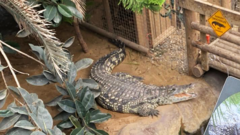
The standard breaking news script is entirely predictable. A horrific incident occurs—in this case, a three-year-old child fighting for life after a crocodile attack, followed by the collective sigh of relief when local authorities announce the victim is no longer in critical condition. The media runs the story, the public reacts with a mix of horror and sympathy, and the conversation halts at the surface.
This reactive news cycle feeds a dangerous illusion. It frames predator encounters as freak, isolated anomalies or, worse, as malicious acts by rogue monsters that need to be culled.
Both narratives are wrong.
By focusing entirely on the visceral shock value of a single predatory strike, mainstream reporting completely misses the structural failure of risk management, habitat encroachment, and public education. The lazy consensus insists that public safety is achieved by tracking down the specific reptile involved. The uncomfortable reality is that human behavior, lax zoning, and tourist ignorance are the actual variables driving these stats.
The Myth of the Rogue Predator
Every time an apex predator defends its territory or acts on its evolutionary programming, the media defaults to "monster" framing. We saw it with Jaws, we see it with grizzly bears, and we see it with saltwater and Nile crocodiles. The immediate public outcry demands a hunt.
Wildlife management professionals know this is a theater of safety.
Crocodiles are ectothermic, apex predators that have survived virtually unchanged for millions of years. They do not hunt out of malice; they hunt out of proximity and opportunity. When we label an animal "critical" or "dangerous" only after it interacts with a human, we ignore the baseline reality of the environment.
Imagine a scenario where a municipality builds a playground next to a known high-density nesting ground of an apex predator, puts up a single, faded sign, and then expresses shock when an accident occurs. The predator didn't change its behavior. The humans changed the math.
Managing these apex reptiles requires acknowledging that culling individual animals does absolutely nothing to lower the statistical probability of future attacks. When you remove one dominant male crocodile from a territory, you merely open up a vacancy for the next mature predator to move in. The risk profile of the waterway remains exactly the same, yet the public is lulled into a false sense of security because "the beast was caught."
The Real Numbers the Media Ignores
Let’s look at the actual data surrounding crocodilian attacks worldwide. While a single attack on a child rightly stirs intense emotional responses, policy and public awareness cannot be dictated by emotion.
Globally, crocodilian species are responsible for an estimated 1,000 fatal attacks per year. By comparison, hippopotamuses kill roughly 500 people, elephants around 500, and domestic dogs kill tens of thousands through rabies transmission and physical trauma. Yet, the systemic infrastructure to manage domestic animal risks or regional wildlife boundaries receives a fraction of the sensationalized coverage dedicated to a single reptile strike.
More importantly, look at the correlation between population growth, tourism booms, and attack spikes. In regions like Queensland, Australia, or parts of Southeast Asia and Sub-Saharan Africa, the data shows a direct lockstep tracking between human encroachment into riparian zones and negative wildlife interactions.
It isn't that crocodiles are becoming more aggressive. It's that our buffer zones are disappearing.
The Flawed Questions People Ask
When these stories break, the search trends and public forums fill up with the same fundamentally flawed questions. Dismantling these common queries reveals how deep the misunderstanding goes.
Are crocodiles actively hunting humans?
No. Crocodiles are opportunistic ambush predators. They react to movement, splashing, and silhouettes at the water's edge. They do not differentiate between a wallaby, a domestic dog, or a human child. To a crocodile, anything entering its strike zone that fits its size parameters is potential prey. Framing this as "active hunting of humans" distorts the biological reality and prevents people from understanding that any presence in the water is the trigger, regardless of intent.
Can we just relocate dangerous crocodiles to remote areas?
This is a favorite solution of politicians looking to appease both voters and conservationists. It rarely works. Large crocodilians possess highly sophisticated homing instincts. Groundbreaking tracking studies have shown relocated crocodiles traveling hundreds of kilometers across open ocean and rugged terrain to return to their original capture sites. If they don't return, they often clash with the resident crocodiles of the release site, leading to violent territorial battles that result in the death of one of the animals anyway. Relocation is often just a delayed death sentence or a temporary pause on local risk.
Why don't we just fence off all public waterways in crocodile territory?
This question highlights a total lack of geographic scale. You cannot fence tens of thousands of kilometers of complex, shifting river systems, mangrove swamps, and tidal estuaries. Even where physical barriers are erected, seasonal flooding routinely destroys them or allows apex predators to swim right over the top. Relying on physical infrastructure to separate humans from prehistoric predators is a logistical impossibility.
The Cost of the "Safety" Illusion
Throughout my years analyzing wildlife management protocols and tracking land-use policies, I have seen regional boards spend millions on superficial safety measures. They print shiny brochures, install high-tech cameras, and deploy drone teams to spot shadows in the water.
It is a massive waste of resources.
The downside of my contrarian approach—which demands total human accountability and strict exclusion zones—is that it is deeply unpopular. It requires telling people they cannot swim where their parents swam. It requires telling developers they cannot build luxury resorts right on the edge of prime reptile habitats. It requires penalizing parents and individuals who ignore posted warnings.
But the alternative is the status quo: waiting for a tragedy, hunting an animal, running a sensationalized news piece, and waiting for the next strike.
True safety does not look like a dramatic capture on the nightly news. True safety looks boring. It looks like enforced zoning laws, massive fines for feeding wildlife, and an absolute refusal to compromise with human convenience when entering an apex predator's domain.
Stop blaming the reptile for acting like a reptile. Lock down human behavior, respect the biological boundaries of the environment, or accept the inevitable consequences of stepping into the food chain.