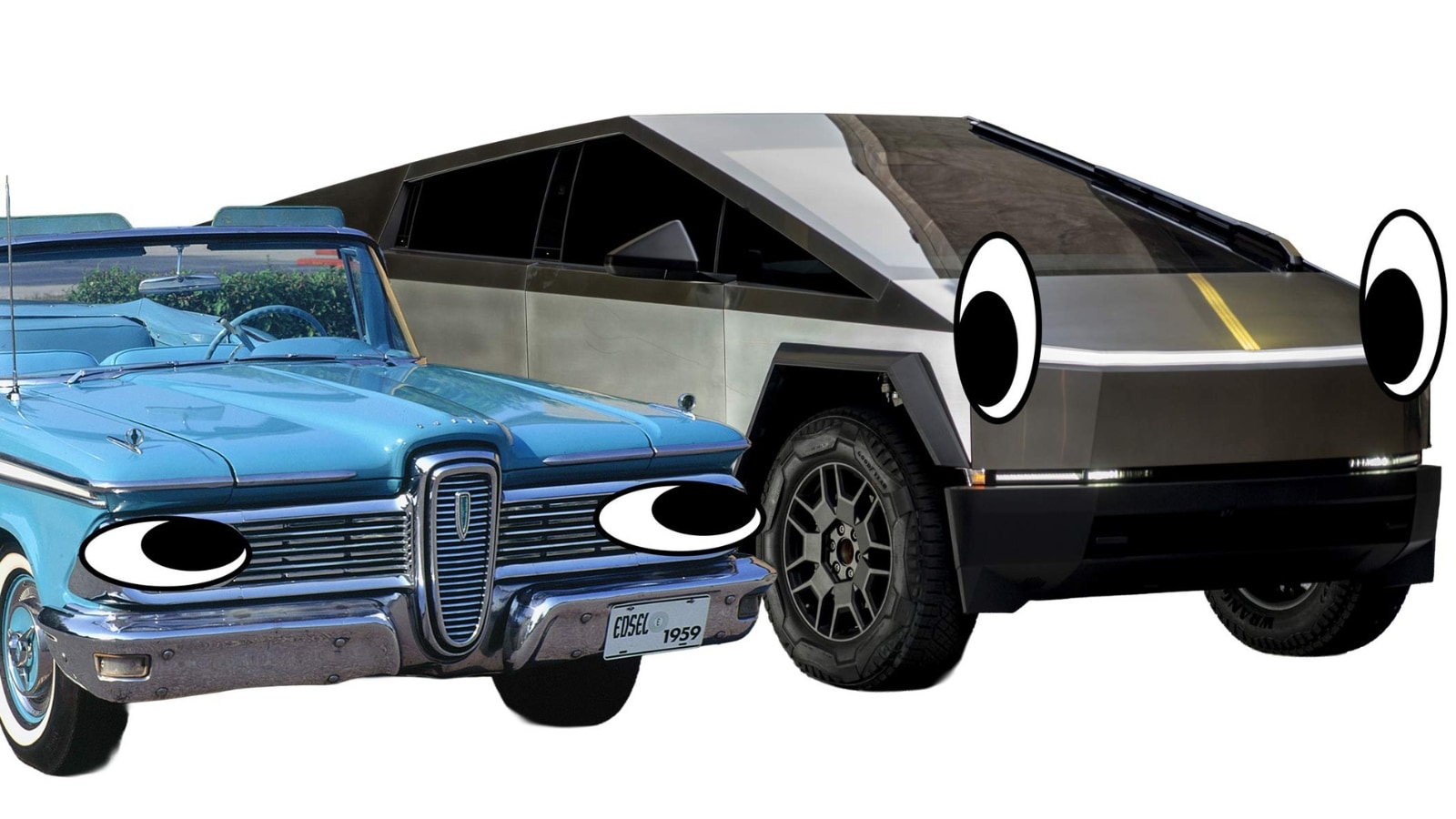
Automotive pundits are practically tripping over their vintage fenders to declare the Tesla Cybertruck the modern Ford Edsel. They point at the registration numbers—fewer than 40,000 units in 2024 and an even steeper drop-off into 2026—and gleefully declare an expensive disaster. They run the math against original promises of 250,000 annual units and $40,000 price tags, arriving at the comfortable, lazy consensus that Elon Musk built an unsellable, stainless-steel paperweight.
They are completely missing the real story.
Comparing the Cybertruck to the 1958 Ford Edsel reveals a fundamental misunderstanding of how capital allocation and manufacturing R&D operate in high-risk technology companies. The Edsel was a marketing blunder built on standard Ford chassis components, offering zero technical innovation while creating an entire redundant dealer division that nearly drained Ford's balance sheet.
The Cybertruck is the exact inverse. It is a Trojan horse for radical, platform-level manufacturing innovations that Tesla needed to validate at low volumes before porting them to high-volume, lower-margin mass vehicles.
The Fallacy of the Edsel Comparison
Every auto analyst loves a familiar historical narrative. When Ford launched the Edsel in September 1957, executives projected 200,000 sales in year one. Instead, buyers bought roughly 63,000 units before sales plummeted to 44,000 in year two, costing Ford roughly $350 million—over $2.5 billion in adjusted modern currency.
The main cause of the Edsel disaster was structural overhead. Ford didn't just build a weird car with a controversial front grille; they created a whole standalone division. They signed up over 1,000 dedicated dealerships, built dedicated logistics pipelines, and spent millions on marketing campaigns for a vehicle that shared nearly all its mechanical underpinnings with existing Ford and Mercury models. When the market rejected the styling, Ford had no underlying asset to show for its massive capital deployment.
Tesla did none of this.
- Tesla created zero new retail dealership overhead to support the pickup.
- Tesla shared service, distribution, and battery assembly infrastructure with existing Model Y and Model 3 supply chains.
- Tesla used the Cybertruck to absorb the initial capital expenditure of developing 48-volt electrical architecture, steer-by-wire mechanics, and high-yield stainless steel stamping.
The narrative that Cybertruck is an enterprise-killing failure ignores basic corporate finance. I have watched legacy Detroit automakers spend billions on conventional platform refreshes that yielded zero intellectual property or engineering advancements. Detroit burns cash on chrome trim updates. Tesla burned cash to re-engineer vehicle architecture from the ground up.
What the Mainstream Media missed About 48-Volt and Steer-By-Wire
When you build a low-volume halo product, the primary goal is not always immediate unit volume—it is field-testing hardware that legacy carmakers are too risk-averse to touch.
For over three decades, the automotive industry knew that 12-volt electrical systems were wildly inefficient. As modern vehicles added advanced computers, infotainment systems, active suspensions, and drive-by-wire actuators, the copper wiring harnesses inside cars grew heavier, thicker, and absurdly complex. Moving to a 48-volt architecture reduces electrical current by a factor of four, allowing engineers to shrink wire thickness, drop vehicle weight, and save massive assembly labor costs.
Legacy OEMs refused to transition because changing supplier ecosystems for a mass-market sedan carrying a $30,000 sticker price is financial suicide if something goes wrong.
Tesla used early-adopter Cybertruck buyers—who willingly paid six-figure prices for early "Foundation Series" badges—to subsidize the real-world validation of a 48-volt architecture and ethernet-based zone controllers.
Legacy 12V Architecture:
[Heavy Copper Wire Harness] ---> [Distributed Relays] ---> [High Power Draw]

Tesla 48V Architecture:
[Thin Copper/Ethernet Loop] ---> [Zone Controllers] ---> [75% Weight Reduction]
Consider what else was validated on this supposed "flop":
- Pure Steer-By-Wire: Replacing mechanical steering columns with redundant electric actuators and variable-ratio software inputs.
- Structural Stainless-Steel Exterior: Eliminating traditional paint shops—historically the most capital-intensive and environmentally regulated part of any auto plant.
- Gigacasting at Scale: Massively reducing individual stamped parts into unified rear and front megacasts.
If Tesla had tried to introduce steer-by-wire and 48-volt zone controllers directly into a $25,000 high-volume commuter car, any initial recall or hardware glitch would have paralyzed the entire corporate revenue engine. By isolating these experimental systems inside a niche, polarizing truck, Tesla forced its engineering teams to solve production bottlenecks on a small production run while charging wealthy enthusiasts a premium for the privilege of being beta testers.
Dismantling the "People Also Ask" Objections
Public discussion surrounding the Cybertruck is filled with flawed assumptions. Address these common questions directly, and the narrative shifts entirely.
"Didn't Tesla lose billions on low sales volumes?"
No. Capital expenditures at Gigafactory Texas were largely allocated toward scaling structural battery manufacturing and heavy casting machinery that will outlive the Cybertruck's current model cycle. The tooling developed for high-voltage power distribution and drive-by-wire software is reusable across every future platform Tesla builds. The sunk cost is not lost capital; it is accelerated R&D.
"Why did traditional pickup truck buyers reject it?"
Because the Cybertruck was never actually designed for commercial fleet managers or rural ranch hands, despite the initial marketing bravado. Traditional truck buyers want standardized bed sizes, drop-in aftermarket racks, predictable diesel or gas ranges, and simple mechanical repairs. The Cybertruck was targeted at suburban tech workers, brand collectors, and urbanites who wanted a rolling statement piece. Failing to capture the rural work-truck market is not a disaster when that market was never going to adopt an ultra-futuristic stainless wedge in the first place.
"Isn't the stainless steel body a dangerous engineering mistake?"
It is an extremely difficult manufacturing challenge, but calling it a mistake ignores the long-term play. Eliminating traditional paint lines reduces factory footprint and energy consumption dramatically. While initial tolerances and panel gaps caused production headaches, mastering thick cold-rolled steel stamping gives Tesla proprietary metallurgical manufacturing expertise that traditional automakers outsource to third-party suppliers.
The Brutal Truth About Halo Vehicles
Let’s be completely transparent: from a pure consumer product perspective, the Cybertruck carries substantial downsides that cannot be hand-waved away.
- Extreme Depreciation: Early buyers who paid over $100,000 are seeing secondary market values drop precipitously as the initial buzz fades.
- Service Overhead: Unconventional body panels and complex electronics mean independent repair shops cannot touch these vehicles, placing a heavy burden on Tesla's service centers.
- Polarizing Aesthetics: The styling turned off millions of mainstream buyers who might have otherwise considered an electric truck from Tesla, effectively handing market share in the conventional truck segment to rival EV designs.
Admitting these drawbacks does not invalidate the underlying strategic value. History is filled with brilliant technological catalysts that were commercial duds in their first iteration.
Consider the original 1981 DeLorean DMC-12 or the 1999 Honda Insight. The Insight sold poorly compared to the Civic, but it perfected Honda's Integrated Motor Assist hybrid drivetrain that powered millions of civilian vehicles over the subsequent two decades. The vehicle itself was merely the envelope; the technology inside was the true product.
The Real Winner of the Pickup Wars
The lazy analysis looks at 2026 registration charts, sees single-digit sales growth, and writes a eulogy.
The rigorous analysis looks at the intellectual property ledger. While legacy Detroit manufacturers are cutting back on their early EV investments and writing off billions in unstandardized battery factories, Tesla has successfully operationalized 48V wiring systems, steer-by-wire software validation, and massive structural casting techniques.
Competitors will spend the next five years buying teardown Cybertrucks, taking apart their zone controllers, and scrambling to reverse-engineer electrical architectures that Tesla has already running on public roads in tens of thousands of units.
The Ford Edsel left behind a caution tape of how bad branding and poor market research can bankrupt a division. The Cybertruck leaves behind a blueprint for how to force an entire industry into modernizing its core electrical and manufacturing standards, funded entirely by early adopters willing to buy a polygon on wheels.
Stop evaluating tech companies through the lens of a 1950s dealership showroom. The Cybertruck isn't Tesla's Edsel—it's their most aggressive, real-world R&D lab disguised as a street-legal vehicle.