The rain in eastern Democratic Republic of Congo does not just fall. It pounds against the thin blue plastic sheets of the displacement camps, creating a deafening roar that drowns out everything else. Underneath one of these tarps, a woman sits in the dark. Let us call her Marie. She is a hypothetical compilation of the countless mothers currently holding their breath in the mud outside of Goma, but her fear is entirely real. Marie is listening to her youngest child breathe. The breaths are too fast, too shallow, and accompanied by a heat that radiates through the thin blanket.
In a standard news report, Marie’s agony is reduced to a fractional increase in a mortality graph. The headlines warn of a spiking death rate. They mention numbers, percentages, and geographical coordinates. But statistics cannot capture the specific terror of watching a child bleed from the gums, or the impossible choice a parent faces when the simple act of comforting a dying toddler could mean wiping out the rest of the family.
An invisible line has been crossed in these camps. For months, hunger and cholera were the familiar monsters. People knew how to fear them. But now, a different whisper moves through the crowded rows of shelters. Ebola.
The word itself carries a historic weight in this part of the world. It is not just a disease; it is a memory of isolation, of burial teams in terrifying white suits, and of communities fractured by mistrust. When the death rate in a displaced persons camp begins to climb unexpectedly, that memory transforms into an active, breathing panic.
The Arithmetic of Containment
To comprehend how a virus transforms a refuge into a trap, consider the basic geometry of a displacement camp. These settlements are built out of sheer necessity, often overnight, as people flee armed conflict in the surrounding hills. Shelters sit inches apart. Families of six or seven pack into spaces meant for two.
In everyday life, we take distance for granted. If someone sneezes on a subway, we turn our heads. If a family member falls ill, they get their own bed, perhaps their own room. In the camps of North Kivu, distance is a luxury that vanished long ago.
When a highly contagious pathogen enters an environment like this, the math turns hostile. Ebola spreads through direct contact with bodily fluids. In a clean, spacious medical facility, containing it requires strict protocols but is entirely possible. In a sea of tents where hundreds of people share a single latrine, containment becomes a daily mathematical improbability.
Every shared basin of water, every communal meal, and every touch of a feverish forehead becomes a potential point of transmission. The very instincts that make us human—the urge to hold a crying child, to wash the body of a deceased relative, to gather in grief—become the virus's primary pathways.
The Friction of Trust
The real battle during an outbreak is rarely fought in the laboratory. It is fought in the human mind.
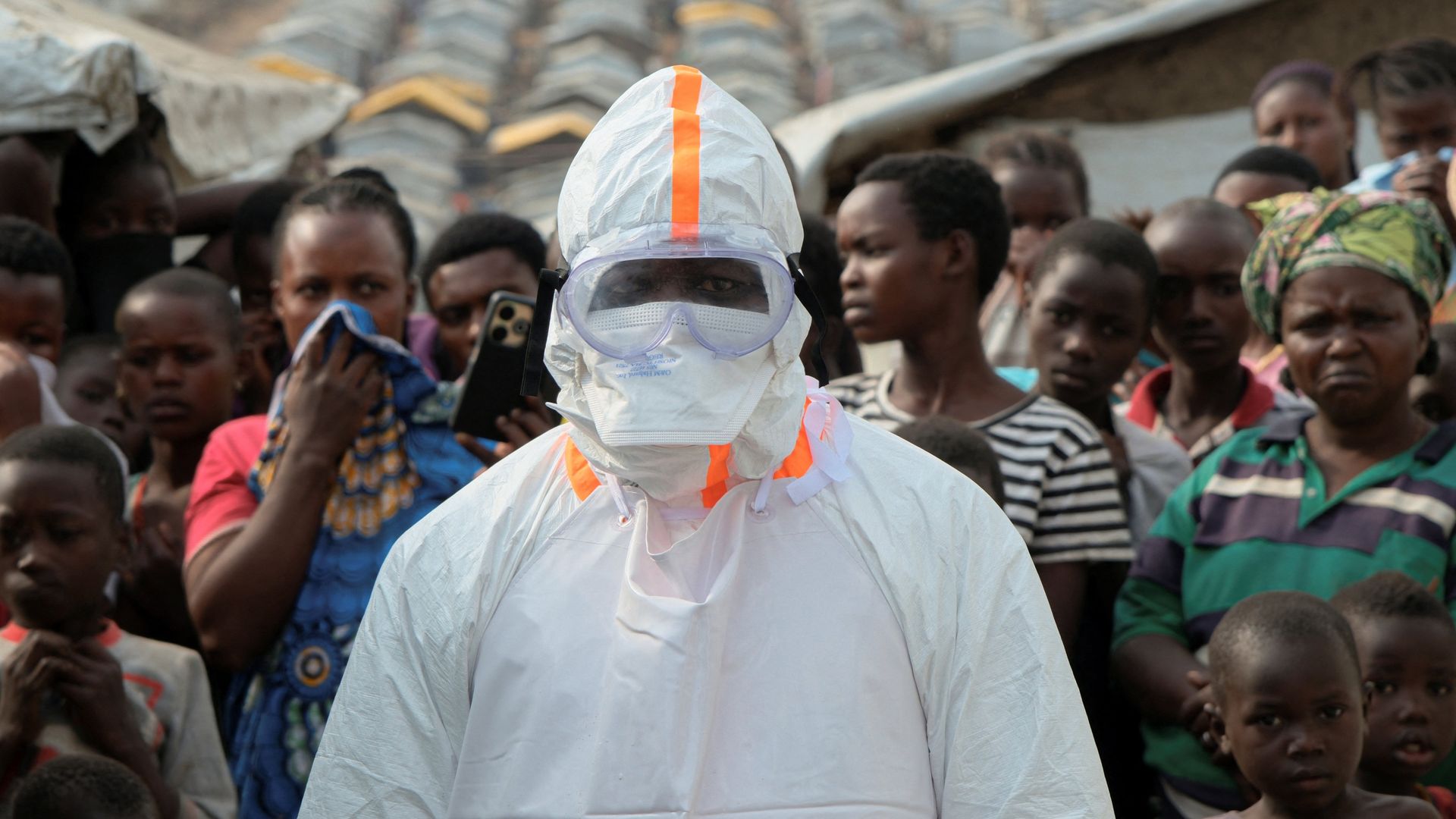
Imagine fleeing your village because of gunfire, walking for days without food, and finally arriving at a camp only to find that people are dying of a mysterious fever. Suddenly, trucks arrive. Strangers descend wearing heavy goggles and thick rubber gloves, looking less like doctors and more like creatures from another planet. They take your loved ones away to isolation zones behind high fences. Sometimes, those loved ones do not come back.
It is entirely rational for a community to respond to this with profound skepticism. Rumors spread faster than the fever. Some believe the treatment centers are where people go to die, not to heal. Others suspect the disease is a political invention or a scheme by foreign organizations to secure funding.
This skepticism is not born out of ignorance; it is born out of a history of abandonment. When a population has been neglected by the global community during decades of conflict, they do not automatically trust that same community when it arrives in the middle of a health crisis.
Breaking this cycle requires more than just distributing medicine. It requires sitting on the dirt floor, listening to the fears of the elders, and acknowledging the trauma that preceded the virus. Until that trust is established, medical interventions remain ineffective. People will hide their sick relatives under tarps, preferring to let them pass away in the comfort of family rather than risk sending them to an anonymous isolation ward.
The Collateral Cost
When a shadow like Ebola falls over a region, it changes the value of every other medical emergency. The health system, already fragile, tilts entirely toward containment.
Consider what happens next: a mother goes into obstructed labor, but the local clinic has been converted into an isolation triage unit. A toddler develops severe malaria, but the healthcare workers are exhausted, out of supplies, or too terrified of infection to perform routine blood tests without extensive protective gear. The spike in the death rate is rarely caused by the virus alone. It is driven by the collapse of everything else.
The tragedy of the current situation in the DRC is that the world possesses the tools to stop this. We have highly effective vaccines. We have therapeutics that, if administered early, drastically increase the chances of survival. The failure is not scientific; it is logistical and humanitarian. The tools exist, but they are sitting in warehouses or stuck behind bureaucratic red tape and security checkpoints while the mud in the camps grows thicker.
The Mirror of Global Health
It is easy to look at a map of Central Africa and view this crisis as a distant, isolated tragedy. That is a dangerous illusion.
An outbreak in a displacement camp is a vulnerability for the entire global network. In an interconnected world, a virus does not respect borders, conflict zones, or the boundaries of a refugee settlement. The conditions that allow a pathogen to simmer and spike in North Kivu are the exact conditions that allow new variants and strains to emerge and eventually find their way into international transit hubs.
Investing in the health infrastructure of a displacement camp is not an act of distant charity. It is a fundamental requirement for global security. It is an acknowledgment that the health of a child in Goma is intrinsically linked to the health of a commuter in London, New York, or Tokyo.
The rain eventually stops in North Kivu, leaving behind a heavy, humid stillness. In that quiet, the work continues. Local volunteers, often young people from the camps themselves, walk from tent to tent with plastic buckets of chlorinated water and educational flyers. They do not have advanced medical degrees, but they have something far more valuable: the trust of their neighbors.
They are the ones turning the tide, one conversation at a time, convincing a terrified community to let the doctors help. The future of the outbreak hangs on whether the rest of the world will provide them with the resources to finish the job before the next storm arrives.