For decades, the standard playbook of conservation has remained blissfully unchanged. A wealthy benefactor or a well-meaning couple purchases a massive tract of land, slaps a strict preservation order over most of it, and calls it a victory for biodiversity. They lock the gates, walk away, and congratulate themselves on saving nature from humanity.
It feels noble. It looks great on a plaque. And it is fundamentally broken.
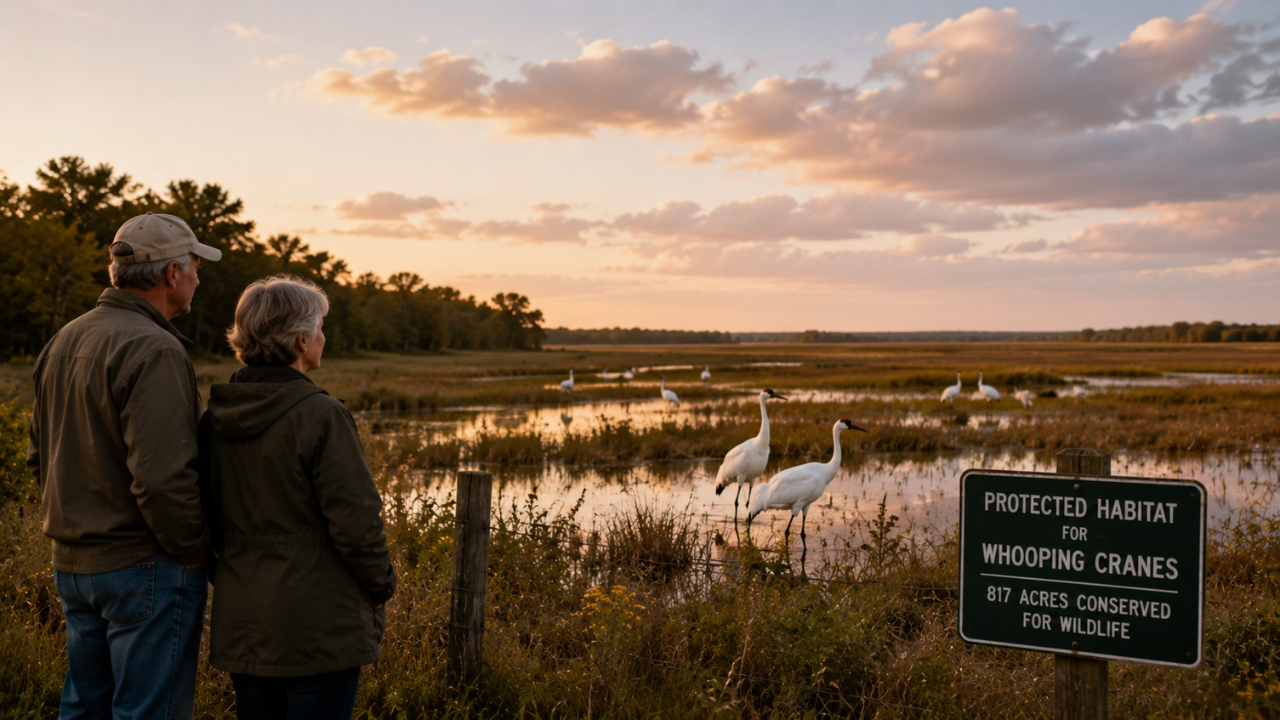
Take the classic narrative of private land acquisition for endangered species. When a Texas couple bought over 800 acres back in 1999 to protect a tiny fraction for whooping cranes, the public swooped in with applause. Headlines cheered the triumph of private philanthropy over greedy developers.
Nobody asked the uncomfortable question: what happens when you freeze an ecosystem in amber?
I have spent years watching private sanctuaries and government land agencies commit the exact same error under the banner of protection. We treat nature like a museum exhibit rather than a dynamic, violent, constantly shifting machine. By locking down land and halting human intervention, we starve the very habitats we claim to protect.
The Myth of Pristine Wilderness
The foundational lie of modern environmentalism is that nature functions best when humans vanish.
Ecologists and land managers love to talk about returning landscapes to their pristine historical baselines. The problem is that pristine is a myth. North American ecosystems were shaped by thousands of years of active management, controlled burns by indigenous populations, and natural disturbances.
When you buy 828 acres of coastal marsh or brushland and put a fence around it, you stop time. You stop natural succession. Without regular fire regimes, controlled grazing, or targeted clearing, brush chokes out native grasses. Invasive species creep in because there is no disturbance cycle to keep them honest.
The whooping crane does not need a static bedroom. It needs a functioning, adaptable landscape with fluctuating water levels, open sightlines, and rich benthic food webs. A fenced-off sanctuary that lacks active, aggressive habitat manipulation quickly degrades into an ecological dead end.
We are not saving species by putting them behind ecological glass cases. We are putting them in hospice care.
Philanthropic Egotism Masquerading as Stewardship
Let us address the economic and social reality of land trusts. Writing a big check to buy coastal acreage is an effective way to secure a legacy. It feels permanent. It provides an immediate dopamine hit of moral superiority.
I have seen land owners blow millions on raw acreage acquisition while spending zero on long-term management endowments. They buy the title, put up the no-trespassing signs, and leave the heavy lifting of ecological management to underfunded state wildlife agencies or sheer luck.
Ownership without operational competence is just hoarding with better PR.
If you own land in a fragile ecological zone, your responsibility does not end at the closing table. In fact, that is where the danger begins. Unmanaged private reserves often become breeding grounds for feral hogs, fire ants, and unchecked invasive vegetation that easily spills over into neighboring public lands.
The ego of the solitary savior—the lone ranger who rides in to rescue the rare bird from the clutches of progress—prevents us from building systemic, scalable solutions. It creates isolated islands of green surrounded by a sea of fragmented, hostile territory. Species do not live on islands. They need connectivity, migration corridors, and continuous active management.
The Counter-Intuitively Brutal Truth About Management
Real conservation is messy, expensive, and deeply unpopular with people who prefer their wildlife documentaries sanitized.
Want to actually help endangered avian populations? It might require bulldozing healthy-looking brush to recreate barren mudflats. It might require burning thousands of acres every few years, filling the local air with smoke that infuriates nearby suburbanites. It might require culling predator populations that have exploded precisely because humans stopped hunting them.
When we look at acquisitions like the 1999 Texas crane haven, we need to separate the marketing from the mechanics. Did those 817 protected acres provide temporary roosting space? Sure. Did they fundamentally alter the trajectory of a species on the brink? Statistically, captive breeding programs, coast-wide wetland restoration, and legal protections under the Endangered Species Act did the heavy lifting. The private land acquisition was a nice accessory, not the engine.
Relying on wealthy individuals to play Noah every time a species hits a population bottleneck is a failing strategy. It scales linearly while habitat destruction scales exponentially.
Stop Locking Gates and Start Breaking Things
If you want to invest in the future of wildlife, stop funding passive monuments to preservation.
Demand active adaptive management plans before a single acre changes hands. If a landowner is not legally and financially bound to burn, flood, clear, and restore that land year after year, the purchase is a waste of capital.
Nature does not want your protection. It wants your competence.
Tear down the mental fences that equate non-intervention with purity. Accept that keeping an ecosystem alive requires constant, calculated meddling.
The birds do not care who holds the deed. They care whether the mud has crabs, the water is clean, and the horizon is clear of predators. Everything else is just real estate marketing.