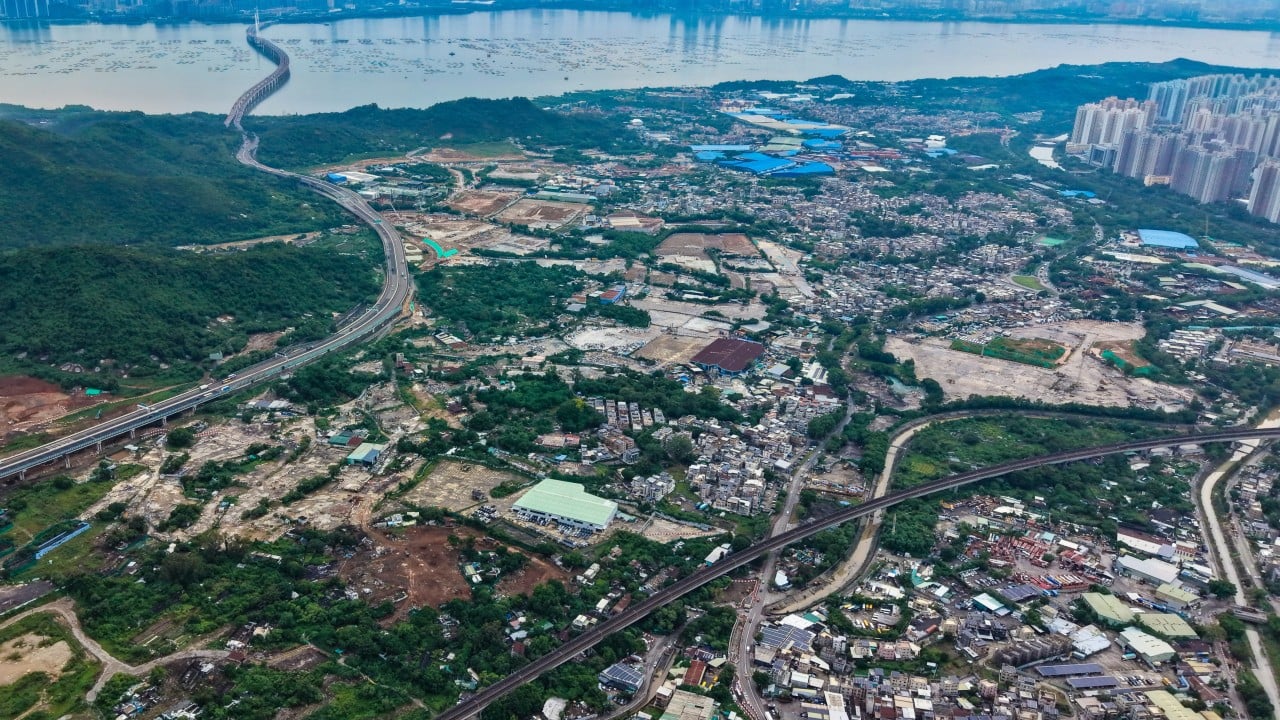
The dust of the New Territories has settled on quiet village lanes for generations. Tractors rarely disturbed the heron-filled wetlands of Kwu Tung North. The rhythms here were dictated by the seasons, by slow damp air rolling off Shenzhen bay, by the low hum of cross-border commerce murmuring in the distance.
Then came the cranes.
Stand on a ridge above the borderlands today and the horizon has changed its mind. Concrete skeletons climb into the heavy subtropical haze. Glass panels catch the afternoon glare. This is not just another luxury housing estate or a sprawling shopping mall designed to siphon weekend crowds from the urban core. This is a campus. Or rather, it is the beating heart of an entirely new intellectual city, rising from flat farmland with an audacity that only Hong Kong can muster.
The first building of this monumental university town project is scheduled to open its doors in a matter of months.
To understand why this matters, you have to look past the architectural blueprints and the municipal press releases. You have to understand the quiet panic of a global financial hub realizing it must reinvent its soul or risk becoming an echo of its former self.
For decades, Hong Kong thrived on the sheer momentum of trade, banking, and real estate. It was a city of dealmakers, shipping magnates, and stockbrokers. The formula worked brilliantly until the world shifted beneath its feet. Knowledge economies do not run on real estate speculation alone. They run on talent, innovation, and the messy, unpredictable collision of bright minds in university laboratories.
Enter the Northern Metropolis development strategy.
It is a massive territorial blueprint designed to tether Hong Kong more tightly to the Greater Bay Area of southern China, transforming a sleepy border zone into a powerhouse of advanced technology and higher education. At its core lies the university town project—a designated zone meant to host multiple tertiary institutions, research facilities, and student residences.
And now, the very first tangible proof of that vision is weeks away from completion.
Consider what that means for a student entering higher education today. Imagine walking into a lecture hall where the smell of wet paint hasn't quite faded, looking out a window that faces northward toward the sprawling tech giants of Shenzhen. You are not just studying history or engineering; you are standing at the exact intersection of two distinct economic ecosystems.
The planners call this strategic alignment. The students who will fill these halls will simply call it opportunity.
Yet, building a campus in a swamp is easier than building a community. Anyone who has lived through the frantic expansion cycles of East Asian mega-cities knows the ghost town risk. You pour billions into concrete and steel. You pave wide boulevards. You hang glossy signage promising the future. And then you wait for the people to arrive.
Will professors commute out to the remote northern frontier? Will students accustomed to the neon-drenched pulse of Tsim Sha Tsui or Central trade their urban haunts for a suburban campus surrounded by ongoing construction?
The government's answer is infrastructure. Mass transit links are being redrawn. Express rail lines and new highway extensions are being slammed into the earth to shrink the psychological distance between the northern border and Victoria Harbour. The university town is designed not as an isolated ivory tower, but as a dense, self-sustaining micro-city where housing, research labs, and commercial spaces blur together.
When the first building opens its doors in the coming months, it will house more than just classrooms. It will house the credibility of the entire Northern Metropolis initiative. If this first structure succeeds—if it hums with late-night debates, glowing computer screens, and the unmistakable energy of academic ambition—the rest of the project gains unstoppable momentum. If it feels sterile, isolated, or disconnected, skepticism will harden into public resistance.
This is the invisible stake of urban planning. Buildings are physical objects, but they are also emotional barometers. They tell a population whether its leaders believe in tomorrow.
For a long time, the narrative surrounding Hong Kong's youth has been heavy with anxiety. High housing costs, fierce job market competition, and political shifts have left many feeling cornered. A new university town cannot magically solve every structural economic challenge, but it alters the physical geography of possibility. It says to the next generation: we are building new ground for you. Literally. We are carving out space for your laboratories, your startups, your failures, and your breakthroughs.
Look closely at the construction schedules. Watch the final panels of glass go up on that pioneering structure. Listen to the dull thud of heavy machinery echoing across the Kwu Tung plains.
The cranes are still turning. The dust has not settled. But beneath the grey haze of the New Territories, the foundation for a different kind of future has already been poured.