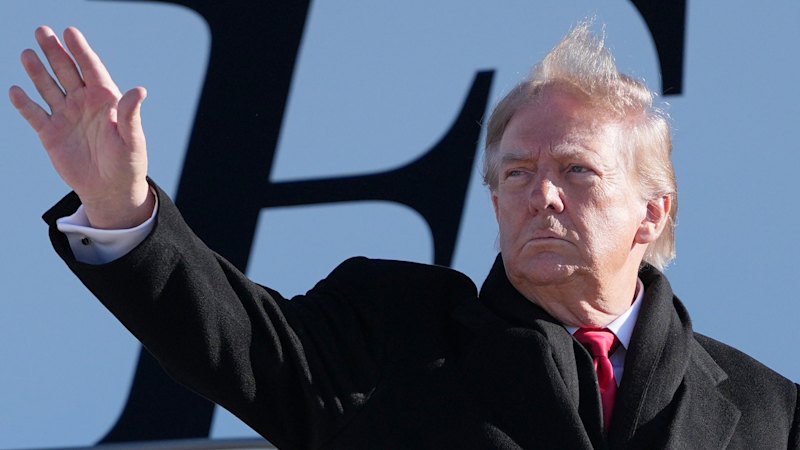
As Donald Trump boards his flight to Asia, two seemingly unrelated threads have collided on the tarmac of international diplomacy. In remarks preceding his departure, Trump signaled backing for Nvidia chief executive Jensen Huang’s efforts to re-establish commercial footing in restricted Asian markets, while simultaneously floating the prospect of renewed direct engagement with North Korean leader Kim Jong-un. On the surface, these statements read like standard pre-trip political theater—a mix of pro-business rhetoric and personal summitry. Look closer at the mechanics of modern statecraft, and a different picture emerges. Semiconductor supply chains and nuclear brinkmanship are no longer separate policy tracks in the Indo-Pacific; they are competing levers on the same geopolitical board.
For decades, Washington treated trade policy and national security in East Asia as distinct disciplines, even when they overlapped. Export controls belonged to commerce bureaucrats; nuclear deterrence belonged to the Pentagon and Foggy Bottom. That firewall has collapsed. Today, the silicon wafers fabricated in Taiwan and South Korea—and designed by American firms like Nvidia—form the bedrock of both commercial artificial intelligence and next-generation defense systems. When a U.S. president weighs in on Nvidia’s market access on the same day he teases a handshake in Pyongyang or the Demilitarized Zone, allies and adversaries alike read the two signals together.
The Silicon Trap Behind Huang’s Nvidia Dilemma
To understand why presidential backing matters so much to Jensen Huang, you have to look at the structural bind Nvidia faces. Over the past several years, tightening U.S. export controls have systematically walled off Nvidia’s highest-performing artificial intelligence accelerators from mainland China, historically one of the company’s largest revenue engines. Engineers in Santa Clara repeatedly designed modified, lower-bandwidth chips to comply with federal thresholds, only to watch subsequent regulatory updates close those loopholes months later.
Nvidia is not merely selling graphics cards; it is defending an ecosystem. The company’s real moat is CUDA, the proprietary software architecture that millions of developers rely on to train and run AI models. Every month that Chinese cloud providers and research labs are forced to build workarounds using domestic alternatives from firms like Huawei, the global uniformity of that software standard erodes. Huang has argued publicly and privately that ceding the world’s largest engineering workforce to homegrown Chinese silicon does not protect American national security—it accelerates the creation of a rival tech stack independent of U.S. influence.
Trump’s expression of support for Nvidia’s commercial return taps directly into this tension between national security hawks and Silicon Valley pragmatists. Yet presidential rhetoric alone does not rewrite the Federal Register. Any meaningful reopening of market access requires unwinding or granting sweeping exemptions to complex rules administered by the Bureau of Industry and Security.
The Regulatory Reality Check
Even with White House blessing, three institutional hurdles stand between Nvidia and an unrestricted return to its former Asian footprint:
- Bipartisan Congressional Guardrails: Lawmakers across both parties have framed advanced semiconductor restrictions as a core national defense imperative. Any move to relax export licenses on high-end AI chips faces immediate legislative pushback, potential subpoenas, and riders attached to must-pass defense authorization bills.
- Allied Export Alignment: Washington spent years pressuring the Netherlands and Japan to restrict shipments of extreme ultraviolet and deep ultraviolet lithography machines. If the U.S. unilaterally loosens restrictions on finished AI accelerators while demanding Dutch firm ASML and Japanese suppliers hold the line on manufacturing equipment, allied compliance will fracture overnight.
- Supply Chain Chokepoints: Nvidia does not manufacture its own silicon. It relies entirely on Taiwan Semiconductor Manufacturing Company (TSMC) for fabrication and South Korean giants SK Hynix and Samsung for high-bandwidth memory. Geopolitical concessions in one theater directly affect capacity allocation and diplomatic goodwill in Taipei and Seoul.
The Return of Personal Summitry on the Korean Peninsula
While semiconductor executives watch Commerce Department rulings, diplomats in Seoul, Tokyo, and Beijing are dissecting Trump’s comments regarding Kim Jong-un. During his first term, Trump broke decades of diplomatic orthodoxy by meeting Kim three times—in Singapore, Hanoi, and at the inter-Korean border in Panmunjom. Those encounters froze long-range missile and nuclear tests for a period, though they ultimately stalled over the sequencing of sanctions relief versus denuclearization.
The strategic environment in Northeast Asia has shifted dramatically since those initial handshakes. North Korea has spent the intervening years expanding its fissile material stockpiles, testing solid-fuel intercontinental ballistic missiles, and deepening military ties with Moscow. Pyongyang is no longer negotiating from the same position of acute isolation it faced in 2018.
Teasing a meeting with Kim before wheels-up serves an immediate diplomatic purpose: it disrupts the assumptions of regional capitals before formal meetings even begin. For South Korea and Japan, the prospect of sudden bilateral U.S.-North Korea talks triggers familiar anxieties. Both allies rely on the American nuclear umbrella, and both worry that a bilateral deal focused narrowly on halting missiles capable of reaching the U.S. mainland could leave short- and medium-range threats aimed at Seoul and Tokyo unaddressed.
Where Chip Diplomacy and Nuclear Brinkmanship Collide
The intersection of these two stories is geographic and strategic. Every major flashpoint on Trump’s Asian itinerary sits within a few hundred miles of the world’s most critical semiconductor infrastructure.
Consider the triangle formed by Taiwan, South Korea, and mainland China. South Korea is not just a treaty ally hosting tens of thousands of U.S. troops on the front line against North Korea; it is also the global hub for memory chips essential to AI data centers. Seoul’s conglomerates have invested tens of billions of dollars in fabrication plants in both the United States and China, leaving them perpetually caught between Washington’s export controls and Beijing’s economic leverage.
When Washington signals flexibility toward an American chip giant like Nvidia, South Korean and Taiwanese executives immediately ask whether similar carve-outs will apply to their own operations on the mainland. Conversely, if the White House uses tariff threats or export restrictions as bargaining chips in broader trade negotiations, the ripple effects hit supply chains across the entire Pacific Rim.
Three Counter-Arguments Rarely Mentioned in Headlines
Mainstream coverage often frames these developments as either a triumph of dealmaking or a dangerous abandonment of strategic discipline. Both readings miss quieter dynamics driving policy behind closed doors:
- Commercial Leverage as a Diplomatic Buffer: Proponents of controlled commercial re-engagement argue that keeping Asian tech giants dependent on American architecture preserves visibility and influence. If foreign data centers run on U.S.-designed hardware and software, Washington retains regulatory visibility into global compute capacity—a window that slams shut once adversaries transition entirely to indigenous hardware.
- The Limits of Leader-to-Leader Theater: Critics of personal summitry point out that high-profile meetings without working-level groundwork often raise expectations without altering underlying force postures. In the case of North Korea, Pyongyang has repeatedly stated that it views its nuclear arsenal as non-negotiable, making a repeat of the Singapore framework far harder to execute than a quick photo opportunity suggests.
- Beijing’s Dual-Track Calculus: China watches both tracks simultaneously. From Beijing’s perspective, U.S. tech restrictions and U.S. diplomacy with Pyongyang are tools of regional containment. Beijing has little incentive to help Washington rein in North Korea’s weapons programs if Chinese firms remain locked out of advanced semiconductor supply chains.
What Allies and Markets Are Actually Watching
Financial markets react instantly to headlines about Nvidia’s revenue outlook, while defense ministries track troop movements and missile telemetry. Yet the real test of this trip will not happen in front of television cameras at an airport tarmac or a summit hall.
Watch the fine print that follows in the weeks after Air Force One returns to Washington. Will the Commerce Department issue revised licensing guidance for data-center processors, or will rhetorical support for Nvidia remain just that—rhetoric? Will Pyongyang respond to Trump’s overtures with a quiet diplomatic channel, or with a ballistic missile launch timed to test Washington’s resolve?
In the Indo-Pacific, the line between a trade concession and a security guarantee has vanished, leaving every chip shipment and every diplomatic handshake carrying the weight of the entire regional order.