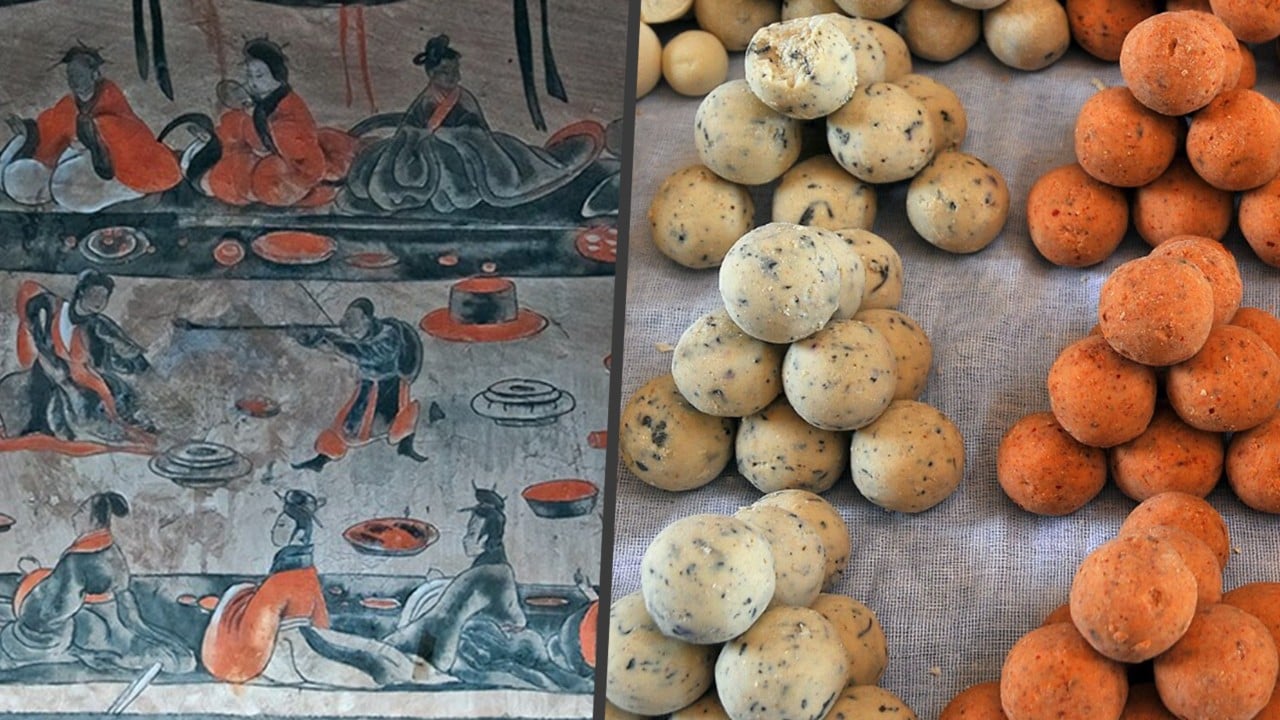
Stop treating Chinese culinary history like an unbroken, 5,000-year museum exhibit that occasionally took a detour when nomads rode through town.
The mainstream food media loves a neat, romantic origin story. They point to sun-dried yoghurt on the steppes, the introduction of the huchuang—the folding stool—during the Han dynasty, and the gradual shift from floor mats to high tables, framing these moments as charming footnotes in an otherwise continuous, monolithic tradition.
That framing gets the mechanics of food history completely backward.
Migration and furniture did not merely "reshape" Chinese food. They invented the very concept of what we call Chinese cuisine today. Without the violent disruptions of northern nomadic invasions, Silk Road trade bottlenecks, and the ergonomic revolution of getting off the floor, the culinary repertoire of the Central Plains would have remained an austere, boiled, millet-heavy diet eaten in rigid, hierarchical isolation.
I have spent years dissecting culinary texts, auditing heritage restaurant concepts, and watching hospitality groups burn millions trying to market "authentic" regional Chinese food based on lazy textbook myths. Every single time, they fall for the same trap: believing that authenticity equals stasis. In reality, Chinese food has always been an aggressive, unsentimental engine of assimilation.
The Lie of the Unbroken Culinary Lineage
When food writers discuss how migration changed Chinese eating habits, they usually treat foreign ingredients as spices sprinkled onto an existing base. Wheat flour, dairy, mutton, sesame, and the folding chair get cast as supporting actors.
Look at the actual archaeological and textual evidence from the Han through the Tang dynasties, and that narrative collapses.
Before the widespread adoption of northern nomadic technologies, elite dining in the Yellow River basin was defined by the yan—a low banquet mat—and individual low tables called an. You knelt. Your posture was dictated by Confucian ritual propriety. Because you were sitting on your heels, reach was limited, shared communal platters were physically impractical, and food had to be pre-cut or served in individual portions that did not require rigorous table-side manipulation.
Enter the huchuang—literally the "barbarian bed" or folding camp stool—imported from nomadic steppe cultures during the late Eastern Han dynasty.
Most commentators treat the folding chair as an interior design trend. It was not. It was an ergonomic demolition of the entire ritual dining apparatus. Once people raised their hips off the floor and dangled their legs, the center of gravity shifted. High tables became mandatory. With high tables came the death of individual floor trays and the birth of the communal round table, shared central dishes, and the high-heat, fast-paced stir-fry service model that defines modern Chinese dining.
You cannot separate the wok from the chair. High-heat bao (flash-frying) and chao (stir-frying) only scale when dishes can be rushed from a roaring stove to a central table where multiple diners reach in simultaneously with chopsticks. On a floor mat with individual trays, food cools too fast, portioning requires extra kitchen labor, and communal sharing violates spatial etiquette. The folding stool did not just make people more comfortable; it rewired the kitchen workflow.
Sun-Dried Yoghurt Was Not a Quaint Snack
Let us dismantle the second lazy trope: the fetishization of nomadic dairy products like naipi (milk skin) or sun-dried yoghurt curds (qula or chura) as exotic, forgotten curiosities of the northern borderlands.
Mainstream narratives treat dairy in Chinese history as a brief, fashionable flirtation during the Tang and Yuan dynasties before the Central Plains returned to its "natural" soy-and-tea equilibrium.
That is historical amnesia.
Dairy was a critical caloric and biochemical engine of northern Chinese statecraft and gastronomy for over a millennium. During the Northern Wei dynasty—ruled by the Tuoba clan of the Xianbei people—agricultural handbooks like Jia Sixie's Qimin Yaoshu (Essential Techniques for the Welfare of the People, compiled around 544 CE) dedicated extensive, hyper-technical chapters to processing milk, churning butter (su), clarifying ghee (tihu), and fermenting dry yoghurt curds.
Why? Because sun-dried yoghurt was the ultimate shelf-stable logistics fuel.
On the Eurasian steppe, fluid milk spoils in hours. By boiling milk, skimming the fat, fermenting the curds, and dehydrating them in the arid wind and sun, pastoralists created a dense, lightweight block of protein and lactic acid that could survive months in a saddlebag without refrigeration.
When Xianbei, Khitan, Jurchen, and Mongol elites conquered and governed northern China, they did not leave their supply chains at the border. They brought dairy fermentation directly into the imperial kitchens of Luoyang, Chang'an, Kaifeng, and Dadu (modern Beijing).
Here is what culinary historians routinely miss: those fermented dairy techniques cross-pollinated with Han Chinese grain and soy fermentation. The mastery of controlled microbial environments—managing Lactobacillus alongside Aspergillus oryzae—accelerated the sophistication of northern fermented pastes, vinegars, and wheat doughs. Even today, the ghost of steppe dairy lives inside Beijing's nailao (imperial fermented milk pudding), Yunnan's rubing and rushan (pan-fried goat and cow milk cheeses brought south by Mongol garrisons in the 13th century), and Inner Mongolian naidoufu.
To call Chinese cuisine "historically dairy-free" is to erase the entire northern half of the country's political history.
What Everyone Gets Wrong About Migration and "Authenticity"
If you search online for how migration shaped Chinese food, you run into a wall of flawed questions. People ask how traditional Chinese food survived foreign influence, or which region holds the purest version of ancient Chinese cooking.
Both questions are built on a broken premise.
Is there a "pure" regional Chinese cuisine untouched by migration?
No. Not a single one.
Cantonese cuisine, often held up as the pristine vault of ancient Tang and Song dynasty culinary traditions, is a monument to mass migration and maritime trade. The Hakka, Teochew, and Yue populations are waves of northern refugees who fled wars during the Jin, Tang, and Song dynasties, carrying northern wheat techniques south and forcing them onto tropical ingredients. Add centuries of Portuguese, Southeast Asian, and British port contact in Macau and Hong Kong, and you get baked cha siu bao, Worcestershire-spiked dim sum, and tomato-based beef stews.
Sichuan cuisine? Its signature flavor profile—the numbing-spicy mala—did not exist in antiquity. While Sichuan pepper (huajiao) is native, the chili pepper (Capsicum) arrived via maritime trade routes from the Americas during the late Ming dynasty, centuries after Mongol invasions had devastated and depopulated the Sichuan basin, triggering massive forced repopulation migrations from Hubei and Hunan during the Qing dynasty.
Did Chinese people adopt chairs because of Confucian social progress?
Wrong again. Confucian purists actively resisted the folding stool and the high chair for centuries.
In traditional Han ritual, kneeling on mats represented humility, self-restraint, and clear vertical hierarchy. Sitting with legs dangling from a chair was initially viewed as vulgar, uncivilized, and overly casual—a posture associated with foreign mercenaries and frontier outposts.
Adoption happened through military utility and elite subversion, not philosophical consensus. Commanders used folding stools on campaign because they were portable and kept officers out of the mud. Aristocrats in the Tang capital of Chang'an—a city obsessed with foreign fashion, Sogdian music, and Central Asian clothing—adopted high seating because it signaled cosmopolitan power. Once the Song dynasty institutionalized high tables and chairs across urban taverns and tea houses, floor dining vanished from daily life, surviving only in Korea and Japan—countries that had imported Tang dynasty floor-mat culture before the chair fully conquered China.
Why did wheat noodles replace millet porridge in the north?
Not because northern farmers suddenly preferred the taste of wheat.
Millet requires minimal processing; you boil the whole grain into a gruel (zhou). Wheat, by contrast, has a tough bran coat and requires stone milling—a technology imported and scaled via Central Asian contact—to turn into flour. Once rotary stone mills spread across the Yellow River plain during the Han dynasty, wheat flour unlocked bing (a catch-all term for noodles, dumplings, flatbreads, and steamed buns).
Unlike millet porridge, which had to be eaten hot out of a bowl at home, baked flatbreads (shaobing) and dried noodles could be carried on marches, sold from street carts to urban laborers, and traded across long distances. Wheat won because it was portable, commercial, and calorie-dense.
The Structural Mechanics of Culinary Disruption
To understand how food actually evolves, strip away the romanticism and look at the three hard constraints that govern every kitchen in history: ergonomics, preservation, and energy.
- Ergonomics dictates portioning. When seating moves from floor mats (height: 0 cm) to chairs (height: 40–45 cm) and tables (height: 75–80 cm), human reach expands by nearly 40 percent. Food transitions from individual, bite-sized ritual portions to shared, central platters. Chopsticks lengthen slightly to bridge the distance across a communal table.
- Preservation dictates flavor profiles. Nomadic migration brought dehydration (sun-dried yoghurt, air-dried mutton) and heavy salting into contact with sedentary agriculture's wet fermentation (soy sauce, rice wine, pickled vegetables). When wet fermentation meets dry preservation, umami concentration spikes.
- Energy dictates cooking method. Deforestation across the North China Plain forced cooks to abandon slow-roasting whole animals over massive wood fires. Instead, they chopped ingredients into uniform, thin slices—an ergonomic necessity for chopsticks—and cooked them over intense, brief bursts of brushwood or coal fire in thin-walled iron woks.
Every major shift in Chinese food comes down to these physical realities, not poetic cultural exchange.
The Uncomfortable Downside of Culinary Disruption
Here is the truth that contrarian cheerleaders rarely admit: radical culinary assimilation is neither painless nor purely additive. When a food culture aggressively absorbs foreign technologies, ingredients, and dining postures, something valuable always gets permanently erased.
When China abandoned floor dining and individual an trays for high tables and communal round-table banquets, it gained speed, social warmth, and culinary variety. It also lost spatial silence, individual pacing, and the precise aesthetic plating of single-portion banquets—rituals that Japan preserved and refined into kaiseki.
Similarly, when rapid urbanization and commercial restaurant culture standardized wok stir-frying and wheat noodles, hyper-local, labor-intensive ancient cooking methods—such as complex clay-pit steaming, wild-foraged steppe herb fermentations, and slow-rendered bone marrow emulsions—became economically unviable outside remote villages. Efficiency always cannibalizes delicacy.
How to Apply This to Modern Food Strategy
If you work in hospitality, food media, or culinary product development, stop selling nostalgia. Consumers are exhausted by fabricated origin stories claiming a dish has been made the exact same way since the Tang dynasty.
Instead, build your narrative and menu architecture around friction and adaptation:
- Audit your menu for historical honesty. If you run a northern Chinese concept, stop hiding dairy and mutton as "fusion" experiments. Lean into Qimin Yaoshu techniques—clarified butter emulsions, fermented milk curds paired with roasted lamb, and hand-pulled wheat noodles—and present them as the historical backbone of northern statecraft.
- Design the dining room around ergonomics, not aesthetic clichés. The physical height of your seating, the diameter of your tables, and the reach of your diners dictate how food tastes before it hits the tongue. A communal dish served on a table too wide for comfortable chopstick reach kills the dining rhythm faster than bad seasoning.
- Stop equating "traditional" with "static." The most authentic thing a Chinese kitchen can do is steal a superior tool, adopt a foreign ingredient, and adapt its workflow to the realities of the current street outside its door.
Imagine a scenario where a Tang dynasty aristocrat from Chang'an sat down at a modern Sichuan hotpot table in Chengdu. He would not recognize the chili peppers, the New World potatoes, the industrial induction burner, or the stainless-steel folding chairs stacked by the door. Yet he would immediately understand the fundamental operating system: foreign tools, nomadic heat, communal reach, and ruthless adaptation.
Chinese food never survived migration and folding chairs. It was forged by them—and the moment it stops stealing from outsiders, it dies.