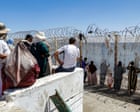
Every time a crowd gathers near the perimeter fences of Ceuta, the standard media playbook snaps into gear. We get the same visual grammar: anxious families clutching laminated photographs, tearful mothers waiting for a phantom phone call, and breathless reporting about desperate humanity crashing against the fortress walls of Europe. It is a neat, emotionally tidy narrative designed to extract sympathy and generate quick outrage cycles.
It is also fundamentally wrong about how migration actually operates, why people gather at those specific coordinates, and what those crowds represent.
The lazy consensus treats these border congregations as spontaneous human explosions born of sudden desperation. That viewpoint ignores the systemic mechanics, the structural incentives, and the cold economic calculations that dictate every single body standing within sight of the Spanish enclave. If you want to understand why people wait by the border, you have to stop looking at it through the lens of a humanitarian tragedy and start looking at it as a managed market with its own distinct supply, demand, and risk profiles.
The Myth of the Spontaneous Exodus
Watch any standard news broadcast covering the Spanish-Moroccan border zones. The framing insists that hundreds of people simply woke up one morning, packed a bag, and marched toward the wire out of sheer, unadulterated hopelessness.
I have spent years analyzing cross-border movement patterns, tracking illicit logistics networks, and watching policy failures ripple across North Africa. Spontaneous mass migrations do not exist. What looks like a sudden wave of humanity is almost always the calculated output of an invisible, highly structured pipeline.
People do not arrive at the gates of Ceuta by accident. They are moved there.
Networks of brokers, fixers, and informal logisticians manage the flow from thousands of miles away, dictating routes, pricing, and timing. When a crowd accumulates near a border town, it is rarely because a group of lost travelers wandered into the scrubland together. It is because the logistical bottleneck downstream shifted, a price point dropped, or a specific window for crossing was signaled by the market operators pulling the strings.
By framing these gatherings as sudden, emotional outbursts of desperation, mainstream commentary strips agency away from the migrants and absolves both local and international authorities of the systemic policy incentives they created in the first place.
Follow the Incentive Structure
To dismantle the conventional narrative, we have to look at the economics of the wait.
Why do families linger near the border for weeks, sometimes months, in grueling conditions? The standard answer assumes they are waiting for a miracle. The real answer is far more clinical: they are holding a position in an economic queue.
Imagine a scenario where a high-risk venture promises a lifetime return that dwarfs any possible legal income in a migrant's home region. In economic terms, the expected value of crossing into European territory—even via an informal, dangerous route—remains vastly higher than staying put, despite the steep probability of failure or deportation.
The crowds near Ceuta function less like desperate refugees fleeing active artillery fire and more like investors camping outside a ticket booth for a sold-out stadium where the stakes are life-altering wealth. They are calculating risks. They know the patrols. They know the diplomatic friction between Rabat and Madrid. They know that political leverage shifts daily, and that a momentary diplomatic spat between Morocco and Spain can soften border enforcement overnight.
When you view the crowd through this lens, the anxiety on their faces is real, but its source is misunderstood. They are not paralyzed by helplessness; they are calculating volatility. They are traders watching a volatile stock chart, waiting for the exact minute the market dips in their favor.
The Policy Failure Nobody Wants to Admit
Governments love the border fence narrative because it provides a convenient villain. Politicians in Madrid can point to the physical barrier and claim they are defending sovereignty, while politicians in Rabat can point to the same barrier and demand more international funding to secure it.
Meanwhile, the multi-million-dollar industry surrounding border management thrives on the very friction it claims to solve.
I have seen billions of dollars poured into surveillance technology, concrete walls, razor wire, and rapid-response units. Every single euro spent on hardening the perimeter achieves two predictable outcomes:
- It drives up the cost of crossing, enriching the illicit smuggling syndicates who adapt by finding more dangerous routes.
- It concentrates desperate people in vulnerable border pockets like Ceuta, creating the exact media spectacles we are conditioned to pity.
The harder you make a border, the more sophisticated and expensive the illegal market becomes to bypass it. Basic economic theory teaches us that supply finds a way around artificial barriers when demand is high enough. Yet, policymakers continue to double down on fortification while acting surprised when crowds form at the bottleneck.
The Uncomfortable Truth About Missing Persons
Let us address the most devastating element of the conventional reporting: the missing loved ones.
When families gather near Ceuta searching for news of relatives who attempted the crossing by sea or through the rugged border hills, the media treats it as a singular human rights catastrophe. It is tragic, yes. But pretending it is an unpredictable accident of nature is dishonest.
Every single actor in this dynamic knows the baseline mortality rate of these transit routes. The Moroccan authorities know. The Spanish border guards know. The smuggling networks definitely know. When a person steps onto a makeshift rubber raft or attempts to scale a barbed wire perimeter at midnight, the probability of injury, detention, or disappearance is a known variable in the equation.
By treating these disappearances as shocking aberrations rather than the mathematically probable outcomes of a closed-door migration policy, we sanitize the debate. We pretend that a humane, open system exists just out of reach, when in reality, current policies intentionally manufacture these choke points by keeping legal pathways virtually nonexistent while maintaining a voracious underground demand for low-wage labor across Europe.
Dismantling the Rescue Industry Complex
We also need to talk about the perverse incentives within the humanitarian response apparatus.
Non-governmental organizations, relief workers, and international agencies descend on these border zones with noble intentions, but their presence often stabilizes the very equilibrium they wish to disrupt. By providing temporary relief, food, and medical triage at the friction points, they inadvertently lower the immediate cost of waiting at the border.
This creates a permanent holding pattern. Migrants can sustain themselves outside the fence for months longer than they could on their own resources, keeping the pressure cooker pressurized indefinitely.
It is an uncomfortable conversation because nobody wants to criticize charity. But if an intervention subsidizes a dysfunctional system without addressing its root cause, it becomes part of the architecture it opposes.
The Wrong Questions Are Being Asked
If you ask mainstream commentators what should be done about the crowds at Ceuta, they will offer a predictable menu of tired suggestions: more humanitarian aid, deeper diplomatic cooperation between Europe and North Africa, or tougher patrols to deter departures.
All of those answers miss the mark entirely because they accept the premise that migration can be permanently locked out if we just build a higher wall or write a bigger check.
The real question we should be asking is why we continue to treat human mobility as a law enforcement emergency rather than an inevitable structural reality of global economic inequality. As long as the wealth gap between the Global North and South remains a chasm, and as long as Europe’s labor markets rely on undocumented, under-the-table workers to harvest crops, build infrastructure, and staff service industries, no amount of razor wire will stop the queue.
The crowds near Ceuta are not an anomaly. They are the mirror reflecting the structural contradictions of modern globalization. Until we stop treating them as a sudden weather event and start dismantling the policy architecture that creates the bottleneck, those families will keep waiting, the media will keep filming, and nothing will change.
Stop looking at the fence. Look at the balance sheet.