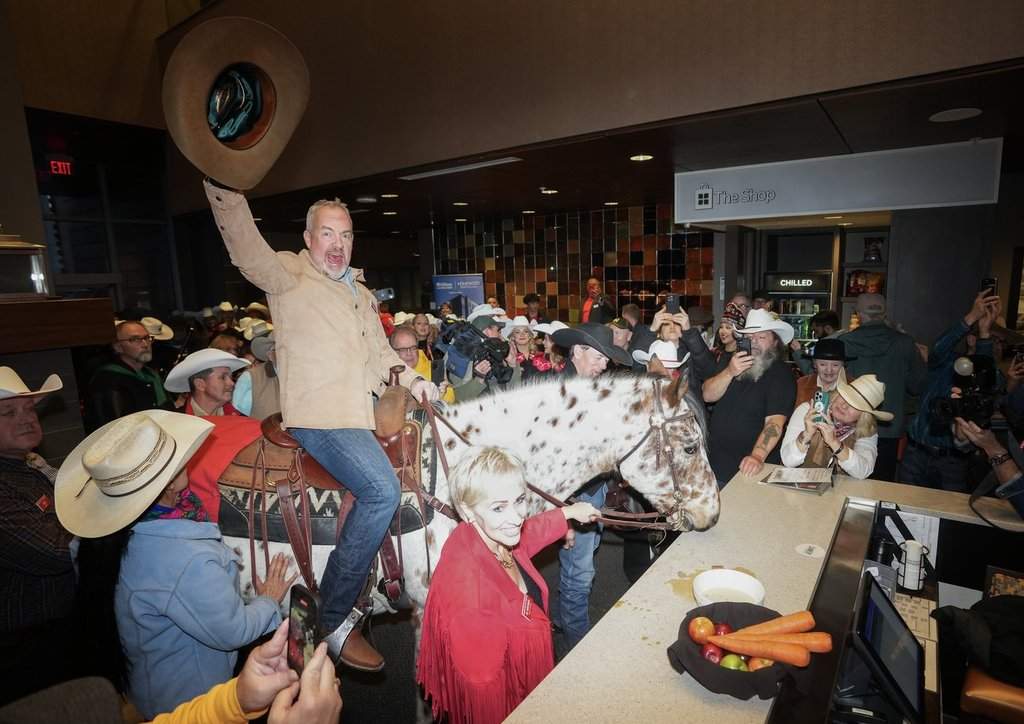
Every November, sports media falls over itself to post the exact same clip. A horse walks through the lobby of a luxury Calgary hotel during Grey Cup week. Fans cheer. Reporters call it "charming." Executives pat themselves on the back for keeping Canadian football traditions alive.
They are celebrating a symptom of stagnation.
The annual Calgary Grey Cup Committee horse stunt—a tradition dating back to 1948 when fans rode a horse into the Royal York Hotel in Toronto—is treated like untouchable sporting heritage. In reality, relying on a 75-year-old bar trick to generate national headlines exposes a massive marketing blind spot. When your championship week's biggest viral moment is livestock on marble flooring rather than the athletes on the turf, you have a positioning problem.
The Lazy Consensus Around Legacy Stunts
Ask any legacy sports marketer about the Calgary hotel horse, and you will hear the same tired script. They claim it builds community. They argue it differentiates the Canadian Football League from the corporate juggernaut south of the border. They insist that quirky, grassroots authenticity is the league's superpower.
That logic worked in 1955. It fails miserably in an attention economy dominated by high-definition storytelling, athlete-driven brands, and fierce competition for Gen Z eyeballs.
I have watched regional leagues and heritage brands bleed market share for decades because they confused nostalgia with relevance. They cling to inside jokes that delight sixty-year-old season ticket holders while alienating anyone under thirty who tunes in expecting elite athleticism. A horse in a hotel lobby does not sell the speed of three-down football. It does not showcase the tactical brilliance of a wider field. It sells a caricature of the sport as a regional novelty act.
What the Nostalgia Crowd Misses About Modern Fandom
Modern sports fans do not fall in love with mascots or lobby animals. They fall in love with stakes, rivalries, and human drama.
Look at how Formula 1 transformed its North American footprint. They did not parade vintage cars through hotel lobbies to beg for local news coverage. They built a narrative engine around driver personalities, engineering pressure, and high-stakes rivalry. Look at the NFL Draft or NBA All-Star Weekend. Every activation is engineered to elevate the players as cultural icons.
Compare that to Grey Cup week coverage. When a casual viewer searches for the championship game and the top result is a horse trotting past a concierge desk, the subconscious message is clear. This is a quaint, small-town festival, not a premier professional sporting event.
The Opportunity Cost of the Viral Novelty
Every media cycle has limited oxygen. During Grey Cup week, the CFL has a rare seven-day window where national sports networks, casual fans, and corporate sponsors actually pay attention.
Wasting forty percent of that earned media oxygen on a horse walking through the Fairmont Palliser—or whatever host hotel is taking the liability insurance hit that year—is strategic malpractice. That is airtime stolen from:
- Quarterback matchups that feature some of the most dynamic dual-threat passers in professional football.
- Coaching chess matches dictated by the unique 20-second play clock and three-down urgency.
- Local economic grit and the actual athletes who grind through an 18-game schedule in brutal weather.
When you lead with a gimmick, you train the public to treat the game itself as secondary.
Answering the Wrong Question About CFL Tradition
Whenever someone criticizes these legacy stunts, fans immediately ask: "Why do you want to erase Canadian football history?"
That question relies on a false dichotomy. You do not have to choose between sterile corporate boredom and bringing farm animals indoors. True heritage honors the essence of the competition, not the drinking habits of mid-century boosters.
Let us look at the actual history. In 1948, Calgary Stampeders fans brought a horse into Toronto's Royal York Hotel to celebrate their first Grey Cup appearance and inject western flair into an eastern establishment. At the time, it was disruptive. It was rebellious. It shocked the buttoned-up media elite of Toronto.
Repeating the exact same stunt nearly eighty years later is the opposite of rebellious. It is predictable. It is sanitized, pre-approved by hotel legal teams, escorted by security, and scheduled on a media advisory sheet. A rebellion with a PR schedule is just corporate theater.
The Real Questions Fans Should Be Asking
If you actually care about the survival and growth of Canadian football, stop asking how to preserve 1948 party tricks. Start asking harder questions:
- Why do casual viewers know the name of a horse stunt before they know the names of the starting quarterbacks?
- What does it say about a league's star-making machinery when livestock outperforms its Most Outstanding Player on social media?
- How do we translate the genuine warmth of Grey Cup festival culture into something that looks like a modern major-league spectacle?
The Mechanics of Brand Dilution
In sports marketing, there is a concept known as brand anchoring. Whatever image a consumer sees first becomes the anchor against which all subsequent information is judged.
Imagine a scenario where a twenty-two-year-old sports fan in Vancouver or Montreal—someone who watches the NFL, NBA, and Premier League—decides to check out the Grey Cup for the first time. They open their feed. They see a horse in a hotel lobby, fans wearing pancake hats, and reporters giggling about tradition.
Their anchor is set. Before a single snap is played, they view the product as kitschy. Even if the game turns out to be a thrilling, fourth-quarter shootout, they watch it through the lens of novelty rather than prestige.
Now consider the alternative. Suppose that same fan opens their feed and sees cinematic breakdowns of pre-snap motion, mic'd-up defensive linemen talking trash in sub-zero temperatures, and genuine tension between rival cities. The anchor shifts from novelty to intensity.
The Downside of Killing Sacred Cows
Taking a sledgehammer to beloved traditions carries real risk. There is a legitimate downside to retiring or sidelining the hotel horse stunt, and any honest strategist has to admit it.
The CFL relies heavily on its core demographic. Ticket buyers in Calgary, Regina, and Winnipeg value continuity. They show up in freezing temperatures, buy merchandise, and keep the lights on. If league executives suddenly banned the horse tomorrow with a heavy-handed corporate memo, they would trigger an immediate fan revolt. You never want to look like you are embarrassed by your own supporters.
The mistake is thinking the solution is a ban. The solution is out-competing the stunt.
How to Evolve Without Losing the Soul
You do not kill a weak tradition by outlawing it. You make it obsolete by building something louder, sharper, and infinitely more compelling right next to it.
The Calgary Grey Cup Committee and league marketers need to stop treating the hotel horse as the centerpiece of their media strategy. Let the boosters have their morning coffee and their photo op in the lobby. Do not put it on the main broadcast. Do not send out national press releases begging networks to cover it.
Instead, redirect that creative energy and budget into three specific shifts:
- Elevate the athletes over the antics. Give players unrestricted access, raw documentary storytelling, and center-stage billing at every festival event. Make the players the rockstars of Grey Cup week, not the livestock.
- Modernize the western hospitality hook. Calgary has an incredible, authentic cultural identity rooted in grit, energy, and resilience. Showcase the music, the food, and the modern cityscape rather than leaning on dusty frontier clichés.
- Weaponize the uniqueness of the game. Three downs, a 110-yard field, 12 men, and unlimited backfield motion create a chaotic, high-scoring brand of football that no other league offers. Market the speed and the strategy relentlessly.
Tradition is supposed to be a foundation you build on, not an anchor dragging you backward. Keep the horse in the lobby for the diehards who love the nostalgia, take it off the national pedestal, and finally let the football do the talking.