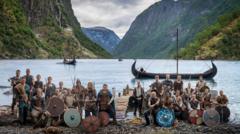
The Norwegian national football team ended a 28-year drought by qualifying for the 2026 FIFA World Cup. Instead of celebrating with standard media days or corporate sponsor templates, the squad assembled on a private beach near Oslo to stage an elaborate, heavily digitized photoshoot dressed as eighth-century Norse warriors. Led by Manchester City striker Erling Haaland and Arsenal midfielder Martin Ødegaard, the team donned tunics, gripped real iron swords, and posed before wooden longships. The underlying objective of this campaign is not historical accuracy or simple athletic pride, but rather a deliberate geopolitical and commercial branding effort designed to transform a historically underachieving team into an elite global sports property before they touch down in North America.
To evaluate this strategy, one must look beyond the immediate viral sensation of Erling Haaland posing in a freezing fjord. The operation reveals an intricate intersection of high-end fine-art photography, corporate public relations, and modern athletic marketing.
The Architectural Scale of the Modern Myth
The photoshoot was orchestrated by British fine-art photographer David Yarrow, an artist known for staging hyper-realistic, cinematic tableaux that often sell for tens of thousands of dollars per print. This was not a quick locker-room PR stunt. It was a multi-location, high-budget commercial production.
The primary shoot took place on a secluded beach outside Oslo. The production crew transported actual replica longships to the site and sourced authentic period attire. The logistical reality of elite sports schedules, however, required significant technological intervention. Martin Ødegaard was unavailable during the initial weekend session due to his participation in the UEFA Champions League final. To resolve this, a precise space was left in the physical lineup. Ødegaard was photographed days later against a green screen in Oslo and digitally composited into the final frame.
Furthermore, the background landscape of the local beach lacked the dramatic, scale-defining presence required for a global campaign. Later that afternoon, Yarrow’s team traveled to Viking Valley in Gudvangen, a heritage site nestled deep within the western fjords. They captured high-resolution plates of the towering rock faces and deep waters, which were then digitally blended into the beach imagery. The final result is a seamless piece of commercial art that presents a unified front, hiding the fragmented reality of its assembly.
The Commodification of National Identity
International football marketing typically relies on clean, safe corporate aesthetics. The Norwegian Football Federation (NFF) deliberately chose to pivot away from this sanitized approach.
| Strategic Element | Traditional Approach | The Norway 2026 Strategy |
|---|---|---|
| Visual Identity | Standard jersey line-ups against white backdrops | Textured, high-contrast historical tableaux |
| Star Utilization | Isolated corporate sponsor endorsement clips | Integrating global icons into a collective national mythos |
| Narrative Engine | Underdog stories and modest tactical humility | Unapologetic cultural dominance and historical legacy |
NFF President Lise Klaveness acknowledged that global media outlets would inevitably default to lazy Viking tropes when covering Norway’s return to the World Cup stage. The federation’s decision was to preemptively capture that narrative. By defining the parameters of their own caricature, they transformed a potential media cliché into a highly controlled marketing asset.
This approach serves a dual commercial purpose. While individual superstars like Haaland possess immense personal brand equity, the broader Norwegian squad lacks international market penetration. Elevating the entire collective into a cinematic concept raises the commercial profile of the secondary roster. It turns a group of domestic league players into recognizable figures within the lucrative North American sports market.
The Risk of the Aesthetic Backlash
The strategy carries inherent risks, particularly within the purist subcultures of modern football. Critics on digital forums and traditional sports columns have pointed out the historic ironies of the campaign. The outfits worn by the players resemble the romanticized, theatrical representations popularized by nineteenth-century opera and contemporary television dramas rather than genuine archaeological findings from the Oseberg or Gokstad ship burials.
More pressingly, the aggressive, warrior-centric imagery borders on hubris for a nation that has failed to qualify for a major tournament since the turn of the millennium. Group I opponents—specifically France and Senegal—possess far deeper modern tournament pedigrees than Norway’s historical lineage can offset. If coach Ståle Solbakken’s squad suffers an early group-stage exit in Foxborough, the images of multi-millionaire athletes holding broadswords will quickly transition from marketing masterstrokes to targets for online mockery.
The Blueprint for the Modern Sports Property
Despite the potential for cynicism, Yarrow’s approach has a proven financial track record. He previously photographed the European Ryder Cup team styled as mid-century mobsters against the backdrop of the Brooklyn Bridge. That image became one of the highest-selling sports photographs in history, raising significant funds for charity while permanently shifting the tone of golf marketing from country-club prestige to pop-culture relevance.
The Norwegian campaign operates on the exact same thesis. The limited-edition prints from these sessions are priced to target luxury collectors, with proceeds directed toward domestic Norwegian charities selected by the players. This mechanism satisfies corporate social responsibility mandates while maintaining an aura of high-value exclusivity around the team brand.
This is the new reality of international sports marketing. Performance on the pitch remains the ultimate arbiter of athletic success, but the financial and cultural footprint of a national team is now manufactured long before the opening whistle. Norway has demonstrated that an unheralded football nation can command global attention by treating its cultural history not as a static museum exhibit, but as raw material for a high-end corporate rollout.
Norway starts its World Cup campaign against Iraq on June 16. The success of this multi-million dollar narrative now rests entirely on ninety minutes of grass, tactical discipline, and whether Erling Haaland can wield a football with the same clinical efficiency as the broadswords of his ancestors.