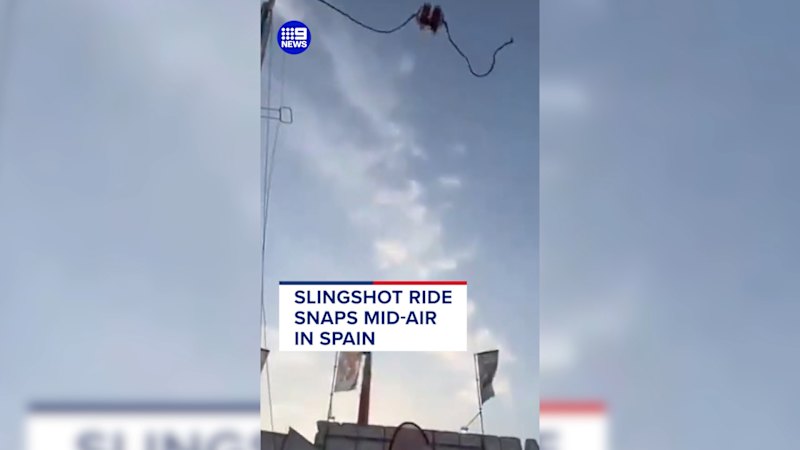
When a high-tension steel cable on a Slingshot ride shears under load, the sound is often described as a gunshot. It is a violent, metallic crack that signals the immediate failure of a system designed to catapult human beings hundreds of feet into the air. While viral videos of these incidents often focus on the terror of the passengers dangling in a metal cage, the real story lies in the physics of fatigue and the inconsistent patchwork of safety oversight that governs the amusement industry. These accidents are rarely "freak" occurrences. They are the predictable outcome of mechanical stress meeting inadequate maintenance cycles.
The Slingshot—a reverse bungee attraction—relies on a deceptively simple mechanism. Two towers, a passenger capsule, and a series of high-strength cables or bungee cords. To launch, the system must store immense potential energy. This is usually achieved by stretching elastic components or using a winch system to pull against the resistance of nitrogen-charged springs. When the release triggers, that energy converts into kinetic force, subjecting the equipment to massive, repetitive G-forces.
The Engineering Behind the Snap
Most modern Slingshot failures trace back to fatigue loading. In engineering terms, this is the weakening of a material caused by repeatedly applied loads. Every time a ride launches, the cables stretch and retract. Over hundreds of cycles, microscopic cracks form within the steel strands or the polymer bonds of synthetic ropes.
If a cable is rated for a certain number of cycles but is kept in service longer to save on operational costs, the risk of a catastrophic break increases exponentially. Steel cables do not usually snap because they aren't strong enough to hold the weight; they snap because the constant vibration and tension have compromised the internal structure of the metal. Corrosion adds another layer of danger. Many of these rides are located in coastal tourist hubs where salt air eats away at exposed metal. Without rigorous, daily inspections using non-destructive testing (NDT) methods like magnetic particle or ultrasonic testing, these tiny fissures remain invisible to the naked eye until the moment of failure.
The Myth of Redundancy
Operators often point to "redundant" safety cables as a guarantee of safety. This is a half-truth. While secondary cables are designed to catch the capsule if the primary drive line fails, the sudden transfer of energy is violent. When one side of a Slingshot snaps, the capsule often whips toward the remaining functional tower. This creates a secondary hazard: the risk of the cage striking the support structure itself. True redundancy requires not just a backup cable, but a braking system capable of absorbing the lateral kinetic energy of a lopsided failure.
The Regulatory Black Hole
The biggest threat to rider safety isn't a lack of engineering knowledge, but a lack of uniform enforcement. In the United States, there is no federal agency that oversees fixed-site amusement park rides. The Consumer Product Safety Commission (CPSC) has the authority to investigate mobile carnivals, but permanent installations fall under state or local jurisdiction.
This creates a dangerous "safety lottery" for travelers. In states like New Jersey or Florida, inspectors are generally rigorous, requiring documented maintenance logs and frequent structural certifications. In other states, the "inspection" might consist of a local official with no engineering background checking to see if the lights work and the insurance premiums are paid. International standards are even more fractured. A Slingshot ride in a European theme park operates under different safety margins than one on a beach in Southeast Asia, even if the machinery looks identical.
Operational Human Error
Beyond the hardware, the "how" of a snap often involves the people at the controls. Overloading a capsule is a common, yet preventable, cause of stress failure. Every ride has a strict weight limit, but in the rush of a busy summer night, staff may skip the scale. When a ride is calibrated for a maximum load of 400 pounds and launches with 450, the internal pressures within the hydraulic or bungee systems can exceed their safety factors.
Furthermore, the "pre-tensioning" phase is critical. If the operator fails to ensure the cables are properly seated or if the launch sequence is triggered while there is slack in the line, the resulting "snap" is a high-impact shock load. This is significantly more damaging than a smooth, gradual pull. It is the difference between pulling a string until it breaks and snapping it with a quick jerk of the hands.
The Cost of Cheap Thrills
The amusement industry is a business of margins. A set of high-grade replacement cables for a Slingshot can cost thousands of dollars, not including the revenue lost during the downtime required for installation. This creates a perverse incentive for smaller operators to "squeeze one more season" out of aging equipment.
We see this pattern in every major reported incident. The post-accident investigation almost inevitably reveals a history of skipped inspections or "makeshift" repairs that weren't authorized by the original manufacturer. When a park buys a ride second-hand—a common practice in the industry—the maintenance history can become murky, leaving the new owner unaware of how many cycles the structural components have actually endured.
The Invisible Warning Signs
A cable rarely snaps without warning. There are tells.
- Fraying or "Birdcaging": Small wires on the outer layer of a cable beginning to unspool.
- Metallic Dust: A fine grey or black powder around pulleys, indicating metal-on-metal grinding.
- Irregular Launch Rhythms: If the capsule hesitates or "shudders" during the initial pull, the internal tensioning is failing.
- Audible Creaks: Not the normal mechanical whir, but a high-pitched "pinging" sound which is the sound of individual steel strands snapping inside the sheath.
If you are standing in line and see any of these indicators, leave. The reality of the amusement industry is that the passenger is often the final line of defense in a system that prioritizes throughput over preventative maintenance.
The Shift Toward Digital Monitoring
The solution to these failures isn't just better cables; it is the integration of real-time load sensors. Modern aerospace engineering uses "smart" materials that can report their own structural integrity to a central computer. If theme park operators were required to install strain gauges that automatically locked the ride if a cable exceeded a certain fatigue threshold, the "snap" would become a relic of the past.
However, retrofitting older rides with this technology is expensive. Until the industry is forced to adopt a universal safety standard—one that treats a Slingshot ride with the same mechanical gravity as a commercial aircraft—we will continue to see these "accidents." They are not acts of God. They are the measurable results of friction, tension, and a calculated gamble on how long a piece of steel can hold a human life.
Check the inspection sticker before you strap in. If it's dated more than a year ago, or if the operator can't show you a daily log, you are no longer a customer; you are a test pilot for a machine that is slowly tearing itself apart.