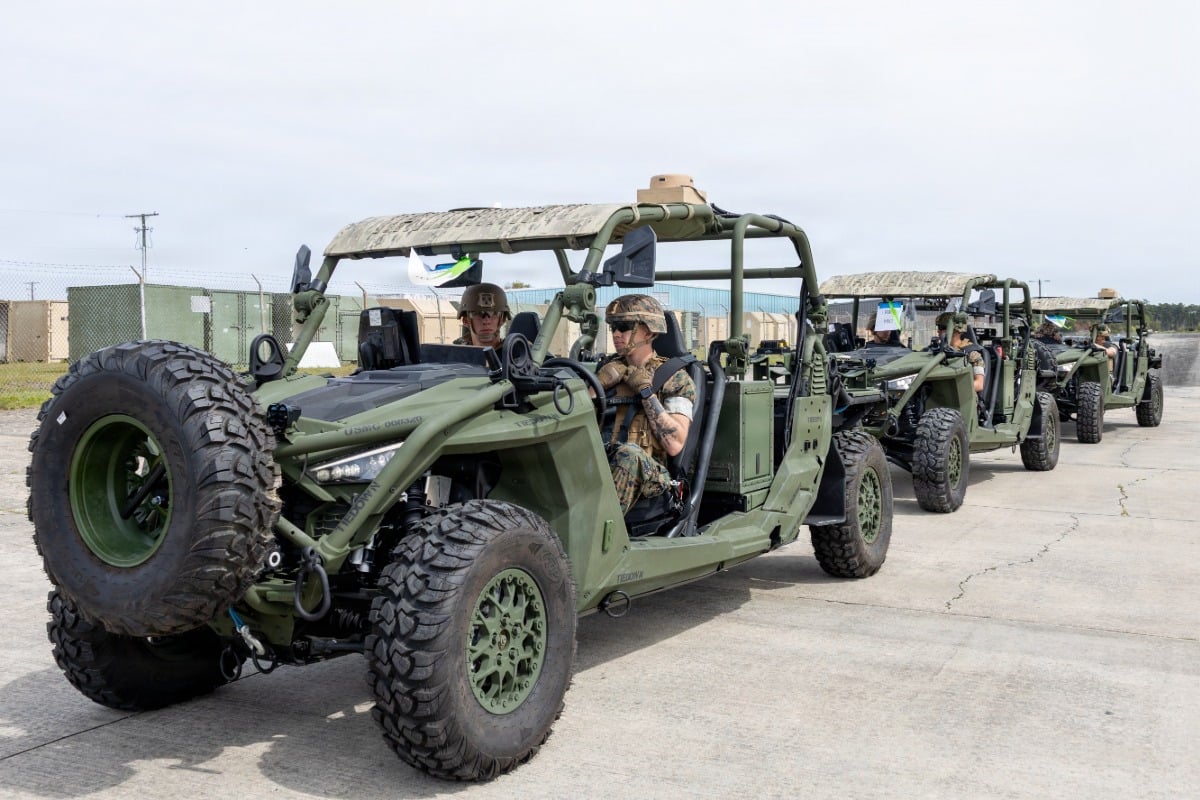
The U.S. Marine Corps has officially placed its first major production order for the Ultra Light Tactical Vehicle, securing over 70 MRZR Alpha platforms from Polaris Government and Defense. While initial trade press framing treats this as a standard procurement win, the reality of the contract reveals a much more aggressive shift in expeditionary warfare strategy. This buy is not just about replacing aging internal transport vehicles. It is a direct response to a glaring vulnerability in the Pentagon’s island-hopping strategy for the Pacific theatre.
For years, the Marines relied on the legacy Internally Transportable Vehicle (ITV) and early-generation commercial off-the-shelf buggies. They were brittle. They lacked the payload capacity for modern anti-ship missiles, and they broke down under the brutal conditions of surf-zone deployments. The procurement of the MRZR Alpha under the ULTV program represents a hard pivot toward distributed operations where heavy, armored logistics lines are non-existent.
The Logistics Crisis Driving the Buy
The Marine Corps is currently rebuilding itself around the concept of Force Design. The core idea is simple. Small, lethal units must scatter across remote islands to spot and sink enemy warships.
Executing this strategy is a nightmare.
If a unit is stuck moving on foot, they are static targets. If they use heavy tactical vehicles like the Joint Light Tactical Vehicle (JLTV), they cannot fit inside the MV-22B Osprey or CH-53E Super Stallion helicopters that are vital for rapid insertion. The Marines needed a vehicle that could fly inside an Osprey, roll off the ramp, and immediately haul thousands of pounds of gear over broken terrain.
The MRZR Alpha fills this exact niche, but the procurement path exposes how desperate the service is to fix its mobility gap. The contract moves the ULTV from a low-rate initial testing phase into true operational deployment. By pushing these 70-plus units directly to the Fleet Marine Force, leadership is signaling that the experimentation phase is over. The threat environment demands immediate capability on the ground.
Inside the Mechanical Overhaul
To understand why the Alpha won this contract over cheaper commercial options, you have to look at the chassis architecture. Standard commercial side-by-sides are built for weekend recreation. They use plastic components and suspension setups that snap under the weight of combat loads, body armor, and ammunition crates.
The ULTV requires a radically different engineering approach. Polaris built the Alpha on a high-strength steel chassis designed to maximize payload without increasing the vehicle's physical footprint.
Power and Exportable Energy
The vehicle runs on a multi-fuel engine, a non-negotiable requirement for forward-deployed military logistics. In a remote Pacific outpost, a unit cannot afford to manage separate supply lines for gasoline and diesel. The Alpha can sip standard military JP-8 fuel, tying directly into the existing aviation fuel supplies available at any temporary dirt landing strip.
More importantly, the platform addresses a modern combat reality: power hunger.
A modern infantry squad carries an immense electronic footprint. They have tactical radios, counter-drone jammers, ruggedized tablets, and target designation systems. The ULTV functions as a mobile generator. It features an expanded exportable power architecture that allows Marines to charge drone batteries and run high-draw command systems directly off the vehicle’s alternator while deeply embedded in contested territory.
Tactical Versatility
The cargo bed is fully modular. In less than ten minutes, a crew can reconfigure the back from a four-seat troop transport to a flatbed capable of carrying two casualties on litters, or a heavy weapons mount.
+------------------------+---------------------------------------+
| Feature                | Tactical Advantage                    |
+------------------------+---------------------------------------+
| Osprey Compatibility   | Rapid roll-on/roll-off deployment     |
| Multi-Fuel Engine      | Eliminates secondary fuel supply lines|
| Modular Cargo Bed      | Quick transition to casualty medevac  |
| Exportable Power       | Charges drone batteries in the field  |
+------------------------+---------------------------------------+
The Unspoken Vulnerability
Every military compromise involves a trade-off. For the ULTV, that trade-off is survival.
The MRZR Alpha possesses virtually zero armor. A single burst of small-arms fire or a fragment from an artillery shell will penetrate the vehicle instantly. Marine planners are banking on a specific tactical philosophy: speed and low signature are the new armor.
In theory, a heavy, heavily armored vehicle protects the troops inside from an improvised explosive device. However, in a Pacific conflict, that heavy vehicle is easily spotted by satellites and long-range drones. Once spotted, it is destroyed by a precision missile.
The ULTV attempts to bypass this targeting loop entirely. Its small thermal and visual signature makes it difficult to detect from the air. It can hide under jungle canopies where a JLTV would get stuck or draw immediate attention.
Yet, this places an immense burden on the operators. If a Marine squad miscalculates an enemy position and drives into an ambush, the ULTV offers no protection. It is a high-stakes gamble that values mobility and deployment flexibility over traditional troop protection.
Shifting Procurement Tactics
The structure of this contract also highlights a major shift in how the Pentagon buys technology. The traditional acquisition system takes a decade to move a vehicle from a requirement sheet to the dirt.
The ULTV program bypassed much of this bureaucracy by utilizing rapid prototyping authorities and leveraging commercial automotive supply chains. This allowed the Marine Corps to field a customized military vehicle in a fraction of the time.
This approach has a distinct downside. Commercial supply chains change rapidly. When a commercial manufacturer discontinues a component or updates a chassis line, the military can find itself holding a fleet of vehicles with obsolete parts. Polaris has attempted to mitigate this by locking in long-term support agreements for the Alpha platform, but maintaining specialized parts in a austere environment remains a massive logistical hurdle.
The delivery of these 70-plus vehicles will immediately impact the training cycles of West Coast and forward-deployed Marine Expeditionary Units. Infantry battalions will no longer view these ultra-light platforms as novelty items for specialized scout snipers. Instead, they are becoming the primary mechanism for moving squads across extended battlefields.
The success of the program will ultimately be judged not by how well the vehicles perform on a testing track in Arizona, but by how they survive the corrosive salt air, humidity, and isolation of decentralized operations in distant island chains. The Marine Corps has made its bet on light, fast, and unarmored mobility. The hardware is now heading to the fleet to prove whether that bet will pay off.