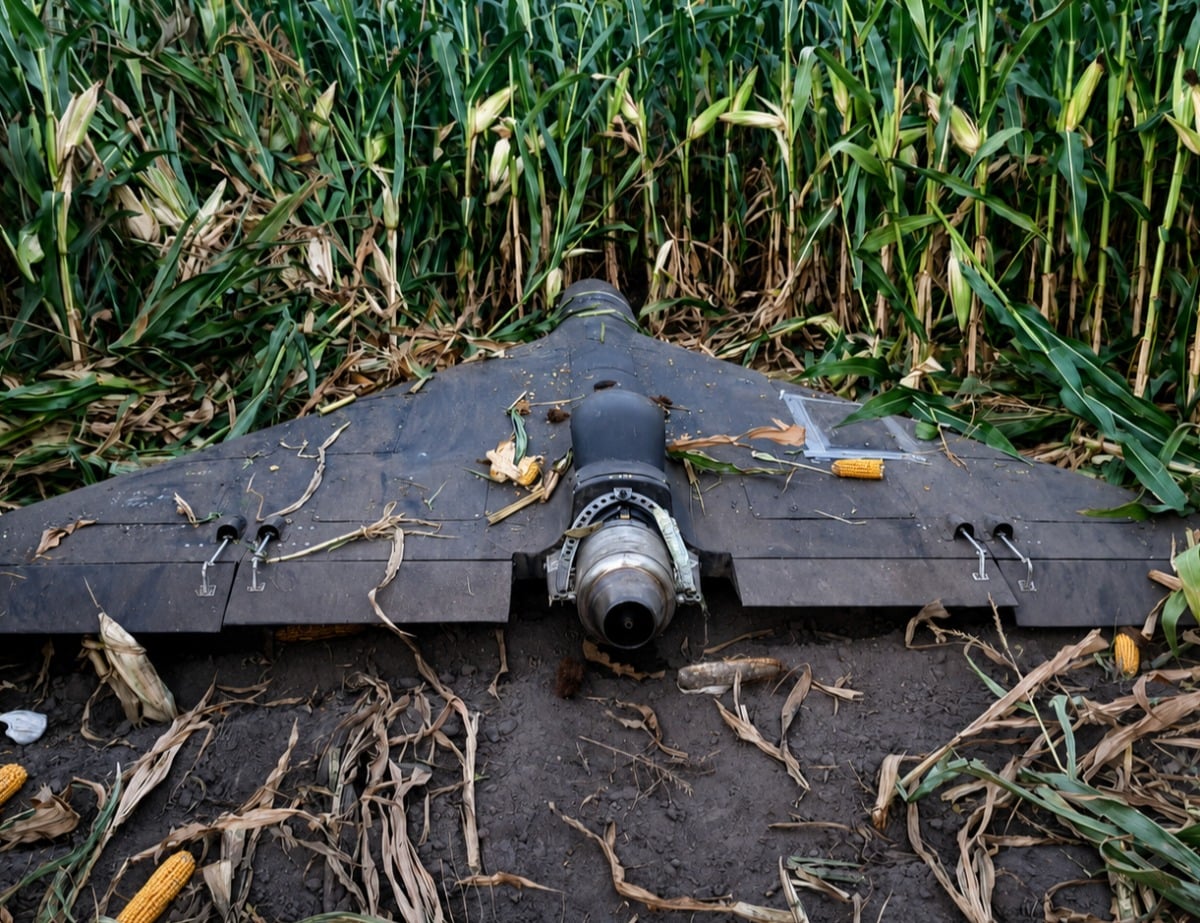
Mobile drone-hunting teams across Ukraine are hitting a hard physical limit. For over a year, these crews—rushing around in modified pickup trucks with searchlights, machine guns, and thermal optics—served as a highly cost-effective shield against waves of low-cost loitering munitions. They saved precious, multimillion-dollar air defense missiles by shooting down slow-moving targets with standard ammunition. But the tactical equation has fundamentally changed. Russia has introduced faster, stealthier, and more adaptable uncrewed aerial vehicles (UAVs) into the theater, and the human reflexes of ground-based spotters can no longer close the gap.
The crisis is not a failure of Ukrainian resolve or ingenuity. It is a matter of hard physics and mismatched vectors. When a drone flies at 90 miles per hour, a coordinated team with a twin-barrel machine gun has a reasonable window to track, lead, and destroy the target. Increase that speed to over 150 or 200 miles per hour, alter the flight profile to low-altitude contours, and wrap the hull in radar-absorbing composite materials, and the human interception window shrinks to mere seconds. Ukraine is facing a severe velocity gap, and closing it requires moving past manual interception entirely.
The Velocity Gap and the Failure of Manual Intercepts
The math behind point defense is unforgiving. To shoot down an incoming aerial threat with a heavy machine gun or an automatic cannon, the gunner relies on three variables: early visual or acoustic detection, a predictable target trajectory, and sufficient time to calculate the necessary lead distance.
When tracking older, piston-engine loitering munitions, the distinct lawnmower-like acoustic signature provides kilometers of advance warning. This gives mobile teams time to position themselves directly beneath the flight path.
The latest iterations of Russian reconnaissance and strike drones have discarded these weaknesses. The introduction of smaller flying-wing designs, electric propulsion options for high-altitude tracking, and micro-turbojet engines for low-altitude sprints has disrupted the detection pipeline.
Consider the mechanical reality facing a mobile crew at 3:00 AM.
An incoming turbojet-powered drone clears a treeline two kilometers away, traveling at 250 feet per second. The acoustic signature is muffled until the craft is almost overhead. By the time the thermal optics track the signature and the gunner traverses the weapon mount, the drone has already cleared the engagement envelope. Manual tracking mounts simply cannot rotate fast enough, nor can human eyes process the deflection angle required to hit a high-speed asset moving across the horizon at close range.
Furthermore, the adaptation of commercial electronic warfare countermeasures means these fast drones often fly autonomously along pre-programmed waypoints using inertial navigation systems. They do not emit radio signals that Ukrainian electronic warfare units can easily jam or track, rendering passive radio-frequency detection methods increasingly obsolete.
The True Cost of Air Defense Inflation
With mobile gun crews neutralized by high-speed profiles, the burden of interception shifts upward to conventional surface-to-air missile (SAM) systems. This is precisely the strategic dilemma the Russian military wants to force.
Using a Western-supplied interceptor missile that costs between $500,000 and $2 million to down a drone that costs perhaps $35,000 is an unsustainable economic trajectory. The issue extends beyond monetary costs to sheer inventory limits. Production lines for advanced air defense missiles cannot match the manufacturing throughput of localized drone assembly plants operating on a wartime footing.
+------------------------------------+-----------------------------------+
| Interception Method                | Estimated Cost Per Engagement     |
+------------------------------------+-----------------------------------+
| Mobile Gun Crew (Max 90 mph target)| $500 - $2,000 (Ammo/Fuel)         |
| Western SAM System (High-speed)    | $500,000 - $2,000,000+ per missile|
| Experimental Laser/C-UAV Drone     | $10 - $15,000                     |
+------------------------------------+-----------------------------------+
This economic asymmetry creates gaping vulnerabilities in national infrastructure protection. When localized SAM batteries are forced to deplete their magazine depth on high-speed reconnaissance drones tracking troop movements, they are left empty when a coordinated ballistic or cruise missile strike arrives hours later. The high-speed drone acts as a kinetic wedge, forcing the defense to reveal its radar positions and exhaust its limited ammunition supply.
The Myth of the Cheap Software Fix
Some Western defense tech firms argue that artificial intelligence tracking software slapped onto existing gun mounts can solve this problem. This claim ignores hardware realities. A software algorithm can calculate a perfect intercept point in milliseconds, but if the physical actuators on a truck-mounted machine gun can only traverse at 30 degrees per second, the system will still fail to track a fast-moving, low-altitude target.
Upgrading the entire fleet of hundreds of mobile defense trucks with militarized, high-speed automated turrets requires billions of dollars and years of supply chain stabilization. It is not something that can be achieved via a remote software patch in a muddy field in eastern Ukraine.
Shifting from Ground Guns to Aerial Interceptors
To defeat a high-speed aerial threat without bankrupting the state, the defense must match the target's mobility. This means moving the weapon system from a static or truck-mounted ground position into the air.
Ukraine has begun experimenting with first-person view (FPV) interceptor drones specifically modified for anti-UAV operations. These are not the standard quadcopters used to target infantry trenches or armored vehicles. They are high-speed, multi-rotor, or fixed-wing airframes capable of rapid vertical ascent and sustained speeds exceeding 120 miles per hour.
The Mechanics of an Aerial Intercept
An aerial interception bypasses the traditional geometry of ground defense. Instead of trying to hit a speeding bullet with another bullet from below, an interceptor drone is directed via radar or ground-based acoustic networks into the general flight corridor of the incoming threat.
Once in the area, the interceptor uses onboard optical tracking to lock onto the target from a parallel or descending angle. The interceptor then closes the distance and detonates a small fragmentation warhead, or physically rams the target's propellors.
- Decreased Deflection Error: Because both aircraft are moving in the same relative direction, the tracking system does not need to handle the extreme angular velocity shifts inherent to ground-based shooting.
- Extended Engagement Range: A mobile truck is bound by roads and terrain. An aerial interceptor can pursue a target across rivers, minefields, and dense forests.
- Scalable Architecture: Manufacturing hundreds of high-speed FPV interceptors requires a fraction of the raw materials and specialized facilities needed to build even a single traditional radar-guided missile system.
Yet, this approach brings its own technical hurdles. Operating high-speed interceptor networks requires seamless integration between forward-deployed radar units, automated command-and-control software, and localized drone pilots. If the communication link between the ground radar and the drone pilot experiences even a three-second delay due to Russian electronic jamming, the high-speed target will outrun the interceptor's deployment radius.
Directed Energy and the Reality of Hard Power
Beyond aerial dogfights between uncrewed systems, the long-term resolution to the high-speed drone problem lies in directed-energy weapons, specifically high-power microwave (HPM) systems and solid-state lasers. These technologies eliminate the concept of lead distance and ammunition depletion entirely. A laser beam travels at the speed of light, rendering the velocity of a turbojet drone irrelevant.
However, treating directed energy as an immediate solution is an exercise in wishful thinking. Current laser weapon prototypes require massive, stabilized power generation units that are difficult to ruggedize for frontline deployment. Heavy fog, rain, or thick battlefield smoke can scatter the laser beam, drastically reducing its effective range and energy density.
Furthermore, the cooling requirements for high-energy systems mean they cannot sustain continuous fire against a saturated, multi-directional drone attack. They are components of a larger system, not a magic cure for defensive gaps.
The immediate imperative for survival dictates an aggressive diversification of short-range air defense frameworks. Relying on human eyes and manual triggers to stop assets moving at near-sonic speeds is a tactical dead end. The air defense networks that will survive the next phase of industrial warfare must rely on automated, distributed webs of low-cost aerial interceptors paired with high-frequency radar networks, stripping away the speed advantage the adversary currently enjoys.