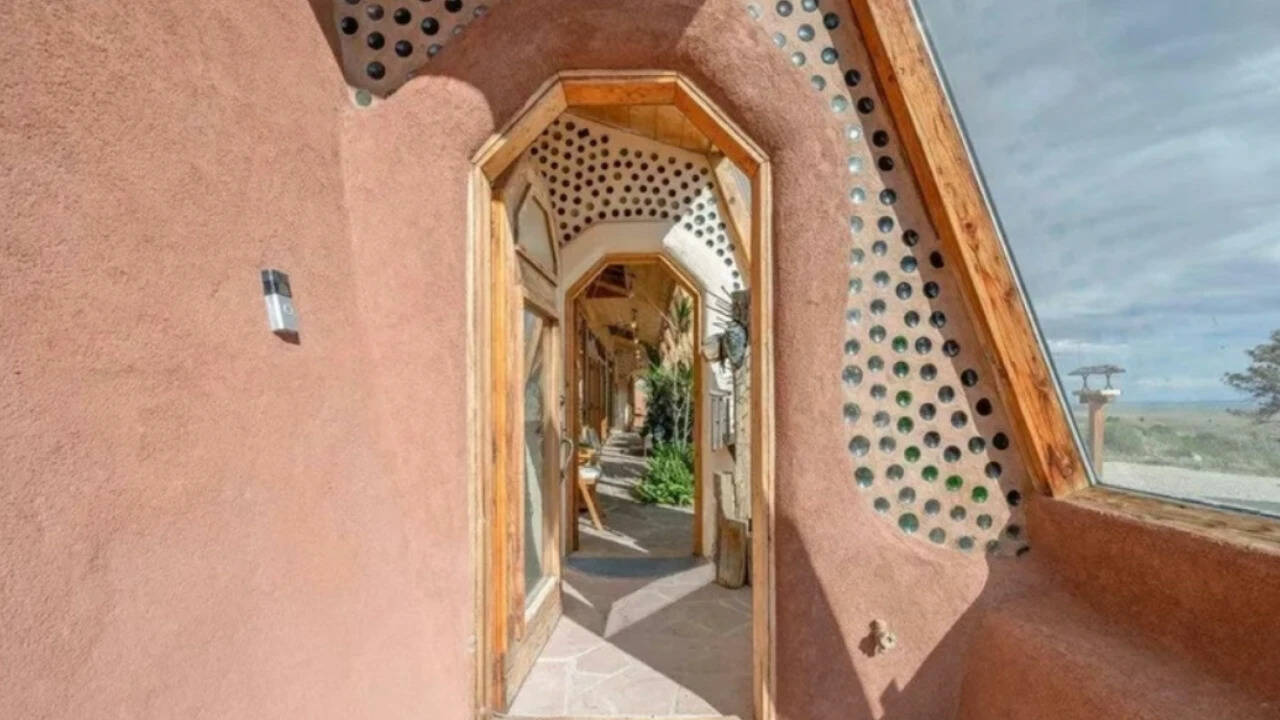
When a retired naval officer spent five years packing 1,343 discarded tires with rammed earth to build a 1,500-square-foot off-grid sanctuary in the Laramie Peak foothills of Wyoming, he was not just constructing a home. He was engaging in a slow, grueling architectural rebellion against municipal utility grids and suburban dependency. Fifteen years after breaking ground on that 55-acre parcel near Wheatland, the builder has placed the property on the market for $625,000.
Real estate listings love to romanticize alternative architecture as effortless idealism. They talk about the 66-foot south-facing greenhouse yielding indoor jungle vegetation, the thermal-mass walls keeping interior temperatures comfortably regulated without traditional HVAC systems, and the pristine panoramic views stretching across public lands. What glossy sales brochures routinely omit is the sheer, unyielding operational friction of living entirely outside standard municipal infrastructure. An Earthship is not a turnkey suburban estate. It is a complex, high-maintenance machine that demands total operational literacy from whoever holds the keys.
The mechanical footprint of this specific property reveals the compromise required for true energy independence. The compound relies on a 2,180-watt solar array paired with a wind turbine, backed up by a diesel generator. Water is managed via a 1,658-square-foot metal roof catchment system feeding four cisterns, with a permitted domestic well serving as a secondary lifeline. Every critical system features a redundant backup, from propane water heaters to mechanical circuit switches.
This redundancy is necessary because off-grid living offers zero margin for error. If a municipal grid fails in a conventional subdivision, a utility crew restores power within hours. If a wind turbine fails during a blinding Wyoming winter blizzard at the end of Fletcher Park Road, the homeowner becomes their own emergency repair technician, electrician, and plumber.
The valuation of $417 per square foot for a two-bedroom, one-bathroom home on 55 acres forces a serious market calculation. In standard real estate metrics, structure costs are generally tied to conventional building materials, local contractor access, and standardized utility hookups. Earthships defy traditional appraisal models. Banks frequently struggle to finance homes constructed from rammed-earth tires and glass-bottle mosaic walls because comparable sales data simply does not exist in conventional municipal databases. Traditional lenders view unconventional structural integrity with institutional suspicion. Securing a mortgage for an alternative home often demands specialized agricultural lenders, substantial cash reserves, or outright buyers who understand alternative construction methods.
The buyer pool for a remote Wyoming off-grid compound is inherently narrow. This lifestyle rejects convenience. Groceries, medical facilities, and commercial hubs sit miles away down rural stretches. Winters bring sub-zero temperatures and drifting snow that can temporarily test the resolve of even the most hardened survivalist. The seller noted that if someone's ideal vacation spot is the Las Vegas strip, an isolated Wyoming ridge is likely the wrong zip code.
Yet, the listing highlights a profound cultural shift in how modern buyers view property value. As conventional grid stability faces new pressures and land costs in urban centers soar, self-sufficiency carries an escalating market premium. Buyers are no longer paying merely for drywall and square footage; they are purchasing insulation from rising utility costs, municipal regulations, and external supply chain vulnerabilities.
The sale of this Wyoming sanctuary will test whether alternative architecture can successfully transition from eccentric DIY passion project to a viable asset class for affluent buyers seeking absolute autonomy. The tires buried deep within those earthen berms have spent a decade and a half holding back the hillside. Now, they must hold up under the cold, analytical gaze of the open real estate market.