You don't expect a quiet suburban synagogue in northwest London to look like a high-security border checkpoint, but that's exactly what happened on June 14, 2026. Metal detectors guarded the entrance of the Edgware United Synagogue. Outside, a massive crowd of roughly 1,000 protesters split down the middle, screaming at each other while lines of Metropolitan Police officers tried to keep the peace.
By the end of the day, 14 people were in handcuffs. The charges ranged from violent disorder and assaulting police officers to racially and religiously aggravated public order offenses.
The spark for this chaos? A private, invitation-only real estate exhibition called the "Great Israeli Real Estate Event."
Human rights groups, over 100 British lawmakers, and London Mayor Sadiq Khan had spent the week begging the government to ban it. The reason is simple. Critics argue the show wasn't just selling condos in Tel Aviv or Haifa. It was actively marketing homes built on occupied Palestinian land in the West Bank, an area considered completely illegal under international law.
Stolen Land with a Sales Pitch
If you managed to get past the metal detectors, the exhibition looked like any standard property expo. There were mortgage advisors, tax consultants, insurance brokers, and experts on how to transfer funds overseas. The tour had already hit major diaspora hubs across the United States and Canada, including a controversial stop in New York that drew sharp condemnation from local politicians.
But it's the maps and options presented to prospective buyers that caused the real uproar.
Earlier in the week, the event's website let registered attendees explicitly tick a box to express interest in properties located in Gush Etzion. For context, Gush Etzion is a massive cluster of Israeli settlements inside the occupied West Bank. Following a wave of public pressure and media scrutiny, the organizers quietly scrubbed Gush Etzion from the online registration forms just days before the London doors opened.
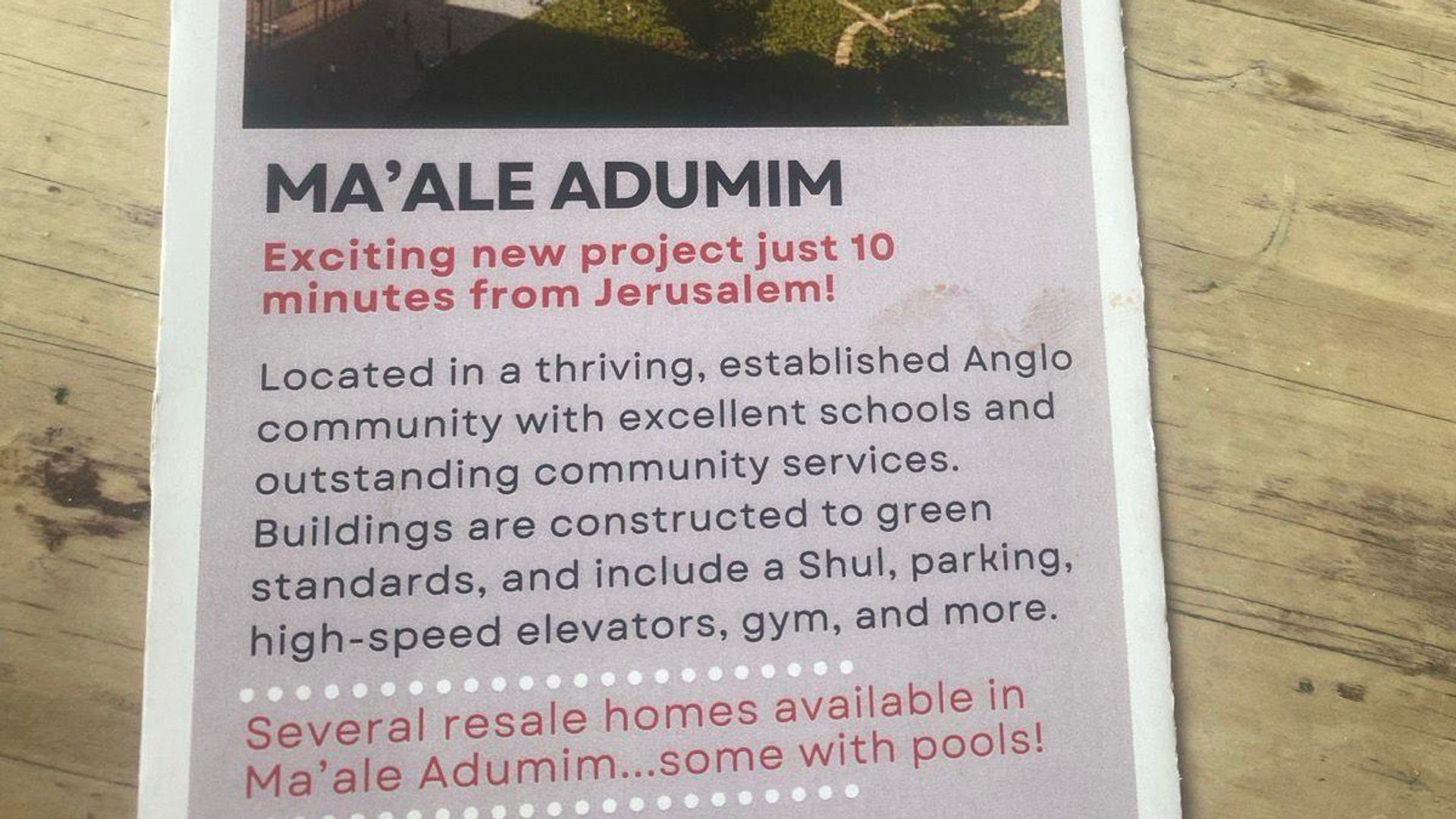
Yet, past editions of this exact roadshow tell a different story. Previous marketing materials openly advertised luxury properties in both Gush Etzion and Ma'ale Adumim, another heavy-hitting settlement block deep inside the West Bank. Even the general map used by the exhibition organizers features a unified territory with absolutely no delineation or borders indicating the West Bank, the Gaza Strip, or the occupied Golan Heights.
The event organizers, operating under the name "My Home in Israel," aggressively denied the accusations. A spokesperson dismissed the backlash, claiming that all exhibitors "without exception" were only dealing with projects within the Green Line—the internationally recognized 1948 borders of Israel. They went further, labeling the protests as "ridiculous allegations" driven by anti-Israel bias.
But human rights groups like Amnesty International UK say that's a smoke screen. They argue that mixing settlement properties with standard Israeli real estate is a calculated move to normalize land theft. It frames real estate built on displaced communities as a standard, everyday investment opportunity for international buyers.
The Toxic Reality on the Ground
To understand why this real estate fair caused such fury, you have to look at what's actually happening in the West Bank right now.
We aren't talking about a theoretical legal debate. The situation on the ground has hit a boiling point. According to data published by Amnesty International, the speed and scale of land annexation under the current Israeli government has broken records. Since 2023, Israel's state-led displacement campaign has forced at least 5,910 Palestinian Bedouins and herding community members from their ancestral lands. Over 3,400 Palestinian homes and structures have been flattened in Area C alone.
State-backed settler violence has also spiked dramatically. It's an environment of intense intimidation, where Palestinians are routinely forced from their homes at gunpoint.
The International Court of Justice and the UN Security Council have repeatedly stated that these settlements violate the Fourth Geneva Convention, which explicitly bans an occupying power from transferring its own civilian population into occupied territory. Because these settlements are illegal, buying a home there isn't just a questionable ethical choice—it directly funds and entrenches what major human rights organizations document as a system of apartheid.
British Foreign Policy Hypocrisy
The UK government finds itself in an incredibly awkward, hypocritical position. British Foreign Secretary Yvette Cooper recently announced new sanctions aimed directly at cutting off financial networks that fund violent Israeli settlers in the West Bank. The UK has even slapped sanctions on far-right Israeli ministers Itamar Ben-Gvir and Bezalel Smotrich for inciting violence and pushing annexation.
Yet, while the government uses one hand to sign sanctions against settlement expansion, it used the other hand to let a private company market those exact territories on British soil.
Before the event, 101 members of Parliament and the House of Lords sent an urgent letter to the Foreign Office. They warned that allowing the expo to move forward stood in direct opposition to the UK’s obligations under international law. Liberal Democrat MP Calum Miller took to the floor of Parliament to demand action, stating plainly that "Palestinian land is being advertised, bartered and sold on the streets of our capital."
The government's response was lukewarm at best. A spokesperson gave the standard line that settlements are illegal and harm the prospects of a two-state solution, while Cooper stated they were "pursuing" the event for any breaches of UK law. But they didn't stop it.
This hesitation highlights a massive loophole in British law. The UK officially advises British businesses against economic or financial involvement with illegal settlements, warning of clear legal and reputational risks. But it doesn't actually criminalize the trade, marketing, or sale of these properties inside the UK.
Spotting the Risks of Settlement Real Estate
For anyone looking to invest in overseas real estate, or for activists tracking global asset flows, you need to understand how these properties are packaged to unsuspecting buyers. Settler real estate companies rarely use the word "settlement" when marketing to international buyers in London or New York.
Instead, they rely on specific euphemisms and sales tactics:
- The "Anglo Neighborhood" Angle: Marketing materials heavily push the idea of moving into established "Anglo communities" or "neighborhoods," making a West Bank colony sound like a friendly, English-speaking suburb.
- Vague Geography: Properties are often listed as being "just 15 minutes from Jerusalem," completely omitting the fact that you have to cross a military checkpoint and build on occupied land to get there.
- All-Inclusive Relocation Packages: Organizers bundle the property sale with tax advisors, currency transfer services, and even subsidized burial plots, framing the entire purchase as a spiritual or cultural return rather than a geopolitical land grab.
The backlash in London shows that the international community is losing patience with this cross-border property market. If you want to push back against the normalization of these illegal land sales, the most effective step is targeting the local venues and local financial service providers that enable them.
Public pressure campaigns have already forced several international venues to cancel these events over safety and legal concerns. True accountability won't come from vague government statements of "grave concern"—it will happen when the UK shuts down the financial and promotional pipelines that turn occupied land into a commercial commodity.