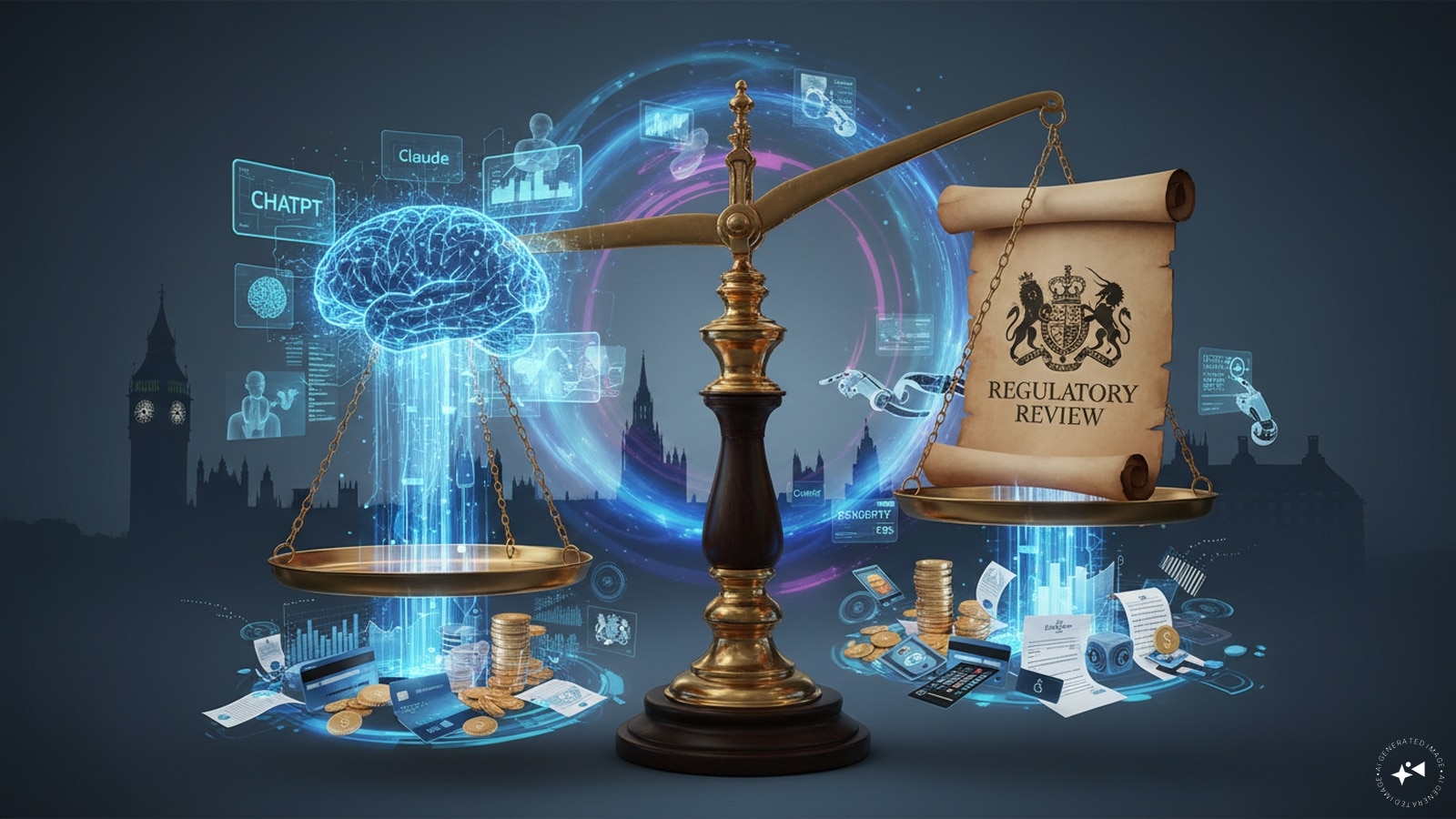
You’re sitting at home, looking at your savings account, and you don’t know whether to lock your cash into a fixed-rate bond or risk it in an index fund. Instead of paying hundreds of pounds to a human financial adviser, you type your financial life story into ChatGPT, Claude, or Gemini. The chatbot spits out a highly confident, professional-sounding recommendation. You follow it.
If that advice ruins your finances, who do you blame? Right now, nobody. You’re completely on your own.
That exact loophole is causing panic inside the UK Financial Conduct Authority (FCA). On July 6, 2026, the watchdog dropped the Mills Review, a massive look into how artificial intelligence will reshape retail banking, pensions, and investing by 2030.
The core message isn't subtle. The regulator thinks Britain needs to expand its legal perimeter to directly police general-purpose AI models. Sheldon Mills, the FCA executive director who led the review, openly admits that regulators are locked in an "arms race" against technology. If the government doesn't give them stronger powers soon, consumers are going to get hurt.
Here is what's actually happening behind the scenes, why the current system is broken, and what it means for your money.
The Blind Spot in British Financial Regulation
Britain has historically treated technology with a light touch. The official stance has been "technology-neutral," meaning the FCA doesn't care how a firm delivers a service, as long as it follows the rules. If a bank uses an algorithm to check credit scores, the bank is still on the hook if that algorithm discriminates.
But large language models (LLMs) completely break this setup.
When you use an LLM for financial guidance, you aren't using a tool built by a regulated bank. You’re using a tool built by a tech company in Silicon Valley. Research commissioned by the FCA found that 20% of UK adults—about 11 million people—are ready and willing to use autonomous AI to manage their savings and borrowing.
Here is the problem: OpenAI, Anthropic, and Google aren't authorized financial institutions. If a chatbot gives you a bad pension recommendation, you can't complain to the Financial Ombudsman Service. You can't get a payout from the Financial Services Compensation Scheme.
The tech firms argue they include terms of service stating their bots shouldn't be used for professional financial planning. But people are doing it anyway. The FCA realizes that telling consumers "buyer beware" doesn't work when an AI sounds incredibly authoritative, even when it's hallucinating entirely false data.
The Danger of Agentic Finance
The real panic isn't just about chatbots giving bad tips. It’s about what the industry calls "agentic AI."
We're rapidly moving away from systems that just answer questions. We're entering an era where you give an AI agent a goal—"maximize my ISA returns while keeping £5,000 liquid for emergencies"—and the AI goes out, opens accounts, shifts money, and executes trades on your behalf.
This isn't sci-fi. Tech firms are already deploying these agentic systems. While this could democratize wealth management for lower-income households who can't afford traditional advisers, it introduces terrifying systemic risks.
- Flash Herding: If three million UK consumers use the same underlying AI model to manage their money, and that model suddenly decides to liquidate a specific asset due to a glitch or a weird news event, it could trigger an instant market crash.
- The Mythos Factor: Cybersecurity fears are real. Look at Anthropic's powerful model, Mythos. The company restricted its use because it posed a severe threat to corporate cyber defenses. If a rogue agentic AI gets compromised, a hacker wouldn't just steal data; they could drain thousands of linked bank accounts simultaneously.
- Opaque Pricing: AI can hyper-personalize products. Sounds great, right? Wrong. It also means an AI can figure out exactly how much you are willing to overpay for insurance or a loan based on your personal data, leading to hidden, predatory pricing structures.
What the FCA Wants to Do About It
The FCA isn't waiting around. The Mills Review laid out seven major recommendations, and the watchdog wants a decision on expanding its regulatory perimeter within the next three to six months.
Instead of just forcing tech companies to register as banks, the FCA wants to use the UK's Critical Third Parties regime. This would allow regulators to directly audit and monitor tech giants like Microsoft, Google, and Amazon if their infrastructure becomes vital to the British financial system.
They also want to use something called the Designated Activities Regime. This lets the FCA regulate specific AI behaviors and applications without wrapping the tech companies in the entire, suffocating fabric of traditional banking licenses.
To fight fire with fire, the FCA is scaling up its own AI Lab. If banks and tech companies are using advanced code, the regulator needs to use its own supervisor AI to monitor transactions and flag market manipulation in real time.
Your Next Steps to Protect Your Money
Regulators move slowly, but your money is live right now. If you're using or planning to use AI tools to help manage your personal finances, don't wait for the British government to pass a new law to protect you. Take these steps immediately.
Treat Chatbots like Wikipedia
Use ChatGPT or Claude to explain financial concepts, compare the basic features of different accounts, or brainstorm budgeting strategies. Never rely on them for final investment decisions. They do not know the tax laws of your specific jurisdiction perfectly, and they frequently get complex pension calculations wrong.
Check the Human Accountability
Before you use any new app that promises automated investing or automated savings, look at the fine print. Is there a regulated UK firm behind it? Is there a human manager named under the Senior Managers and Certification Regime? If you can't find a real person or a regulated company holding the keys, don't link your bank account.
Diversify Your Platforms
If you use automated tools to manage your portfolio, don't put all your cash into platforms that rely on the same tech stack. If an app uses OpenAI for its backend, and OpenAI suffers a global outage, you might be locked out of your portfolio during a market downturn.
The financial world is shifting from human-led interactions to automated, continuous code. It’s going to make things cheaper and faster, but it removes the safety net. Assume you are operating without a net until the regulators catch up.