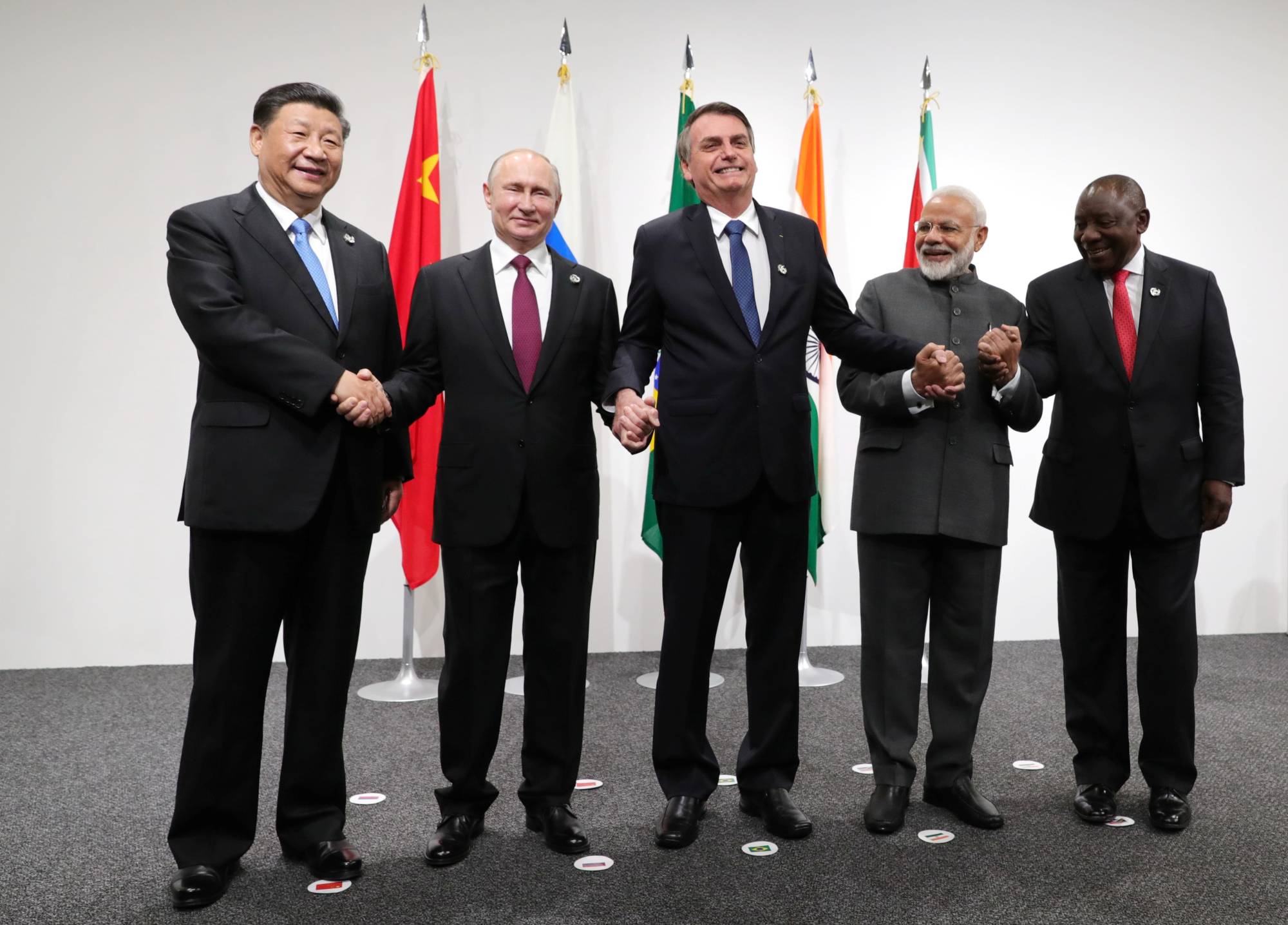
The expanded BRICS bloc presents itself as an anti-hegemonic force ready to dismantle Western financial dominance, yet its internal fractures reveal an association of convenience rather than a cohesive geopolitical alliance.
For two decades, Western capitals dismissed the acronym coined by a Goldman Sachs economist as little more than a marketing slogan for emerging market funds. That dismissal was a strategic error. Today, the bloc represents nearly half of the global population and over a third of the world's economic output in purchasing power parity terms. With the recent inclusion of oil heavyweights like Iran, the United Arab Emirates, and Saudi Arabia, the bloc controls a staggering share of global energy supplies.
Yet, controlling oil and representing billions of citizens does not automatically translate into a unified currency, a shared ideology, or a functioning alternative to the Washington-backed financial architecture. The real story of this expanded coalition is not about a smooth, unstoppable march toward de-dollarization. It is about a high-stakes, contradictory tug-of-war between states trying to insulate themselves from American sanctions while remaining deeply entangled in Western markets.
The Structural Fault Lines Beneath the Summit Photos
Diplomats love group photographs on polished marble floors. Analysts know to look at the room's corners.
The friction within the expanded group starts with its anchor economies. China and India share a heavily militarized border in the Himalayas, a history of armed conflict, and a deep-seated technological and geopolitical rivalry for leadership across the Global South. Beijing views the bloc as a vehicle to institutionalize its own economic gravity and challenge American hegemony directly. New Delhi views the bloc through a lens of strategic autonomy, determined to prevent the group from becoming a subsidiary of Chinese foreign policy.
Then there is the macroeconomic mismatch. Brazil and South Africa operate under floating exchange rates, open capital accounts, and Western-aligned legal frameworks. Russia sits under a suffocating regime of international sanctions, operating a war economy shielded by capital controls. Meanwhile, the Persian Gulf monarchies peg their currencies to the US dollar and rely on Western security umbrellas even as they diversify their diplomatic portfolios.
How does a trade bloc forge a common monetary policy or a unified payment system when its members harbor deep territorial disputes and diametrically opposed domestic economic models? The short answer is that it does not. The BRICS framework functions less like the European Union and more like the Non-Aligned Movement of the Cold War era: a loose diplomatic umbrella for nations that find common utility in pushing back against unilateral Western leverage.
The De-Dollarization Mirage
Much of the Western anxiety surrounding the bloc centers on the prospect of de-dollarization—the wholesale abandonment of the greenback in international trade. Headlines warn of a new gold-backed currency or a massive dumping of US Treasuries.
The reality on the ground is far more nuanced, messy, and constrained by hard structural economics.
Bilateral trade settlements in local currencies—such as India buying Russian oil in rupees or Chinese yuan—have certainly ticked upward. Beijing has steadily internationalized the renminbi, pushing its Cross-Border Interbank Payment System as an alternative to SWIFT. But establishing a currency as a global reserve medium requires more than political willpower. It requires deep, liquid, and open capital markets, absolute rule of law, and a willingness by the issuing nation to run persistent trade deficits so the rest of the world can acquire its money.
China maintains strict capital controls. Global investors cannot freely move yuan in and out of mainland markets without regulatory hurdles. Because of this, foreign central banks remain deeply hesitant to hold massive reserves of a currency managed by a capital-controlling state. The US dollar maintains its supremacy not merely out of habit or military might, but because global commerce requires a deep pool of safe, frictionless, and universally trusted assets. No member state within the bloc currently offers an alternative that meets those criteria.
Instead of a dramatic replacement of the dollar, what is actually occurring is a slow friction. Nations are building alternative plumbing—bilateral currency swaps, localized messaging networks, and commodity trading channels denominated in non-dollar assets. It is not an overnight collapse of Western financial architecture. It is an accumulation of bypass routes designed to route around Washington's ability to weaponize the financial system via secondary sanctions.
The Weaponization of Interdependence
To understand why emerging economies are rushing to join or align with the bloc, one must examine the turning point in modern financial history.
When the United States and its allies froze roughly three hundred billion dollars of Russian central bank reserves following the invasion of Ukraine, a silent alarm went off in capitals from Riyadh to Brasília. The message was unmistakable. If reserve assets held in New York, London, or Frankfurt can be seized overnight by executive order, then foreign exchange reserves are no longer safe insurance policies. They are hostage to Western foreign policy priorities.
This realization catalyzed a quiet scramble for financial diversification. Central banks in the Global South have increased gold purchases to multi-decade highs, quietly repatriating bullion from Western vaults to domestic depositories. They are experimenting with central bank digital currencies designed to settle cross-border trade without touching correspondent banks in New York.
The expansion of the coalition is a direct symptom of this anxiety. Nations want insurance. They want multiple doors to knock on when negotiating trade deals, infrastructure financing, or security arrangements.
The Institutional Counterweight
While Western media often focuses on rhetorical flourishes from summits, the real institutional engine of this bloc operates out of a sleek glass tower in Shanghai: the New Development Bank.
Established as an alternative to the World Bank and the International Monetary Fund, the New Development Bank was designed to finance infrastructure and sustainable development projects without the painful, politically toxic structural adjustment conditions traditionally attached to Western-led bailouts.
Yet, even here, reality has bitten hard. Following the invasion of Ukraine, the bank felt compelled to freeze new projects in Russia to protect its own access to Western capital markets, where it routinely raised funds by issuing bonds denominated in dollars and other major currencies. The episode underscored an unyielding truth: you cannot simply opt out of the global financial grid when the entire infrastructure of modern capital is wired through Wall Street and the City of London.
Despite these limitations, the bank and similar multilateral initiatives provide developing nations with leverage. When a low-income country sits across the negotiating table from an IMF delegation demanding severe austerity measures in exchange for emergency loans, having an alternative institutional door changes the calculus. It introduces competition into sovereign lending.
Navigating the Multipolar Disorder
The trajectory of the bloc will not be defined by grand declarations or dramatic manifestos. It will be forged in the unglamorous details of port construction contracts, bilateral currency swap agreements, commodity pricing mechanisms, and cryptographic payment rails.
The Western policy establishment faces a difficult pivot. Dismissing the bloc as an ineffective talking shop breeds complacency, while treating it as an existential civilizational threat invites overreaction. The proper lens is to view it as a symptom of a fracturing global order where middle powers refuse to accept a binary choice between American unipolarity and Chinese hegemony.
As these nations muddle through conflicting national interests and macroeconomic contradictions, they are steadily carving out spaces of economic autonomy. The global financial system is not splitting cleanly in two; it is fragmenting into overlapping networks of localized resilience. The architecture of the twentieth century is straining under the weight of a multipolar century, and no amount of diplomatic spin can patch the cracks.