The sun over the Kalahari Desert does not just shine. It heavy-presses against your skull. It bakes the red sand until the horizon wavers like a dying television screen. Standing on the surface, surrounded by thorn trees and an ocean of dust, you would swear that water is a myth invented by desperate men. You feel entirely, irrevocably dry.
But beneath the soles of your boots, past the scorched roots and the packed stone, lies a secret that defies the desert completely.
Imagine dropping a stone through a crack in the earth. It falls past the heat. It falls past the reach of the roots. It falls down into a silence so absolute it vibrates.
Two hundred and sixty-four meters below the surface, the stone breaks water.
This is Dragon's Breath Cave. Inside it sits the largest non-subglacial underground lake on Earth. It is a body of water so massive, so profoundly isolated, that it has created its own closed universe. A world where the sun has never risen, where the rules of survival were rewritten millions of years ago, and where humanity's presence is nothing more than a brief, intrusive blink of a flashlight.
The Weight of the Dark
Stepping toward the mouth of the cave requires a specific kind of nerve. The air changes first. The searing, bone-dry heat of the Namibian desert gives way to a humid, heavy breath rising from the throat of the earth. It smells of old stone and moisture.
For the handful of divers and researchers who have ever descended into this abyss, the journey is less an expedition and more an eviction from the known world. You are leaving the realm of sight.
To reach the water, explorers must rope down through a terrifyingly narrow, jagged fissure. The limestone teeth of the cave scrape against gear. The light from the surface thins, turns grey, and then vanishes.
Then, the cavern opens up.
Your headlamp cuts through the dark, but the dark fights back. It swallows the beams. When the light finally hits the surface of the lake, the visual is staggering. The water is utterly still. It looks like a sheet of black glass, polished and perfect, stretching out into the gloom. Because there is no wind, no weather, and no current, the water mimics the air. Divers have reported feeling an intense vertigo standing on the edge; it looks as though you are peering into an endless, empty void rather than a lake.
The scale is difficult to process when your world has shrunk to the width of a headlamp beam. The lake is vast, spanning several football fields across, its true depth only mapped by specialized equipment and daring plunges. The water is surprisingly warm, hovering around 24 degrees Celsius, kept cozy by the geothermal warmth of the earth's crust.
But the real shock is not the water. It is the life.
Living Without a Sky
In our world, light is the currency of existence. Plants turn light into energy, animals eat plants, and the chain rattles onward. Remove the light, and the entire structure collapses.
Or so we thought.
If you sit quietly by the edge of the underground lake, your eyes adjusting to the absolute zero of the cavern, you might notice a ripple. A tiny, ghostly movement on the water's surface.
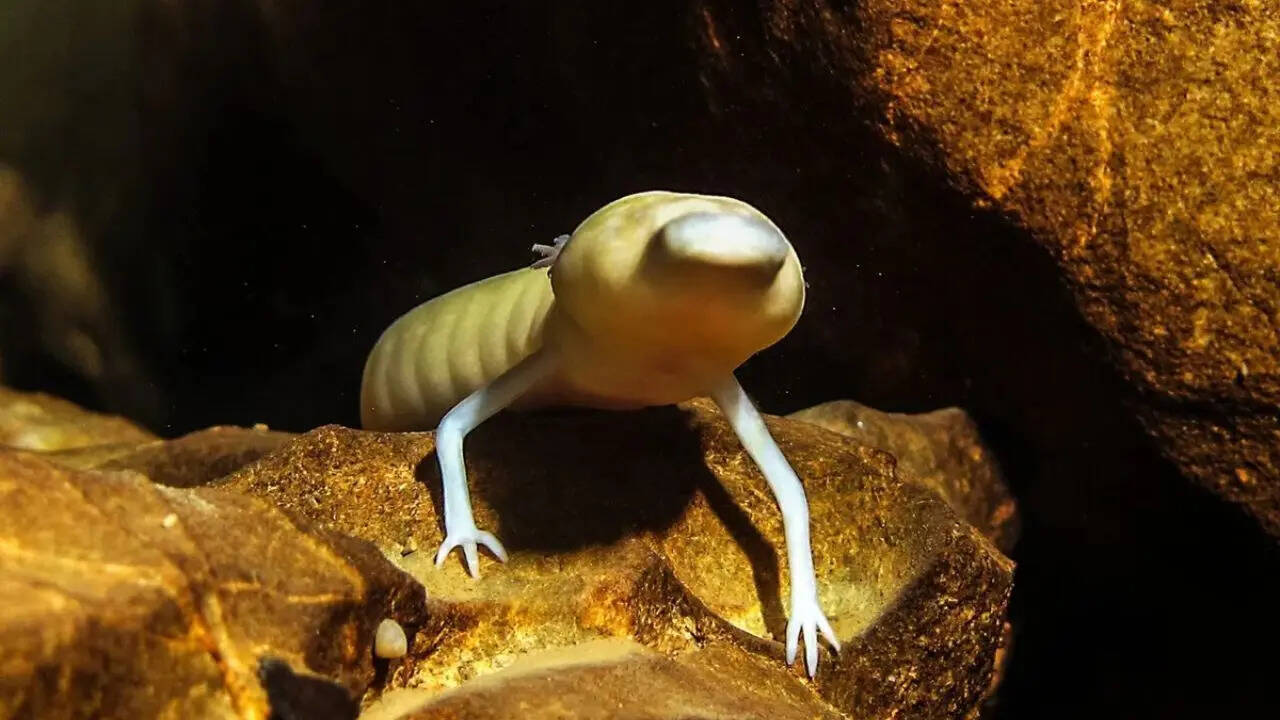
This is the home of the golden catfish (Clarias cavernicola), one of the rarest fish on the planet. They are the monarchs of this dark empire, but they look nothing like their surface-dwelling cousins. Evolution, finding no use for color in a world of pure shadow, stripped them of their pigment. They are pale, translucent, almost ethereal.
More strikingly, they are completely blind.
Their eyes have shiveled away into useless, skin-covered dots. In this lake, an eye is nothing but a liability—a delicate organ that can get infected or damaged, offering zero return on the biological investment. Instead, these creatures have leaned heavily into their other senses. They navigate by a sophisticated system of lateral lines and sensory barbels, feeling the microscopic pressure waves in the water. They can sense a single insect falling into the lake from the cavern roof hundreds of feet above.
Consider the reality of their existence. They have never seen a shadow. They do not know what a tree is, or a cloud, or the moon. Their entire universe is defined by the temperature of the water, the texture of the cave walls, and the vibrations of their neighbors.
They are not surviving in spite of the darkness. They are thriving because of it.
The Invisible Stakes of a Hidden World
It is easy to view Dragon's Breath Cave as a beautiful anomaly, a natural curiosity to be cataloged and forgotten. But that view misses the point entirely.
This underground lake is a time capsule. The water down here has been shielded from the surface atmospheric changes for millennia. It is a pristine laboratory, offering a glimpse into how life adapts when pushed to the absolute edge of possibility.
Scientists studying the microbes and unique fauna of the cave are not just looking at old fish. They are looking at the blueprint of survival. The adaptations found in these dark waters have implications for biotechnology, for understanding evolutionary triggers, and even for astrobiology. If we ever find life beneath the icy crust of Jupiter's moon, Europa, or deep under the Martian soil, it will likely look a lot like the pale, vibration-sensitive residents of the Kalahari underbelly.
Yet, this alien world is fragile.
The water level in Dragon's Breath Cave is tied to the broader subterranean aquifers of southern Africa. As human populations expand, and as climate patterns shift, the demand for groundwater on the surface rises. Pumping water from miles away can cause the water table to drop inside the cave.
A shift of just a few meters could dry out the shallow ledges where the golden catfish feed and breed. For a species that exists nowhere else on Earth, a drop in the water level is not an inconvenience. It is an eviction notice from existence.
The tragedy of the subterranean world is that it is out of sight, and therefore, out of mind. We watch the destruction of rainforests because we can see the smoke. We mourn the bleaching of coral reefs because the satellite images are stark and vibrant. But when a dark lake deep beneath a desert shifts, nobody notices. There are no cameras to capture the quiet retreat of the water.
Touching the Abyss
The few divers who have plunged into the depths of the lake describe an eerie, spiritual experience. Once you drop beneath the surface, the bubbles from your regulator are the loudest sound in the universe.
Looking up from twenty meters deep, your flashlight illuminates the underside of the water's surface, reflecting back like a silver mirror. Below you, the water drops down into the full 264 meters of the abyss. It is clear. So clear that you feel like you are suspended in outer space, floating between stars that don't exist.
You realize, in that moment, how small the human story really is.
We spend our lives sprinting across the surface of the planet, building cities, fighting wars, and worrying about the weather. We think we own the Earth. But just beneath our feet, tucked away in the deep pockets of the stone, the planet is harboring ancient, quiet kingdoms that care nothing for our politics or our technology.
The golden catfish will continue to drift through the black water. They will continue to hunt by touch and vibration, oblivious to the scorching desert sun directly above them, as they have done for millions of years.
The rope is pulled back up. The headlamps are switched off. The heavy steel grate over the fissure is locked.
The desert above returns to its dry, whispering heat, completely indifferent to the ocean of dark water sleeping eternally in the deep.