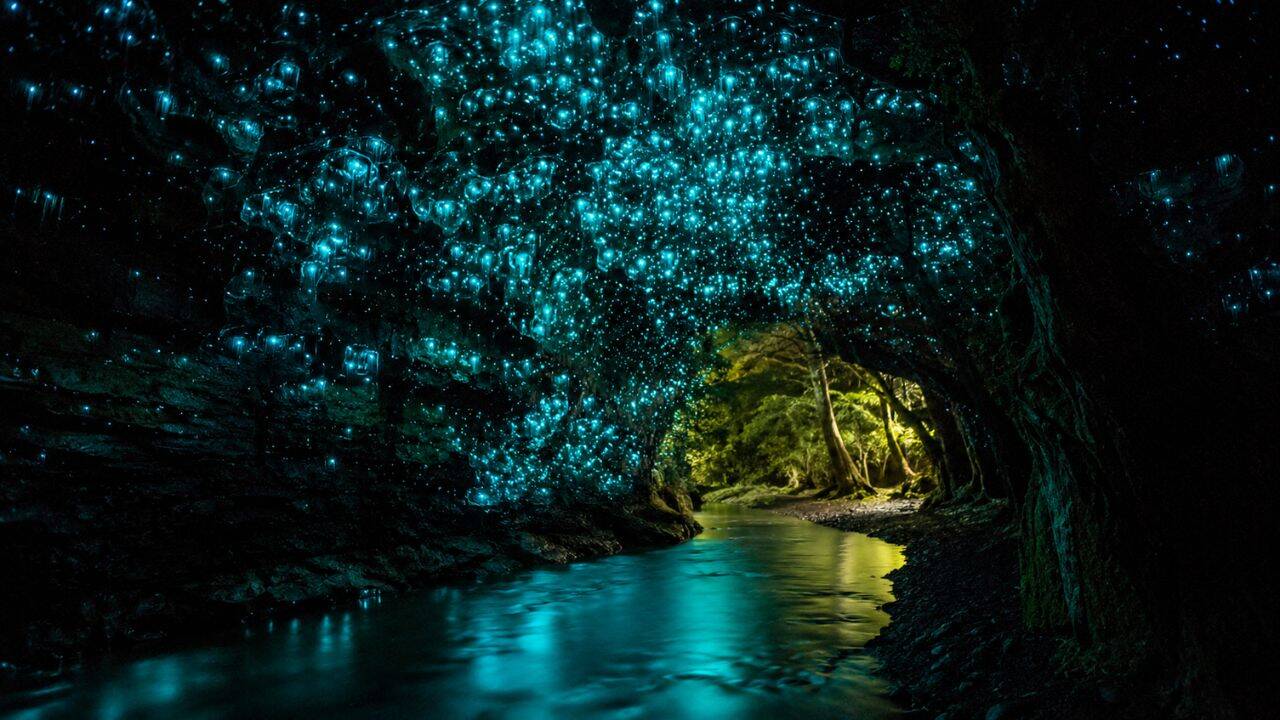
Tourism boards have spent decades selling you a fairy tale. They show you glossy photographs of Waitomo and Te Anau, painting New Zealand’s forests and caves as subterranean galaxies, mystical sanctuaries where nature puts on a gentle, celestial light show just for your wonderment.
It is a beautiful lie.
If you travel halfway across the world expecting a serene, cosmic connection with the universe, you are falling for a marketing gimmick designed to mask a brutal biological reality. The "galaxy" you are admiring is actually a high-density death trap. Those twinkling blue lights are not peaceful stars; they are the glowing rears of thousands of starving, predatory maggots using chemical warfare to lure their prey into a agonizing demise.
When you strip away the romanticized eco-tourism narrative, the reality of New Zealand’s bioluminescent attractions gets much darker, much grosser, and infinitely more fascinating than the sanitized version sold to crowds packed shoulder-to-shoulder in damp caves.
The Carnivorous Truth Behind the Glow
Let us dismantle the romantic consensus immediately. The creature responsible for this phenomenon is Arachnocampa luminosa, a species of fungus gnat endemic to New Zealand. Calling them "glowworms" is a brilliant stroke of PR; calling them "predatory gnat larvae" does not move tickets.
During their larval stage, which occupies the vast majority of their lifespans, these maggots build a complex web of mucus and silk. They construct vertical, sticky strings—often called "snares"—that hang down from the cave ceilings. To attract prey into these lines, the larva utilizes a biochemical reaction inside its excretory organs. Luciferin reacts with luciferase to produce a cold, blue-green light.
[Larval Bioluminescence] ---> [Attracts Aquatic/Flying Insects] ---> [Entanglement in Mucus Snares] ---> [Larva Reels in and Devours Prey Alive]
Every single point of light you see in a New Zealand cave is an active, hungry predator trying to trick an insect into flying into a wall of deadly glue. The brighter the light, the hungrier the maggot. You are not looking at a night sky. You are looking at a crowded, competitive slaughterhouse operating at a microscopic scale.
The Tragedy of the Ephemeral Adult
The irony of the travel industry’s obsession with the beauty of these creatures is that the beauty is born entirely out of desperation. The larval stage is the only time these insects actually possess a functional mouth.
Once the maggot pupates and emerges as an adult fly, it enters a frantic, tragic race against time. The adult fungus gnat has no digestive system. It cannot eat. It exists for only a few days with a single, desperate mandate: find a mate, lay eggs, and die of starvation.
If you visit these sites during peak periods, the sheer volume of human disruption—carbon dioxide emissions, artificial light leaks, and acoustic noise—stressed the local ecosystem. When an adult gnat is disoriented by a tourist's stray smartphone screen, it wastes precious energy. In a life cycle measured in hours, a single mistake means extinction before reproduction. The very industry built on celebrating these creatures is actively complicating their brutal, fragile survival loop.
The Eco-Tourism Machine is Ruining the Experience
I have spent years analyzing how travel destinations manipulate natural phenomena for mass consumption. The commercialization of the Waitomo Caves is a textbook case of turning ecological niche events into assembly-line operations.
You are funneled into a cave system, told to remain dead silent, and floated through the darkness on a boat alongside dozens of strangers who are secretly trying to sneak photos on their smartwatches. The artificial restriction of the environment completely sanitizes what makes the biology interesting. You are paying premium rates to look at maggots in the dark while a tour guide recites a scripted monologue.
If you actually want to experience the raw, unmanipulated reality of Arachnocampa luminosa, you need to avoid the commercial cave systems entirely. The "lazy consensus" dictates that you must go underground to see the glow. That is entirely false.
How to Find the Real Subterranean Underworld
These insects do not require caves; they require high humidity, shelter from the wind, and a constant supply of food. Because of this, they thrive across the damp, native forests of both the North and South Islands.
Instead of booking a commercial boat tour months in advance, find a public, native bush walk that features steep embankments, overhanging clay banks, or streamside grottos. Walk these tracks at midnight without a flashlight.
- The Overlooked Hotspots: Locations like the McLaren Falls Park near Tauranga or the Velma Woods tracks offer open-air displays that rival the commercial caves, completely free of charge.
- The Risk Factor: Navigating New Zealand's native bush at night carries genuine risks. Slippery tree roots, sudden drop-offs, and total disorientation are real dangers. If you misstep, you can easily break an ankle or get lost in the dense undergrowth.
- The Reward: You get to witness the raw, chaotic struggle for survival in total isolation. You can hear the actual sounds of the forest—the rushing water, the nocturnal insects—while watching the predatory light show happen in its true, unmanaged habitat. You see the system as it evolved, not as a curated amusement park ride.
Stop consuming sanitized versions of nature. Stop looking at predatory larvae through the lens of cheap romance. Acknowledge the cruelty, the hunger, and the chaotic engineering of the forest for what it actually is: a magnificent, terrifying machine designed for absolute survival.