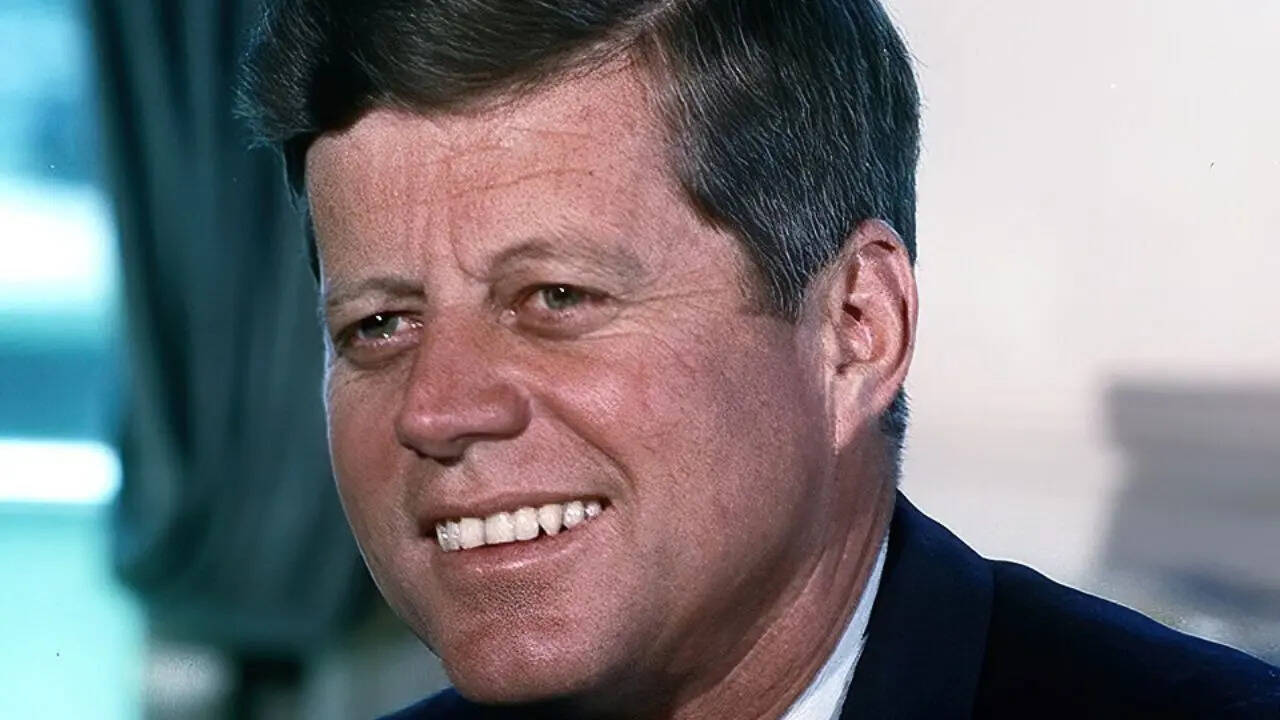
The stability of global systems relies on a recognition of existential non-negotiables rather than ideological alignment. John F. Kennedy’s 1963 commencement address at American University—often reduced to a moral appeal for peace—actually functions as a blueprint for high-stakes risk management. By identifying shared biological and planetary constraints, Kennedy moved beyond the zero-sum logic of the Cold War to propose a framework of mutual survival via resource interdependence. This analysis deconstructs the four variables of Kennedy’s equation: spatial scarcity, atmospheric integrity, generational investment, and biological mortality.
The Spatial Constraint: Small Planet Dynamics
The "small planet" observation is not a poetic metaphor but a statement on closed-system physics. In a globalized economy, the physical proximity of nations is irrelevant compared to the speed of contagion, whether that contagion is financial, viral, or radioactive.
Strategic tension arises when sovereign interests collide within finite geographic and digital boundaries. The "smallness" Kennedy references creates a high-friction environment where unilateral actions produce immediate, often unpredictable, second-order effects. In game theory terms, we are operating in a non-iterated prisoner’s dilemma where the cost of defection (nuclear conflict or total environmental collapse) is so high that it renders "winning" impossible.
- Territorial Saturation: As population density and resource extraction reach peak levels, the buffer zones between competing interests vanish.
- Information Velocity: The compression of decision-making time—driven by hypersonics and AI-integrated command structures—further shrinks the "size" of the planet by reducing the window for diplomatic intervention.
Atmospheric Integrity as a Shared Utility
The assertion that "we all breathe the same air" establishes the atmosphere as the ultimate global commons. From an analytical perspective, this is a discussion of negative externalities. No nation can isolate its air supply; therefore, the degradation of the atmosphere by one actor is a direct tax on the biological capital of all others.
This shared utility creates a forced partnership. During the Cold War, the primary threat was radioactive fallout—a physical manifestation of shared risk that ignored national borders. Today, this framework applies to:
- Carbon Scarcity: The finite capacity of the atmosphere to absorb CO2 without triggering systemic failure.
- Aerosol Injections: The risk of unilateral geoengineering projects that alter global precipitation patterns.
- Orbital Debris: The "atmosphere" now extends into Low Earth Orbit (LEO), where the Kessler Syndrome represents a shared threat to the global communication infrastructure.
The mechanism at play here is biological parity. Regardless of GDP or military capability, the physiological requirement for oxygen and a stable climate remains a constant. This creates a baseline for negotiation that precedes political agreement.
Generational Investment and the Cost of Future-Discounting
Kennedy’s focus on "our children's future" addresses the economic concept of intergenerational equity. Societies typically fail when they over-consume current resources at the expense of future stability. By framing children as a common link, Kennedy identifies a universal human incentive to maintain a "safe" environment for long-term ROI.
In modern strategy, this is the struggle against Hyperbolic Discounting, where humans prioritize immediate rewards (short-term political gains, quarterly earnings) over long-term survival. Kennedy’s logic suggests that "diversity" is not just a social ideal but a survival strategy—a way to ensure that multiple pathways for human development remain open.
- Human Capital Preservation: The health and education of the next generation are the primary drivers of future economic complexity.
- Risk Hedging: Protecting a diverse range of political and social systems prevents a "single point of failure" for the human species. If one system collapses, others remain to carry the genetic and cultural load.
The Mortality Constant: The Ultimate Strategic Limit
The final pillar—"we are all mortal"—is the most clinical observation of the four. It serves as a reminder that all political regimes, ideologies, and leaders are transient. This creates a time-bound constraint on power.
When leaders recognize their own mortality, the incentive structure shifts from personal accumulation to legacy and system preservation. The "mortality constant" forces a move from tactical maneuvers to strategic architecture. If the actors are temporary but the system is permanent, the goal of the strategist must be the maintenance of the system itself.
The Cost Function of Divergence
To "make the world safe for diversity" requires an understanding of the Tolerance Threshold. In any complex system, high levels of variance (diversity) can lead to instability unless there is a unifying protocol. Kennedy’s protocol was the shared biological reality.
The cost of failing to manage this diversity is Total Systemic Entropy. When nations focus on "ending differences" rather than "managing differences," they often resort to homogenization through force. This is energetically expensive and historically unsustainable. A more efficient strategy is the creation of "Safe Zones for Friction," where ideological competition can occur without threatening the shared atmospheric or biological baseline.
Structural Limitations of the Kennedy Framework
While the logic of shared risk is sound, several bottlenecks prevent its full implementation in modern geopolitics:
- Asymmetric Risk: Not all nations suffer equally from the same threats. A rising sea level is an existential threat to an island nation but a manageable infrastructure project for a landlocked power. This creates a "free rider" problem in global risk management.
- The Decoupling Illusion: Technological advances in life extension, isolated habitats, and private resource chains create a false sense of security among the elite, leading them to believe they can opt out of the "common link" Kennedy described.
- Cognitive Dissonance: The human brain is not evolutionarily wired to prioritize abstract, slow-moving threats (like climate change) over immediate, visceral threats (like an economic rival or a border dispute).
Engineering a Safety Protocol for Diversity
Moving from JFK’s 1963 rhetoric to a 2026 operational plan requires the institutionalization of shared risks. We cannot rely on the "common link" being recognized by individual leaders; it must be hard-coded into our global architecture.
1. Hard-Coding Interdependence
We must increase the "cost of conflict" by deepening the integration of critical supply chains. When the economic cost of war exceeds the potential gain of territory or resources, peace becomes a fiscal necessity rather than a moral choice. This includes shared energy grids and internationalized research centers for pandemic prevention.
2. Standardizing Environmental Accounting
The atmosphere must be treated as a balance sheet. By moving to a system where ecological degradation is tracked with the same rigor as debt-to-GDP ratios, we force the "small planet" reality into the daily decision-making processes of finance and government.
3. Radical Transparency in Mortal Threats
The shared risk of mortality must be quantified. Global health databases and real-time environmental monitoring systems remove the "fog of war" from our shared biological threats. When the data is undeniable and universal, the political will to ignore it diminishes.
The strategic play is not to seek a world without differences, but to build a world where those differences do not have the power to dismantle the life-support systems of the species. We must treat global stability as a technical problem of containment and redundancy. The objective is to isolate ideological friction so it cannot ignite the common atmosphere.
Strategic actors should stop attempting to "solve" diversity and start optimizing for it. This means investing in decentralized systems that can survive localized failures, while maintaining a centralized, ironclad commitment to the planetary commons. The survival of the "small planet" is not a byproduct of peace; it is the prerequisite for it. Execute on the shared biological bottom line, or accept the inevitable liquidation of all political assets.


