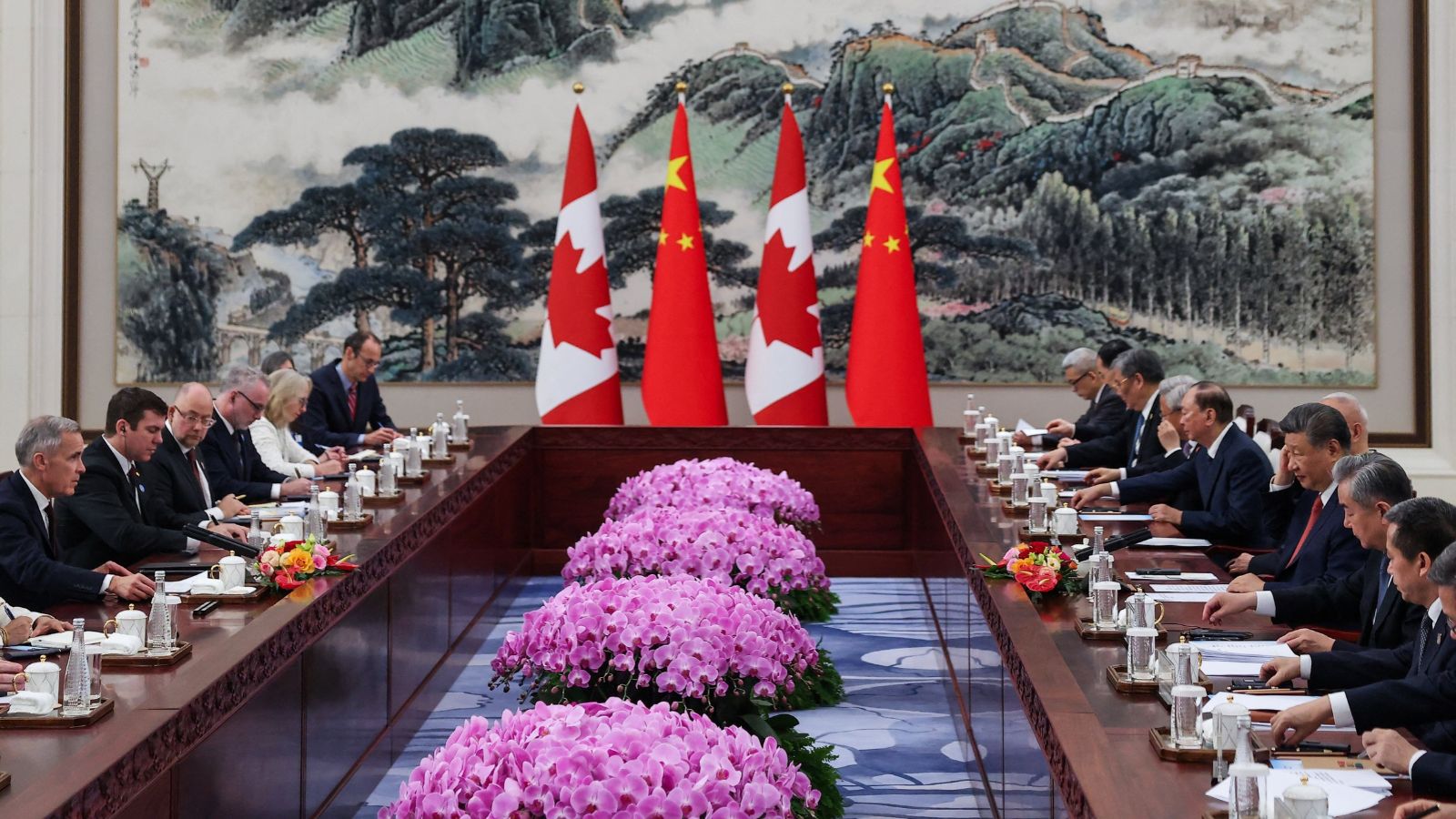
Canada and China have extended key bilateral trade frameworks following direct talks between Prime Minister Mark Carney and President Xi Jinping ahead of the Asia-Pacific Economic Cooperation summit. Rather than signaling a sudden ideological reconciliation, the move represents a calculated economic truce driven by agricultural supply pressures, critical mineral dependencies, and shared vulnerability to shifting North American tariff regimes.
The headlines sound routine. Diplomatic readouts always do. Yet anyone who has watched Ottawa and Beijing over the past decade knows that a handshake between a Canadian prime minister and the Chinese president is never just protocol. For years, the relationship sat in a deep freeze, locked down by arbitrary detentions, retaliatory tariffs on canola and pork, electric vehicle levies, and foreign interference inquiries. For a closer look into similar topics, we recommend: this related article.
Now, ahead of the APEC summit, the two sides have quietly chosen pragmatism over posture. They extended commercial agreements that keep vital commodity channels open while sidestepping the thorniest security disputes. To understand why this happened now, you have to look past the podiums and examine the balance sheets in Ottawa, Beijing, and Washington.
The Arithmetic of Survival in Ottawa
Mark Carney did not enter politics to manage diplomatic stalemates; he built his career pricing risk. When a former central banker looks at Canada’s trade ledger, the math is unforgiving. Roughly three-quarters of Canadian exports still cross a single border into the United States, leaving the domestic economy dangerously exposed whenever Washington flirts with protectionism or renegotiates continental trade terms. For further context on the matter, in-depth coverage is available on MarketWatch.
Diversification is an old Canadian talking point. Usually, it dies in committee.
This time, the pressure on prairie farmers and resource producers left little room for diplomatic purity. When Beijing restricts imports of Canadian canola, peas, or seafood, the economic pain concentrates immediately in Western provinces that already harbor deep skepticism toward federal leadership. Extending existing trade mechanisms and opening regulatory pathways for agricultural inspection removes an immediate domestic flashpoint.
There is also the matter of capital expenditure and the energy transition. Canada sits atop vast reserves of lithium, nickel, cobalt, and potash, yet lacks the domestic refining capacity to process most of it independently. While Ottawa has forced Chinese state-owned enterprises to divest from several Canadian lithium miners on national security grounds, total decoupling remains commercially impossible in the short term. Beijing still dominates global processing supply chains for battery-grade minerals, and global automakers operating in Ontario still rely on inputs tied to Chinese industrial networks.
Carney’s approach reflects a distinct shift from moralized diplomacy to transactional realism. You do not have to trust a trading partner to recognize that locking the door completely hurts your own exporters more than it alters Beijing’s behavior.
What Beijing Actually Wants From Canada
From Zhongnanhai’s perspective, engaging Ottawa ahead of APEC serves a broader strategic purpose that has very little to do with maple syrup or lumber. China is facing persistent domestic headwinds—sluggish consumer demand, a prolonged property sector slump, and severe industrial overcapacity in green technologies. When domestic growth slows, export markets become oxygen.
At the same time, Western alignment against Chinese industrial policy is showing hairline fractures. Washington has maintained steep tariffs on Chinese goods across administrations, pushing Beijing to look for pressure valves among G7 nations willing to talk business. Canada, as a member of both the G7 and the Five Eyes intelligence alliance, carries outsized symbolic value.
If Beijing can stabilize trade relations with Ottawa, it demonstrates to other middle powers in Europe and the Indo-Pacific that Washington’s containment strategy is not absolute. It sends a clear message that economic engagement remains available to countries willing to compartmentalize security disputes from commercial flows.
Consider how tariff diplomacy works in practice. Beijing rarely dismantles trade barriers all at once; instead, it uses regulatory extensions, phytosanitary approvals, and anti-dumping reviews as adjustable dials. Extending bilateral trade agreements gives Chinese negotiators an ongoing mechanism to reward compliance and penalize friction without resorting to dramatic, headline-grabbing embargoes every six months.
The Tariff Trap Nobody Mentions
Most coverage of the Xi-Carney meeting treats the extension of trade deals as an unqualified win for exporters. That reading misses the structural trap sitting right underneath the agreement.
Canada remains wedded to North American industrial integration. When Ottawa imposed 100 percent surtaxes on Chinese-made electric vehicles and 25 percent tariffs on Chinese steel and aluminum, it did so largely to prevent Canada from becoming a backdoor for Chinese goods entering the United States. The United States-Mexico-Canada Agreement depends on maintaining aligned trade defenses.
Extending broader trade frameworks with Beijing while keeping targeted industrial tariffs intact creates an awkward two-tier economy:
- Raw commodities and agriculture move under renewed bilateral trade protections, benefiting Western Canadian growers and resource extractors.
- Manufactured goods and clean tech remain trapped behind tariff walls, protecting Ontario’s manufacturing corridor while raising input costs for Canadian businesses and consumers.
This split creates permanent friction. Beijing has already demonstrated that it views tariffs on its electric vehicles and metals as violations of World Trade Organization norms, responding with targeted investigations into Canadian agricultural and chemical exports. An extended trade framework provides a forum to manage those disputes, not a magic wand that makes them vanish.
If Washington demands even stricter rules of origin or harsher restrictions on Chinese technology components in North American supply chains, Ottawa will be forced to choose once again between its largest customer and its second-largest single-country trading partner.
Why APEC Changes the Diplomatic Calculus
Timing matters in statecraft. Holding this meeting directly ahead of the APEC summit alters the incentives for both leaders.
APEC is one of the few multilateral forums where the United States, China, Canada, and major Asian economies still sit at the same table under an explicit mandate to promote regional trade facilitation. Unlike security summits dominated by defense ministers and military alliances, APEC revolves around supply chain resilience, digital trade standards, and customs harmonization.
For Carney, arriving at APEC with a stabilized bilateral track with Beijing prevents Canada from looking isolated in the Pacific Rim. Southeast Asian economies—from Vietnam to Indonesia—have spent years hedging between Washington and Beijing, refusing to sever economic ties with China even as they welcome Western investment. A Canadian prime minister locked in an unproductive cold war with Asia’s largest economy struggles to pitch Canada as a reliable Indo-Pacific trade partner.
For Xi, meeting Carney before the main summit plenary allows Beijing to shape the narrative early. Rather than spending the summit on the defensive over industrial subsidies and maritime disputes, Chinese state media can frame Xi as a constructive steward of global commerce welcoming Western leaders back to the negotiating table.
The Quiet Realities of Bilateral Trade Enforcement
Strip away the diplomatic choreography, and the real test of these extended trade deals happens far away from summit cameras. It happens in customs warehouses, port inspection stations, and trade ministry working groups.
Over the last decade, veteran trade lawyers in Ottawa have noticed a distinct shift in how bilateral friction manifests. Formal tariffs are noisy and invite immediate WTO challenges. Administrative friction is quieter and far harder to fight. A sudden spike in phytosanitary inspections at Chinese ports can leave millions of dollars of perishable Canadian agricultural cargo rotting on the docks without a single official tariff ever being announced.
Extended trade agreements matter precisely because they preserve institutional communication channels between technical regulators. When the Canadian Food Inspection Agency and China’s General Administration of Customs maintain active bilateral protocols, disputes over pests, labeling, or certification standards can sometimes be resolved by civil servants before they escalate into political crises.
Yet institutional channels only work when political leadership permits them to function. During the height of the diplomatic freeze between Ottawa and Beijing, technical working groups simply stopped meeting. Phone calls went unreturned. Routine approvals stalled indefinitely.
Restoring and extending formal agreements signals to bureaucracies on both sides that they have political clearance to process paperwork again. That sounds mundane. In international trade, mundane is worth billions of dollars.
Hypothetical Stress Test How the Truce Could Break
To see how fragile this arrangement really is, consider a hypothetical scenario that trade analysts in Ottawa routinely model.
Suppose a major North American automotive manufacturer announces a joint battery venture in Canada that relies on licensed Chinese cathode technology, triggering immediate bipartisan backlash in Washington. Under pressure from Capitol Hill to protect North American supply chains from Chinese intellectual property, Ottawa moves to block the licensing arrangement under national security investment rules.
Within weeks, Chinese customs authorities announce heightened technical inspections on Canadian potash or wood pulp shipments, citing newly discovered environmental compliance issues. Suddenly, the newly extended trade agreements are tested not by economic logic, but by domestic politics on both sides of the Pacific.
Nothing in the current agreements prevents that cycle from repeating. Trade frameworks establish rules of the road; they do not eliminate geopolitical rivalry.
The Domestic Political Tightrope
At home, Carney faces a delicate balancing act that will define his foreign policy credibility. Canadian voters remain deeply skeptical of Beijing’s intentions following years of high-profile investigations into foreign interference in Canadian elections and diaspora intimidation.
Opposition critics are quick to label any commercial outreach to Beijing as naivety or appeasement. They argue that extending trade deals with an authoritarian state rewards coercion and undermines Canada’s commitment to human rights and democratic norms.
Supporters of the government’s approach counter with a harder truth: isolation has failed to change a single policy in Beijing, while actively eroding Canadian market share in Asia to competitors like Australia, Brazil, and the United States. Even during the fiercest rhetoric of the U.S.-China trade war, American agricultural exports to China repeatedly hit record highs while Canadian producers sat on the sidelines watching shipments get blocked.
Strategic compartmentalization is the phrase diplomats use to describe this posture—cooperating where interests align, competing where necessary, and contesting security threats without burning down the entire commercial house. It is an appealing theory. Executing it requires discipline that few democratic governments sustain over an entire election cycle.
What Businesses and Exporters Should Watch Next
For Canadian executives, agricultural producers, and supply chain managers, the extension of these trade deals is a green light to resume cautious engagement, not an excuse to abandon risk management.
The era of frictionless globalization is dead. Anyone building a business model around uninterrupted access to the Chinese market is ignoring ten years of hard evidence. Smart operators treat bilateral trade extensions as temporary windows to diversify revenue streams, clear backlogged inventory, and lock in shorter-term contracts with clear force majeure protections.
Watch three specific indicators over the coming quarters to see whether this truce holds:
- Agricultural clearance times at Chinese ports. If bulk shipments of canola, barley, and pork move through customs without unexplained inspection delays, the political thaw is translating into operational reality.
- Bilateral regulatory committee schedules. Quiet announcements of renewed technical dialogues on energy, environment, and financial services indicate sustained bureaucratic buy-in.
- Ottawa’s response to U.S. trade reviews. How Canada navigates upcoming North American trade alignment talks will reveal whether Ottawa can maintain an independent commercial track with Beijing without triggering retaliation from Washington.
Diplomatic handshakes at international summits make compelling photographs, and extended trade agreements buy valuable breathing room for industries caught in the geopolitical crossfire. Still, no piece of paper signed ahead of APEC alters the fundamental reality that Canada sits wedged between an anxious superpower neighbor and an assertive Asian rival, leaving Ottawa to manage a permanent balancing act where every commercial gain carries a strategic price.