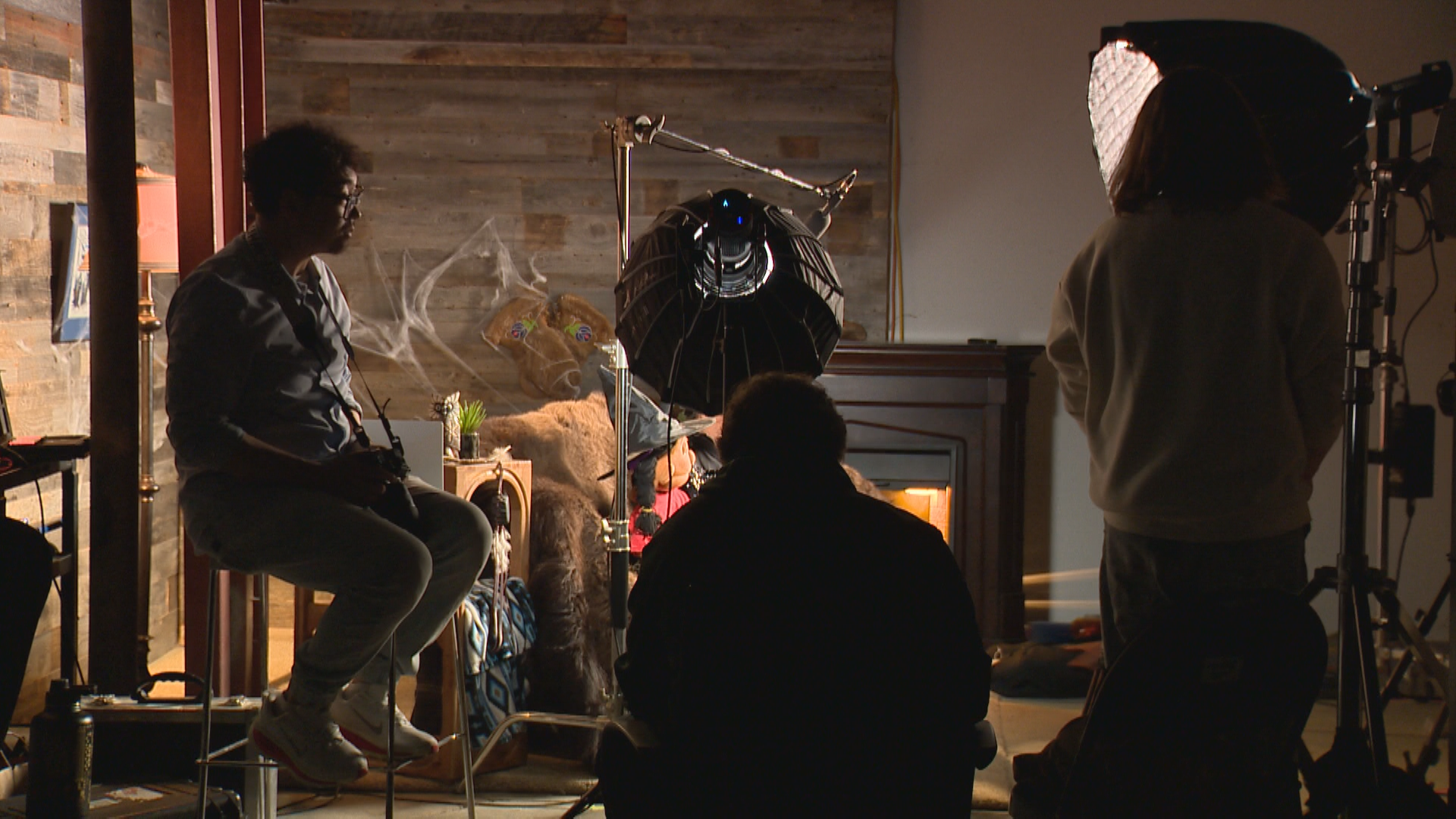
A Saskatoon television studio is quietly launching a radical experiment in cultural survival. The project, a 13-episode children’s puppet series titled Nakon'i'a with Kunsi, aims to preserve the critically endangered Nakoda language by broadcasting it directly into living rooms via the Aboriginal Peoples Television Network later this year.
It is an ambitious, high-stakes gamble. The traditional Nakoda language, also known as Assiniboine, is teetering on the edge of total extinction, with fewer than 100 fluent speakers remaining in Canada.
To reverse a multi-generational decline caused by state-sponsored systemic erasure, the production team is bypassing standard academic textbooks. They are betting instead on foam, felt, and the impressionable minds of toddlers. While mainstream media often treats indigenous language loss as a historical tragedy to be mourned, this Saskatoon crew is treating it as a modern media crisis that can be solved with clever programming.
The strategy addresses a gaping wound in current revitalization efforts. For decades, language preservation has focused almost exclusively on adult education, academic dictionaries, and secondary school electives.
It is a logical approach, but it is failing. Languages do not survive in classrooms. They survive when a parent instinctively uses them to tell a child to put on their shoes. By creating a vibrant, text-free, fully immersive visual universe for toddlers, Nakon'i'a with Kunsi targets human brain development at its most fertile stage for phonetic acquisition.
The Evolution from Classroom Resource to Broadcast Television
The journey of this production reveals how grassroots efforts must adapt to survive in a modern media ecosystem. The show was conceived by writer and director Cory Generoux, who watched his friend, actress and educator Theresa O’Watch, use a single hand puppet to captivate children during community language lessons.
O’Watch discovered that the physical puppet completely altered the classroom dynamic. Children who were otherwise silent or intimidated by the complex phonetics of Nakoda suddenly opened up to a fictional character.
Generoux realized that this intimate classroom magic needed to scale up. A lone teacher visiting a handful of community centers cannot outpace the mortality rate of a language's last remaining elders.
Television, however, can scale. The resulting series is historic because it is performed entirely in the Nakoda language. It does not treat the indigenous tongue as a novelty or a translated afterthought; it treats it as the default operating system of the world on screen.
The Biomechanics of Language and the Puppet Illusion
To understand why puppetry works where textbooks fail, one must look at how young children process language. Toddlers do not learn vocabulary through syntax rules. They learn through emotional resonance, facial tracking, and phonetic mimicry.
When a child looks at an adult human teaching a language, they are often hyper-aware of social dynamics, corrections, and their own anxieties. A puppet strips away that subconscious pressure.
The exaggerated mouth movements of a puppet allow a child to map out vowel shapes and dental consonants without the self-consciousness that comes with human-to-human correction. For an endangered language like Nakoda, which features nasalized vowels and complex glottal stops, this visual exaggerated mimicry is vital.
The production functions as a Trojan horse for the home. The primary target is the child, but the secondary target is the parent sitting on the couch.
Adults who grew up in households where the language was severed due to the legacy of residential schools often carry deep emotional blockages regarding language learning. Watching a children's puppet show lowers the barrier to entry. It permits the parent to become a learner alongside their child, normalizing the sounds of Nakoda within the domestic sphere.
The Infrastructure Problem facing Indigenous Media
Despite the optimism in the Saskatoon studio, the path ahead is fraught with systemic roadblocks. The hard truth is that a 13-episode run on a niche network cannot single-handedly reverse a century of linguistic decline.
Production budgets for indigenous-led children's programming are a fraction of what mainstream networks allocate to global franchises. The crew must stretch limited resources to achieve the high production values necessary to compete for a modern child's attention span.
Furthermore, the pool of fluent voice talent is drastically shrinking. When a language has fewer than 100 speakers, finding individuals who are fluent, available, and possess the specific theatrical timing required for television puppetry is an ongoing logistical nightmare.
The industry is also fighting against a digital tide. A television show airing on a scheduled broadcast network requires deliberate viewing. Today's children are saturated with short-form, algorithmic content on digital tablets.
If the digital infrastructure does not exist to make these Nakoda-language episodes as easily accessible as global streaming hits, the show risks missing the very audience it needs to save. The producers are aware that broadcast television is merely the first step. The true test will be how this content is chopped up, shared, and preserved across digital platforms for future generations.
Moving Beyond the Nostalgia Trap
For language revitalization to succeed, media creators must resist the urge to relegate indigenous languages to the past. Many well-intentioned cultural projects wrap language in historical nostalgia, presenting it exclusively through traditional folklore and historical settings.
Nakon'i'a with Kunsi intentionally pushes past this trap. By placing the language inside a playful, contemporary puppet format, it demonstrates to children that Nakoda is a living, breathing tool for the present day. It can express humor, modern daily routines, and everyday childhood frustrations.
The survival of Nakoda will not be secured by keeping it behind a glass museum case. It will be secured by allowing it to get messy, to change, and to be spoken incorrectly by toddlers who are just figuring out how to articulate their world.
The Saskatoon production is a brave blueprint. Whether it succeeds or fades into the archives depends entirely on whether public funding, broadcasting networks, and community leadership view it as a creative one-off or as the foundational infrastructure of a long-term linguistic rescue mission.