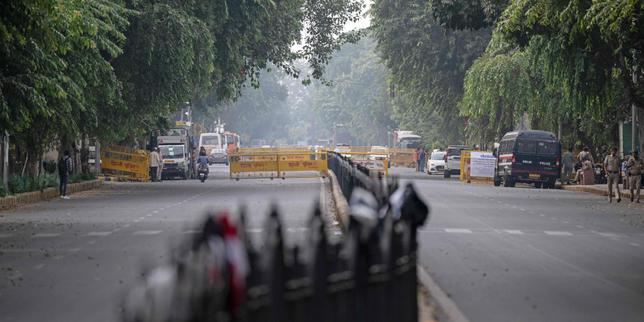
The steel barricade does not negotiate. It arrives in the dark, hauled by diesel trucks and bolted together by men who are only doing their jobs, until a stretch of asphalt that used to belong to everyone belongs entirely to the state.
By morning, the air tastes of diesel exhaust and tear gas residue.
Consider a twenty-two-year-old economics graduate standing fifty feet from that barricade. Let us call him Aarav, though he could just as easily be Priya in Delhi, or Rahul in Patna. He has spent sixteen years inside brick-and-mortar classrooms being told that India is a demographic superpower, a rising tide, an engine of the twenty-first century fueled by youth. He has memorized GDP growth trajectories. He has watched venture capital pour into digital apps that promise him a frictionless future.
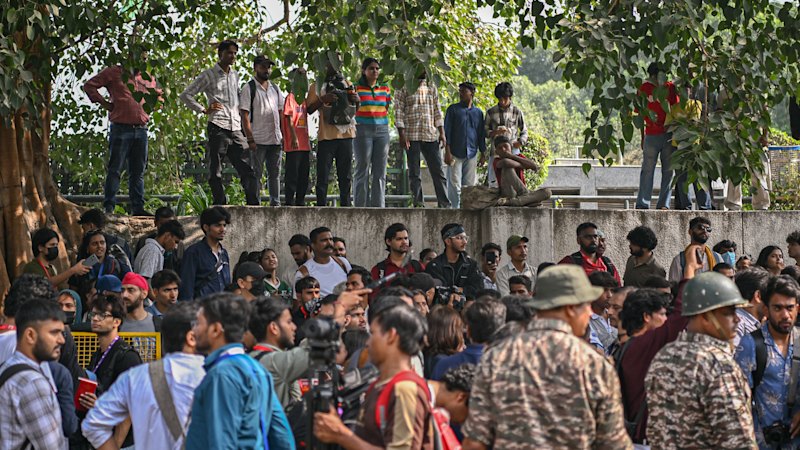
Yet today, his feet are anchored to cracked pavement, his throat burns, and his voice—the voice of the world’s largest youth population—is bouncing off a wall of riot shields.
This is the collision between spreadsheets and concrete.
The Arithmetic of Ambition
To understand why thousands of young Indians are facing down police batons, you have to look past the breaking news banners and study the math. India is the youngest major nation on earth. More than half its population is under the age of twenty-five. Over six hundred million minds are currently trying to figure out where they fit in a shifting global economy.
That is not just a statistic. That is pressure.
Imagine a pressure cooker designed for four cups of water, but filled with twenty. That is the current job market and educational pipeline. Millions of applicants sit for civil service exams where a single vacancy attracts a million hopefuls. Entire years of preparation vanish because a question paper leaks on an encrypted messaging app. Recruitment drives stall for half a decade through bureaucratic inertia.
When a generation is told they are the future, but experiences the present as a prolonged waiting room with the lights turned off, frustration ceases to be a private emotion. It becomes a physical force.
Aarav did not wake up wanting to throw stones or scream slogans at barricades. He woke up wanting an employment offer letter that matched his degree. When months turn into years of quiet desperation at a study desk in a cramped rented room, the silence becomes unbearable. The street becomes the only remaining auditorium.
When the State Builds Walls
Governments rarely know how to converse with a crowd that has nothing left to lose.
When youth protests flare—whether over military recruitment schemes like Agnipath, public sector exam reforms, or broader economic anxieties—the institutional reflex is almost universal. Block the roads. Suspend mobile internet services in the district. Deploy the paramilitary. Treat a structural crisis as a law-and-order disturbance.
It is an expensive illusion. You can turn off the data towers in a neighborhood, but you cannot delete the anxiety of a young person who realizes their family sold their ancestral land to pay for university tuition that yielded no return. You can throw a cordon around a public square, but the ideas circulate faster than the police trucks can reposition.
The tragedy of the barricade is that it symbolizes a failure of imagination. It is a physical admission that the state has run out of arguments and must rely on steel.
Listen to the murmurs in the crowd behind the police lines. You will not hear ideological manifestos or grand partisan designs. You will hear practical grief.
"We just wanted a fair exam," a young woman tells a reporter, her eyes red from pepper spray. She is not shouting anymore; her voice has dropped to a raspy exhaustion. "Just a fair chance to try."
That is the emotional core of the unrest. It is not an insurrection born of revolutionary fervor. It is an insurrection born of broken promises.
The Digital Echo and the Physical Reality
We live in an era that worships connectivity, yet real human contact has rarely felt so isolated.
For the modern Indian youth, life is lived at the intersection of hyper-fast mobile internet and grinding structural stagnation. They watch global wealth unspool on Instagram reels while calculating how to afford a three-dollar train ticket. They watch artificial intelligence reshape global industries while they wait six months for a government board to release the results of a preliminary exam.
This dual reality creates a volatile cognitive dissonance. The digital world tells them they can be anything; the physical world tells them they can barely move.
When protests erupt, they are amplified instantly across borders, translating local grievances into a shared generational language. A student marching in a tier-two city in Uttar Pradesh feels the same invisible weight as a graduate sitting in a cramped flat in Bengaluru. They recognize each other in the pixels of shared footage: the raised fist, the tear-streaked face, the sudden rush of boots.
And so the movement grows, not because of a charismatic central organizer, but because millions of people are living the exact same narrative arc.
The Unfinished Chord
Evening falls on the avenue. The tear gas clears, replaced by the hazy dust of a city refusing to sleep.
The police lines begin to thin. Some barriers are dragged aside to let traffic crawl through, though the tension lingers in the metallic tang of the air. Aarav is walking home, his shoes scuffed, his throat raw, his phone battery down to four percent.
He did not overturn the system today. The exams are still delayed. The jobs are still scarce. The barricades will likely return tomorrow, taller and sharper.
Yet something fundamental has shifted. In the act of standing together, of staring down the uniform and refusing to look away, thousands of young people have stopped being passive consumers of a demographic destiny. They have tasted their own collective weight.
The state can weld shut the streets, but it cannot un-ring the bell of a generation that has looked behind the curtain and decided it will no longer wait in silence.