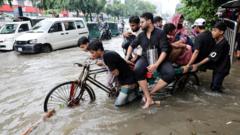
Water doesn't care about borders, but it always hits the most vulnerable people first. Over the past week, relentless monsoon downpours and raging flash floods have ripped through southeastern Bangladesh, killing at least 51 people and leaving more than a million residents stranded. Villages are underwater, roads have turned into rushing rivers, and landslides are actively burying makeshift homes.
While international headlines treat this as just another seasonal weather report, the reality on the ground is a catastrophic humanitarian crisis. The sheer volume of water dumped on the region is staggering. The Flood Forecasting and Warning Centre recorded a jaw-dropping 815 millimeters of rain in Chattogram over just three days, while Lama saw 518 millimeters and Cox's Bazar registered 330 millimeters. This intense deluge, combined with massive upstream runoff from neighboring Indian states like Tripura and Assam, quickly overwhelmed local infrastructure.
If you want to understand why this specific flood is so devastating, you have to look past the raw numbers and look at where the rain is falling.
The Disproportionate Toll on Cox's Bazar
The disaster isn't hitting every region equally. Out of the 51 confirmed deaths reported by the Ministry of Disaster Management and Relief, 28 occurred in Cox's Bazar. That's more than half the total fatalities. Another 13 people died in Chattogram, six in Bandarban, three in Rangamati, and one in Moulvibazar.
Cox's Bazar isn't just a regular coastal district. It houses the world's largest refugee settlement, where more than one million Rohingya refugees live in crowded camps. These families live in makeshift shelters built on steep, deforested hillsides. When 330 millimeters of rain falls on stripped soil, the ground simply liquefies.
Landslides in these refugee camps killed 16 people early in the week, including women and children. It's a tragic reminder that structural vulnerability turns heavy rain into a deadly weapon. Last week, floodwaters even swept through a school in the district, killing several students and a teacher.
Broken Infrastructure and Marooned Communities
Right now, 267,918 families are marooned across seven flood-hit districts: Chattogram, Cox's Bazar, Bandarban, Rangamati, Khagrachhari, Moulvibazar, and Habiganj. The water rose so quickly that people didn't have time to pack up their lives.
In Habiganj, an embankment on the Khowai River completely collapsed under the relentless weight of the water. At least 25 villages were instantly inundated, cutting off traffic on regional roads and trapping residents in their homes. Across the affected areas, 44,500 people have managed to scramble into emergency government shelters, but hundreds of thousands remain isolated.
The military has been deployed to deliver water, dry food, and essential medicine by boat. But let's be honest about the challenges they face. Massive power outages, snapped communication lines, and washed-out roads are making rescue operations incredibly slow and dangerous.
Urban Failure in Dhaka
The crisis isn't confined to rural hillsides or riverbanks. Even the capital city of Dhaka is buckling under the pressure. Streets in the capital have flooded up to knee level, paralyzing daily traffic and trapping workers.
Local media outlets are openly questioning why the city's drainage systems failed yet again despite years of expensive government promises to fix them. When a major capital city floods during regular monsoon cycles, it isn't just a natural disaster. It's an administrative failure.
Prime Minister Tarique Rahman held a virtual meeting with senior officials, ordering all field-level administrations to remain on maximum alert. The government says its highest priority is protecting lives and ensuring prompt relief distribution. But when the water keeps rising, coordination becomes a logistical nightmare.
What Lies Ahead for the Affected Regions
Sarder Udoy Raihan of the Flood Forecasting and Warning Centre noted that while conditions in the southeast might improve slightly as the immediate weather system passes, the danger is far from over. The monsoon is still hammering the northern and northeastern parts of Bangladesh. Rivers like the Kushiyara and the Someswari are flowing well above their danger levels, and officials warn that further inundation is highly likely.
If you are looking for ways to monitor or support the ongoing relief efforts, focus your attention on local humanitarian groups and international agencies operating directly inside Cox's Bazar and the Chattogram division. They need immediate funding for clean drinking water, water purification tablets, baby food, and mobile medical clinics to prevent the outbreak of waterborne diseases in the shelters. Watch the updates from the Bangladesh Meteorological Department closely, as the high risk for subsequent landslides on unstable hillsides remains active.